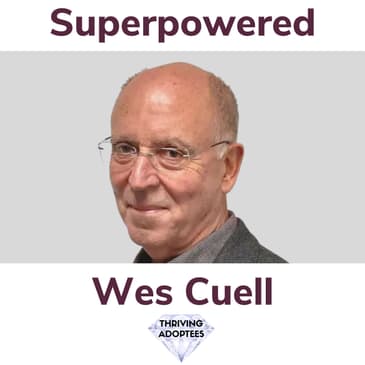
What would it do for you to find your superpower? What if your difference IS your superpower? Listen in as adoptee Wes dives into difference, superpower and more.
Wes has more than 40 years of experience working in social care, primarily in services for children and young people as a qualified social worker.
He worked for many years in local authorities including Luton, Bedfordshire and Hertfordshire as the head of services and was director of services for children and young people at the NSPCC until 2011.
He has a special interest in the support of vulnerable children and families and in safeguarding which included chairing a local children’s safeguarding board and being a board member of the Child Exploitation and Online Protection Service (CEOP).
Wes chairs the Hertfordshire Adoption Panel and, having been adopted as a child, has a lifelong interest in and commitment to the role of adoption in transforming the lives of children.
He lives with his wife in Woburn and has two grown up children and grandchildren who live in the USA. Wes is a keen long distance walker, sailor, trombone player and fly fisherman and loves to travel.
Find out more about Wes and the charity he chairs at:
https://www.facebook.com/pactcharity
https://www.linkedin.com/in/wes-cuell-547b623a/
Guests and the host are not (unless mentioned) licensed pscyho-therapists and speak from their own opinion only. Seek qualified advice if you need help.
Want to learn more about thriving for you, your kids, your families or your colleagues? Pick a time to talk here
[00:00:02] Hello everybody, welcome to another episode of the Thriving Adoptees podcast. Today I'm delighted to be joined by Wes, Wes Cuell. Looking forward to our conversation today Wes, I'm really going to dive deep with you. It was such a great conversation we had a few weeks back. Okay, fine. So Wes, as you'll tell from his voice, is a Brit adoptee. We haven't had many Brits on the show recently, so great to have a fellow Brit. He is an adoptee. He's also the chair of
[00:00:31] PACT, which is parents and children together and had a life in service to kids and children's services in particular. RSPCA I think was it? NSPCC. Sorry, sorry, NSPCC. Yeah, yeah, yeah. Which is the, for American listeners, it's the National Society for Protection of Cruelty to Children. Yeah, is that right? That's right, yeah.
[00:00:57] Yeah. So what does, what comes to mind when you hear the name of the podcast, Thriving Adoptees Wes? Well, I mean, that's why I'm delighted that there are so many people out there like me who are adopted, who consider themselves to be thriving. You know, because you hear a lot from, you know, people talk about adoption, and they often think it's like a problem, a challenge, and that, oh dear, you know, you were adopted. That must have been so tough.
[00:01:25] And it's nice to realise that actually not, you know, for me and for most people I've ever spoken to about being adopted, people sort of rejoice in the fact, and I have a sense of feeling lucky and blessed that, you know, that it happened to them.
[00:01:41] I mean, I feel very aware of the fact of what could have been for me had I not been adopted. And that alternative future for me that you could map out in your imagination is not a good one. Whereas, well, whereas I had a very, very happy childhood, you know, loved and cared for, and got off to a very exciting life. So yeah, I feel, I feel I thrived, and I'm pleased that other people like me thrive.
[00:02:09] Yeah. Yeah. Yeah. It's incredible, it's incredible that the power of something like gratitude when it comes from within. I mean, but what we see in the adoption world, especially, I think this is more in the States than the UK. I'm not sure. But the idea when somebody tells us that we should be grateful, somebody tells us that we should thank our lucky stars or something like that.
[00:02:37] And when we don't feel like that. And when we don't feel like that, perhaps we're going through a tricky spell of our lives and we don't feel like that. It can feel really invalidating. So if there's so much about that on social, and there's even a book, I should be grateful or something like that.
[00:03:04] But whenever I get near gratitude and being grateful for things, I feel that I have to kind of differentiate between that internal spontaneous feeling that comes from within us, which is poles apart from when somebody tells us how we should feel about anything. Nobody likes being told to feel differently than they do.
[00:03:29] Yeah. That's a very good point. I mean, nobody likes to be told you should feel grateful, you should be thankful. But that isn't how it is to me. It's just, it's always been that. It's been a sort of spontaneous, you know, I'm a lucky guy. Yeah. I mean, I'm particularly lucky. I mean, I'm born in 1947. I'm the classic baby boomer. I'm not sure they use that term in the States. I do regard myself, by the way, as being an honorary American, because I spend two months of every year, at least in America, because my daughter and my grandchildren are out in America.
[00:04:00] And I love being told, I love your accent. I mean, that was because of me, a real thrill. I was like, go there. And I love, I love replying. I haven't got an accent. You're the one with the accent. But yeah, I mean, but something that does come from within. And I think that it's interesting to think back about, you know, your own experience of realizing you were adopted.
[00:04:21] And I found, I mean, my generation were, it was unusual in my generation to be told you were adopted. I mean, now, you know, it's all out there from the get go. And kids have books of history, and they know the whole story, really. Life story books are part of the process. My generation, it was like, don't mention the word adoption. You know, everyone, let's all pretend you were, you know, you were the original real deal, native born baby.
[00:04:46] And that's how it was for me. I mean, no one said a word. And then age, what, 12 or 13, you know, rummaging in a drawer where I shouldn't have been rummaging out pops my adoption papers. And, you know, being a smart kid, I read them through. I think, what the hell is this all about? And then I realized what it means. And then, and then made a decision not to say anything about it, you know, to my parents.
[00:05:13] Primarily because when I found my papers were in a box of what you might call contraceptive devices. Now, I'm at age 13, I didn't know anything about contraceptive devices. But again, being a smart kid, I read the instructions and worked out what these gadgets were. And then realized it was not something I wanted to discuss with my mom and dad. Okay.
[00:05:34] So for various reasons, that conversation never happened. And yeah, and I never, my mother never found out that I knew I was adopted until she was 90. That's how long I kept the secret. My dad died at 65, never knowing that I knew I was adopted. And, you know, that's, as far as I know, that was always the case.
[00:05:58] So that was another perspective for me. It was like keeping that secret inside. And again, I mean, some people said that must have been terribly harmful and very damaging for you. And in a funny sort of way, I don't think it was. Because I think for me, it gave me a sort of, I felt slightly on the outside looking in, do you know what I mean? As the world, you know, you all think I'm this person and I'm the only person who knows I'm not that person, I'm me.
[00:06:28] But that slight detachment, I sort of felt personally, I developed it into a bit of a superpower because it became a bit of a protective shield for me. I've always had the capacity, no matter how much crap is going on in the world around me, to step back and reflect. And I think that, again, that's fortunate because there have been times, you know, things have happened in my life that have been hard and tough.
[00:06:54] And I could have easily just sort of, oh dear, you know, but there's always been parts of me that said, actually, no, no, no, you can handle this. No, you can deal with this. You've got this ability. You've got it. And I've never, ever, from one moment down to my ability to get through stuff. And I think that is, you know, quite a powerful thing that helps in life.
[00:07:14] Yeah. Last time we spoke, you talked about having a sense of being different and being, what did you say? I'm not sure if you used the word imposter, but something didn't quite fit. Yeah. I've heard the word imposter syndrome used by adopted people.
[00:07:39] I never, I never felt that. I never felt I was some sort of phony. I just felt that, you know, I was different and I knew why, and they didn't know. But it wasn't, in a sense, a major problem for me. I mean, you didn't have to be a genius growing up in the family I grew up in to realise that you were different. I mean, I was a, I was a miserable little bunny, a soldier as a child. I was a skinny, dark haired, brown eyed. I mean, pictures of me was a permanent frown.
[00:08:07] I mean, I was, I was one of those kids, very wasn't to a poor, very serious. My, my brother, who was a natural child of the marriage, was plump, had curly blonde hair, blue eyes. My mum and dad, plump, blonde hair, blue eyes. So, you know, you look at me then, you know, I reckon by the age of six or seven, I'd worked out there was something a bit strange about me in this family.
[00:08:36] But, you know, it didn't, it wasn't something that was corrosive or damaging for me. I didn't feel, oh gosh, I'm a complete fake. I just felt, I'm a bit different and I know why and that's my secret sort of thing. But it didn't do me, I don't think it did me any personally. And, you know, it may be different for other people, but for me, it wasn't a problem. Yeah. So, it was different rather than weird. Yeah, exactly that. Yeah, yeah. Or wrong.
[00:09:03] Or, you know, it wasn't any, I've never felt weird or wrong or fake or phony. Never had those feelings ever. I felt different in perhaps a good way. You know, as I said, I felt I was lucky and chosen and that's what made me different. Yeah. Was some, I mean, you talked about being able to step back to, you know, to have some perspective. Uh-huh.
[00:09:32] It is, I'm getting a sense that there was a perspective. You were able to step back from that feeling of being different. Yeah. And not let it bother you. I mean, was that what it was about? Yeah. I was able to sort of make sense of what had happened. So, I worked out that my mum and dad had adopted me and they had chosen not to tell me.
[00:10:00] And I worked out they must have had good reasons not to do that. And, you know, and I knew they loved me and I knew they treated me the same as my brother. So, I didn't think they had any reason to feel bothered about it. And I'd like to say it wasn't such a big deal. But the sense of being very sure that I was wanting, you know, adoption means they really wanted you. It was always a big positive for me.
[00:10:27] So, it was a sense of difference but it wasn't a damaging or destructive sense of the word difference, I don't think. I mean, you used the word superpower. Yeah. I remember having a post, a Superman poster on the wall when I was a kid. Yeah. And there's that because he was adopted, wasn't he? Yeah. Superman was adopted. Yeah.
[00:10:55] And I've been listening to a podcast recently about, you know, the fact that Superman is always Superman. Clark Kent is a persona. Yeah. A persona of Superman.
[00:11:14] So, however weak Clark Kent feels in the moment, he always, as Superman, he has that infinite strength.
[00:11:30] And I'm wondering why we don't make more of this in the kind of the adoption space because it's a story, it's a metaphor, it's a way for us to explain difference to kids, to help them see their superpowers. Well, I mean, I think a lot of adopted people don't really think through is the fact that natural children arrive in the world through a natural birth process, you know.
[00:12:00] In most what you might call normal families, often their origins are quite sort of shady. I mean, not everyone, not every child is wanted. Not every child is fathered by the person they think they're fathered by, their realities. Not every parent is delighted when every baby is born. All right. For a lot of cases, they would have preferred not to have another baby or they would have preferred not to have a different baby, all this sort of stuff.
[00:12:25] But when you're adopted, you know, there is a long process whereby your birth, your adoptive parents are trying very, very hard to have a child. And then, you know, and then there's a long process there to go through to be approved to have you. And there's a lot of anxiety involved in you being placed with them and you being adopted. I mean, by the time the adoption has gone through, there's been a lot of greed and stress. So the one thing you can never doubt is that you are really, really wanted. They want you there for a lot of positive reasons.
[00:12:55] And they've been through a lot to get you. And I think that puts all adopted children in a different place, I think, from birth children. It's definitely an edge. You know, you can never say, well, you never wanted me. If you're an adopted child, I mean, they're vanishingly few examples of people adopted and then regressed it. I think most people, adoptive parents are very happy and pleased that they adopted. The adoptions don't always work out as well as they hope.
[00:13:23] But I don't think it's very rare in my experience that adoptive parents say, I wish I'd never done that. Yeah. Yeah. It seems to me, as you talked about having your head in a book and things like that, it seems to me like you've, from an early age, you've been a very reflexive, sorry, reflective. Yeah. I think so. I mean, yeah, I was, you know, smart kid, read a lot.
[00:13:50] And that put me on a different trajectory to my brother. So I was like a scholarship boy, 11, grammar school, good university, all that sort of stuff. My brother left school at 14, you know, quite low paid work. So we were very different in that way too. I mean, I grabbed any book that came into the house and read it and virtually nobody else did. I mean, I was very lucky in that my mother at some point signed up to a book club,
[00:14:20] which produced, you know, a novel or something, a couple of them every month. I don't think anybody else in the house touched them, but I was reading, you know, full length novels. One time I was six or seven. And that also helps me. But I've always been, I've always been that sort of person. I mean, I read a lot, I think a lot. I think that helps. You know, it does help.
[00:14:45] I mean, going forward into my life, that's always been a strength for me. But the main thing about my life is that although my brother and I were so different, we loved each other, we got on really well. He was a very caring brother, very, very supportive. You know, I was devastated when he died, only age 62. And he was a lovely man. Everyone loved him to bits. He was one of those people, you know, and everyone had a, well, he was just a great guy. And he was.
[00:15:14] Now, he must have realised there was a difference between us. You know, we look different, we behave differently. But he never, ever said or made any comment that made me feel that he didn't feel the same way about me that I did about him, which is very interesting, I think. I sort of regret with hindsight, we never had that conversation, but we didn't. Yeah. Yeah.
[00:15:37] I'm also struck by, you know, your reflection on the story compared to my own world, my own life growing up. I didn't reflect on it at all. And then this anger came out towards my birth mother at 40. And I'd never thought about her.
[00:16:02] So I'm wondering the extent to which our feelings can lead us down a tricky path.
[00:16:17] That the reflection that you clearly did, that came naturally to you, kind of, it stopped, that reflection stopped you disappearing down a hole of feeling weird or different or their circumstances. I'm not sure what the question is, Wes.
[00:16:46] I mean, the problem for me only began to arose. I was getting older when I was married and having young children. And then the who am I really became more of an issue. You know, thinking about my birth mother. And all I had was this name, you know, on a certificate, her name and where she lived in 1947.
[00:17:11] And I came across a birth certificate with a, you know, the blank where the father's name should be. So I knew that was going to be a mystery. And I knew that I've spoken to other people who were adopted in that generation of not being told about it, who then felt very angry with their adopted parents for not sharing vital information with me. But for some reason, I know that never happened for me because I knew I could have said something to them. I knew. And I chose not to.
[00:17:40] So I think I sort of took responsibility for that rather than blame them. You know, but I had that choice and I chose not to. So that ended up. But it did become a big issue for me. I mean, when you spoke to medics about having a baby and they said, what's the family medical history? And then you say, well, I'm sorry, I haven't got one. You know, not at all. And then they look at you and think, oh, that's a bit weird, but it is the truth.
[00:18:06] And when I became a father, I think, that's when the desire to know more about my origins became much more powerful. And I felt quite driven to find out more. And I went through the search process when the law allowed it. And unsuccessfully. And now I do, if I feel any anger at all, it's towards the social worker who managed that process.
[00:18:34] Because quite frankly, she didn't do a job properly. Right. You know, I mean, there were records out there to be found that she didn't find, which, you know, 10 years later, a good friend of mine, who was caring enough to think that I needed this information, took a week off from work, took a holiday, spent a whole week searching. And she found all this information within that period of time. Now, if the social worker had done her job properly, I would have found out who my birth mother was when she was still alive.
[00:19:04] OK. But by the time I found out who she was, she died. Now, yeah. So I did have anger. There was a real anger towards that woman, which I chose not to. You know, I could have made an issue, but I chose not to. I just thought, well, you know, she's a busy social worker. You know, I've done that role for other people. I know that it's often another thing to do on top of a long day's work. And she didn't do a good job. Tough.
[00:19:32] But yeah, I had a problem with that for a quite long time. Yeah. Yeah. And did that eventually lift? It did eventually lift. I mean, because of the work my friend, this friend did, I was able to find a relative. Eventually, we were able to identify my birth mother's sister. And I was eventually able to meet her. And, you know, and that's when I then got the story about my birth mother.
[00:20:00] And it was a pretty strange and sad story. You know, in the sense that I was the only child she ever had. That I was obviously a hidden pregnancy. That my birth mother went through her whole adult life. And never told anybody, even people very close to her, that I had ever existed. You know, I thought that was something. Again, I thought that it changed my perspective.
[00:20:29] Because instead of feeling like sorry for me about what I didn't know and what I've missed out on, I started to feel extremely sorry for her. But, you know, I said my perspective moved from my position to her position. And when I started to think, well, what was here? She was an unmarried domestic servant, 1947, brought up in a children's home. You know, her life was children's home, land army, domestic service, pregnant.
[00:20:56] And, you know, I was removed from her, I think when she, when I was two weeks old, when I was separated from my birth mother. And she never heard from me again, saw me again, knew nothing about me ever again. I never told anybody about me ever again. Never had another child. Yeah. That was, yeah. I still feel very, very, very, very sad for her. Yeah. Yeah.
[00:21:24] Despite us being of a different generation, I had exactly the same. Yeah. I had exactly the same shift. And that shift happened for me. I didn't make it happen. I didn't choose to put my perspective onto her. Yeah. And take it off myself. It happened. It happened. And naturally it happened organically. In learning about the story.
[00:21:52] In learning about the circumstances that my birth mother, Pat, was in. I mean, they were different circumstances to your own birth mothers. But reading the letter, my focus shifted to her rather than me in exactly the same way. Yes. As you described.
[00:22:22] And one of the things that is often recommended for adoptees is to read a book. And it's something called The Girls That Got Sent Away or The Girls That Went Away. I'll dig it out and I'll put it in the show notes, listeners. But it's an adoptee who did some research into the circumstances of birth mothers. The Girls That Went Away. Yeah. It's The Girls That Went Away by a lady called Anne Fessler. Anne Fessler. Yeah.
[00:22:51] And it really gives us that deep insight into their predicament. And what was anger morphs into empathy. Absolutely. Absolutely. I mean, I've been thinking about this a lot because I've been working with somebody who's producing a documentary on what's now called forced adoption.
[00:23:23] And when I was a social worker involved in adoption work was part of my profession. I wasn't involved, but I've been involved in removing children, placing for adoption, done the whole thing. You know, the word we used back in the day was relinquish. Mothers relinquish their babies for adoption. Now the language is being used that people are saying is they are forced to give up their children. And when you actually look at the reality of their world, you know, in most cases they had no option at all other than adoption.
[00:23:52] You know, they couldn't get married, obviously. The state wasn't going to give them any money. The state wasn't going to give them accommodation. The state wasn't going to give them any support. And worse than that, the state, you know, in public opinion, regarded them as being moral failures. You know, I mean, when you think about adoption societies were originally called moral welfare associations. That's not in England. I know they were in the States. That's what they called over here. So if you're an unmarried mother, you effectively had failed, your morals had failed.
[00:24:21] And that's why you got pregnant. And that's why you were not fit to have a baby. So, you know, they were in a very dark place. And, you know, adoption was a way of the state said, OK, we'll fix the problem for you. We'll take your baby. And then, yeah, now you can move on and, you know, start again, try again with your life. That was basically the message. No, get it right next time, please. Get married, have a baby, do it right, do it right, was the message. You know, and my mother did eventually marry.
[00:24:50] But, you know, but she married a much, much older man and there were no children in that relationship. She had a happy marriage, but she had no children. I mean, she had a successful life until, sadly, like my brother, she was stricken and died from cancer in her 50s. Yeah. But, I mean, you know, having that information, having that story made a big difference to me. It gave me a perspective, really, on that whole thing.
[00:25:19] Even like meeting my, through meeting her sister, I was able then to meet people who were my genetic cousins. And then that was the novelty because I walked into a room and there were people who looked a bit like me. And one of the other problems that adoptive people often have is that you never see anybody who looks like you. And that resemblance thing is a very powerful force.
[00:25:45] And when you're growing up, people are always saying, oh, you look like your mum, you look like your dad, you've got your mum's eye, your dad's eye, you've got whatever. And, I mean, all my birth family, they all resemble each other like crazy. So you could see one of them on my life. And you look at me and you know instantly I wasn't part of that bunch. But when I met these cousins, they did look a bit more than you know.
[00:26:09] And that's also quite important in giving you a sense of identity, which, you know, when you realise you are adopted, you have to deal with, you know, basically you've got, there are two yous. You've got your adoptive identity, which you know a lot about, and you've got your birth identity, which in my case you knew very little about. So I was still left with half a question mark, you know, birth father. And that was a complete blank.
[00:26:38] And of course there was nobody left to ask. You know, my birth mother was dead. You know, DNA sort of came to the rescue a bit. And only in the last year, DNA has thrown up a 25% match with a bloke who would appear to be a half brother, which is pretty amazing. Yeah. I mean, that's still work in progress, you know.
[00:27:05] But I'm pretty sure that my genetic origins on that side are American. It's quite interesting, really. Because all the connections, all that. So I think, you know, I think I'm the progeny of a GI as well. That's my theory. Because my half brother was born exactly the same year as me. Yeah. 1947.
[00:27:32] So I think we have a fairly socially active, you know, GI relaxation manoeuvres in the British Isles after the war. That's probably, I think, well, probably in 1946. But yeah, OK, there are worse things to have than American dads. Indeed. Can I change tack slightly, Wes? I'm keen to bring out what you've learnt about thriving through your, you know, in your professional career.
[00:28:01] Because, you know, you've been in this lifelong. You're still involved. You're still working. You're still very active in this space even now. Yeah. Yeah. So what have you learnt about thriving? What I've learnt is that people who don't have a strong sense of self, a sense of a core me,
[00:28:28] that has value and worth and people care about and people want to value, they will always have a big struggle going through life. Yeah. Yeah. And no matter how much help and support you throw at people with those sort of problems, if you cannot do anything about that sense of internal worth, it's often wasted effort. On the other hand, when people have that strong sense of worth,
[00:28:57] no matter how crap their life might get at times, they have the ability to survive and recover. There is a core of people which I think is almost, in some cases, unbreakable. You know, we look at the crap that happens to some people, you know, the guy who loses all four limbs to sepsis and bounces back and, you know, speaking in the House of Commons within, you know, months. You know, people like that, as opposed to people that one bad thing happens
[00:29:27] and they just melt down and collapse and life isn't worth living. And that's all about the real sense of you. So, yeah. And I think that, you know, so thriving for me is I have that. I have confidence in that core me that I feel that life might throw all sorts of crap at me in the future. But I don't go through my being terrified because my feeling is, well, whatever it is, I'll deal with it. Yeah.
[00:29:54] If it's bad things happen to my family, bad things happen to me. Yeah. Okay. Yeah. Bring it on. I can handle that. So, yeah, when I'm working professionally, I think any work you can do to try and get to understand the person you're dealing with and help what their real sense is of themselves and their self-worth, that core personality, you need to try and get to that.
[00:30:23] Because if they haven't got it, if they've got it, you know you can build them. If they haven't got it, you know you've got a hell of a challenge on your hands. And that lack of inner strength and self-belief is not going to be mended by light touch therapies. When people have that very deep sense of I'm not worth anything, I don't matter,
[00:30:45] you really do need, I think, very high-level intensive psychos and psychotherapeutic work. It takes time. And what you need to do with those people, I think, to enable them to help them is to get them to realise that. You know, the only way you can help someone in that situation is then to say, yeah, I get it. Yeah, I've got inner pain, inner hurt that I need help with.
[00:31:12] And if you can get people to that point, then that's as far as you can go. Thereafter, it's down to them. You know, you can't mend people unless they want to be mended. But you can help people to realise they've got something that needs to be fixed. Yeah. As you say that, I think of the profundity of this area of our life.
[00:31:37] And this is all about seeing our wholeness. Rather than, you know, we can feel broken, but underneath that feeling of brokenness is our wholeness. Yeah, I mean, you take my example.
[00:32:04] I was, what, 25 years old, doing very well in my job, married, two young children, just bought a new house. All right. And then out of the blue, I had a grand mal epileptic tip. Wow. Now, no one knew where that came from. No medical history. Okay. But what happened? Right. I lost my driving licence. All right. We lived in a new house on the outskirts of town. My wife didn't drive. All right. I had a job that required me to drive.
[00:32:35] Yeah. Now, you can say that, you know, and then I had investigations with a doctor saying, well, you know, your age, you've got to consider the possibility to give me a brain tumour. You know. You have to check this out. Now, I mean, it took me five years to get a driving licence back. Okay. I never had any more bits, but I had tough medication for quite a few years after that.
[00:32:59] Massive strain on my marriage because whatever my wife saw when I had that fit pretty much put her off me pretty dramatically for a long period of time. She would hardly go near me physically for some years. So you might say, yeah, that's a tough thing. And a lot of people in that situation where I said, well, if that's it, then I'm done. But my inner sense said, no, I'll get through this. You know, I'll find a way. And immediately I found I was surrounded by loving, caring, supportive people.
[00:33:29] You know, my work colleagues said, well, okay, you can't drive. Okay, don't worry. We'll pick you up. We'll take you to work. You know, you've got a visit to make. Okay, we'll sort that out for you. You know, I had four or five years of friends sorting that sort of stuff out for me. And my employer said, yeah, well, you're good at your job. So, okay, you can't drive. Okay, forget the contract. You know, we can work around this. You know, you can keep working. I even got promoted in a period of time.
[00:34:00] But eventually, five years later, I got my drive license back. You know, I was driving. Boom, boom, boom. Everything was fine. But, you know, it didn't break me. And I never had a sense at any time did I ever think I'm done here. Yeah. That's where I think is core strength. Now, I mean, I've seen people I know have to do with a lot less than that going to meltdown. You know, complete, massive depression. Life isn't worth it. I can't cope with any of that.
[00:34:30] Blah, blah, blah. And you just know that the problem wasn't that external crisis. It was that inner bit of this very deep part of ourself. This is me. I'm going to survive this. I'm going to get through it. But as I said, you know, I've busted a lot of effort working with people over the years because I didn't realize I didn't actually deal with that fundamental problem.
[00:34:54] Do they own the fact that there's something deep inside that needs mending and enable them to say, I've got a problem here? Because if you don't get to that point and say, I've got a problem, I need help, then help cannot get in. There's no way in. It's like an internal lock on the door. You have to open it inside. Nobody can open it from the outside. When I look at these drug clinics and people trying to help people with drug addiction
[00:35:20] and all these sorts of addictions, when they don't work, I'm always pretty sure I know the reason why they don't work is that they're treating the wrong problem. You know? So are you talking about resilience here really, Wes? Absolutely. Absolutely resilience. Yeah. I think if you've got that inner part of you is solid, you can cope with almost, it's almost unlimited what people can handle. Unbelievable what they can handle.
[00:35:47] And equally, if you haven't got it, you can collapse under what appears externally to be quite trivial problems. Yeah. Problems. Yeah. One of the things I'm talking about quite a lot is what a foster mum shared with me a few weeks ago. So she often fosters teens and she's had her own trauma experience too.
[00:36:13] She nearly died at the hands of her first husband through ongoing domestic violence. And she says, and this isn't on the first day that the kids have moved in, right? These foster kids, foster teens have come to live with her. She says, look, I'm not going to deny your trauma, but you've got a choice now.
[00:36:41] You can either succumb to it or you can rise above it. And that's just stuck with me about the strength of her characters to say that. And also the clarity and the choice that she's giving to those teens.
[00:37:07] When most of us, if we're struggling, we don't see a choice. So the choice has to be kind of laid out before us. And that's what she's doing. I think that most people would understand that, you know, in terms of our sensual self, there is this inner voice. We have this dialogue with ourselves at bad times. And that little voice that says, you know, you can get through this.
[00:37:34] You know, you either have that or some people just don't appear to have that inner voice. Or if it is, it's very muted. You know, I mean, the charity I'm working with, we're not just an adoption agency. We also do a lot of work on domestic violence. And my particular personal interest is in children who grow up in domestic violence settings. And we are developing work to enable us to engage with those children.
[00:38:03] Because I'm fairly convinced in my own mind, if you look at why some people grow up with a very poor sense of self-identity, it's when they grow up in households where they don't feel safe or secure. Where life is, you know, where they witness violence and anger and uncertainty and all these sort of things. And I think they're the circumstances that lead people to have a very poor inner strength.
[00:38:30] And, I mean, the statistics about the number of boys who grow up in domestic violence situations who themselves become offenders later on is a scary, terrifying number. So we've got to reach out to those children. And I think it is about enabling them to realise that they can develop this inner power, this inner support. And try and understand what's going on in their lives. And why they feel angry, for example. Particularly why they feel angry.
[00:38:59] And why they want to lash out at other people when they feel angry. But I think, yeah, understanding, you know, some people are, I suppose, again, my superpower. I always have quite a strong sense of what can I do now? How can I fix this? And obviously, from your point of view, it wasn't as easy for you to do that. Sorry? You feel to me that you weren't that clear yourself about how you could make choices to move on and solve problems as I was.
[00:39:32] I don't think I had that sense of difference. Right. I didn't feel that sense of difference. I didn't. You look different. I didn't look that different. Oh, right. Okay. To my parents. And I was told.
[00:39:53] And so I felt, you know, no child adopted or kept, you know, raised by their biological parent has a... It's not all plain sailing for any kid.
[00:40:18] You know, I had some bullying at school, but that wasn't anything to do with being adopted. I felt that my parents were my real parents. I just had this anger popped up for 10 seconds when I was 40.
[00:40:38] And when this idea came to my head that my birth mother didn't love me, I didn't have that thought until that moment. I was kind of securely attached to my parents.
[00:41:01] My dad was, you know, he was a great guy and tricky in some instances. And it wasn't just me. I didn't take that stuff personally. I guess if there is a primal wound, mine felt like a paper cut. Yeah.
[00:41:29] Which would be similar to you. There was a difference. But you were okay with the difference. I didn't even see a difference. No. Well, I suppose I had to deal with the difference from a very early age. And as I said to you, I worked out that looking different. By the time I found my adoption documentation, it wasn't like a great surprise.
[00:41:57] It was almost like a confirmation of something I had always suspected. Yes. Yeah. You'd had that. You'd had that intuition. Yeah. One thing that I would say that's different to us, that in a sense of resilience that you've had forever. I don't think I had that. Right. I don't think I had that. Yeah. It was different to that. I'd say that in a...
[00:42:27] So you talked about the inner voice of strength. My inner voice... My internal dialogue was tricky. But it was business related. It wasn't... I didn't have that inner voice of doubt when I was a kid or when I was at school or when I was at university.
[00:42:53] I had the inner voice when I took on one of the family businesses. And that drove me nuts. So my inner dialogue, my inner critic was squawking in my ear that I shouldn't let my family down. I should be doing better at business than I am. Oh, right.
[00:43:18] And that business success will give me happiness. Business... Yeah. And then when I found out, when I finally had a good year in business, it didn't bring me happiness. And that was the time when my... When the stuff about my... Around the time that the stuff about my birth mother came up. So that was 19 years ago. That was the start of my search.
[00:43:47] As a social worker, I did quite a lot of work. You know, adoption counseling people who wanted to search for their birth parents. It's interesting to be on the other side of that conversation. And it was very uncommon to find people who felt quite angry and hurt by the fact that their birth mother had given them away. And I think that it's only quite recently that people have realized the reality of the situation of a lot of these birth mothers.
[00:44:15] And this forced adoption debate has kicked off. And I don't think we're anywhere near working that through. But I think it's going to be a very painful realization for the bulk of people in our society to realize just how many birth mothers and babies were involved. You know, if you look at from the late 1940s through to the early 1970s, you know, 40,000 or 50,000 adoptions a year going through of these sort of birth mother adoptions.
[00:44:46] And that's a big number. That's a big number. 40,000, 50,000. Yeah. That's a big number. There's about 600,000 kids a year are born. Yeah. At this time. Sorry. Now. It's a big number. And these were basically the majority of children born wedlock. And that all stopped with, you know, birth control and abortion.
[00:45:12] But in those, you know, back in the day, those activities produced real babies who had to be dealt with. But I mean, all these, you know, all these mothers had no choice. All these babies were suddenly, you know, from one family to another. You know, and there's a lot of, you know, all these people thinking, oh, my mother didn't love me. She gave me away. But I'm going to have to deal with the fact that she probably almost certainly did love you.
[00:45:40] And she almost certainly didn't give you away. Right. She loved you and she couldn't cope with you. And the child was taken from her. And that's going to leave a lot of adoptive people thinking, gosh, you know, my birth mother's life wasn't the way I imagined it to be. It was very, very tough. And when people start to realize that a lot of these birth mothers, especially their whole of their adult lives, feeling hurt and anger and regret about this lost child.
[00:46:10] Yeah. That doesn't help. You know, when I used to think about, you know, I realized that my birth mother could have been thinking about me almost every day. Yeah. That was a very painful. Probably was. Yeah. Yeah. That was very painful for me. Yeah. Yeah. Yeah. Since we spoke last, I've connected with a cousin on my birth mother's side.
[00:46:36] I'd spoken to cousins on my birth father's side a couple of years ago. But this was the first one. And one of the things that I got, I saw we had like a two hour Zoom call. He was, he lives in Canada. And so we had a two hour Zoom call.
[00:46:58] And he shared his aunties, my mother's, my birth mother's happiness. Mm-hmm. Wow. And I was like, that was the constant theme that he kept on coming back. He didn't have a lot of information because he's in Canada.
[00:47:28] My mother, she stayed in the, you know, she's in, she, she stayed in the UK. Her brother, her brother took, took, took his family and his kids, him and his wife's kids to Canada. My birth mother stayed in, in the UK. So there wasn't a lot of contact between my cousin and Pat, my birth mother.
[00:47:51] But what he, what he shared, and he couldn't remember a lot, but he, he said that she was very smiley person. And I'm like, wow, it didn't mar her life. And, and I didn't know that I, I didn't know that I needed to know that. Hmm. Yeah. I mean, that's, that's a nice bit of information to have, I think. Yeah. Yeah. I mean, I don't have that information.
[00:48:17] I, you know, I, I can't imagine my, my birth mother was anything other than horrified. I mean, she was pregnant. I mean, in her situation, the fact that she didn't tell anyone. Yeah. It reinforces that belief. Yeah. Whether she was a, you were a seeker. Her, her pregnancy was secret and, and you're being adopted. That, that was secret.
[00:48:40] My, my birth mother had her reading, reading the letter from her that was in the, in the adoption file. She, she'd gone through hell. But what, what this, what my cousin shared with me a few weeks ago helped me see that she'd come, she'd come through it. She'd been through the darkness and come out of the, the, the other side.
[00:49:07] Maybe there was some lingering stuff on, on the inside that my cousin didn't see, but largely speaking, she was, she was okay. And, and, and that was, that was huge. That, that, you know, when you're talking about, when I think about thriving and I think about the conversations that I, I have had with all the adoptees that, that I've interviewed.
[00:49:35] Everybody's had some tough stuff and degrees of tough stuff and come, come, come through it out of the other side. What really strikes me about you is, is, is that you've always had that sense of, is it, inner resilience. And that, that's what propelled you. That's what's propelled you forward.
[00:50:03] And that what you're trying to do in your, in your professional life is release that resilience in, in others, point other people to that, to their resilience. But you, you can only point. They need to see it for themselves. Exactly that. I mean, I think that, you know, I've, I've recognized over the years, a lot of effort has been put into helping people who don't appear, you know, from the outside to want to be helped. They don't appear to be able to change.
[00:50:30] And I think my recognition is that what's been the problem there is that their inner self doesn't support that change. They either don't think they can, or they don't think they're worth worthy of it. And I think that's a terrifyingly large number of people have a, such a poor inner self that they almost think they deserve things, bad things to happen. And that's my fault. I'm not a good person. I'm a bad person.
[00:50:56] And I think one of the reasons that so many adopters, adoptive people thrive is the adoption process by definition is more likely than the natural family process to give you that inner strength. Because you know from very early on that you, you really are wanted. You know, the parents who are very, very focused, either double or one or single parent adoption, very focused on having you in their lives. They really want you. They're doing their level best to make a good job of being parents.
[00:51:25] Then it was get it right. But there will be ingredients for that to give you the best chance of being, having a strong inner core. And I think that's fundamental, really. I mean, so, as you say, a lot of my work now is to identify those people who haven't got that inner strength. And I think, as I said, my, again, my recognition is that you cannot force change on people. They have to own that need. And then they have to open that inner door and say, OK, look, come in and help me. Yeah.
[00:51:55] And that's the point. Once you've gotten them to that point, what happens then is down to them, really. Once people say, I need help, your job is, in many cases, is done. Then they need to be engaged with the right help, which may not be you. Maybe a therapist or maybe something totally different. Your job is done. Yeah. Yeah. That feels like a good place to bring it in, Wes. Yeah. OK. Lovely to talk to you again.
[00:52:25] Fascinating. Thank you, listeners. Thank you, Wes. What you're doing is great. And best wishes to all your listeners. I mean, those people out there like me, we're getting on with life. We're lucky we were adopted. We've got great experiences. Yeah. And long may it continue. Brilliant. Thanks, listeners. We'll speak to you very soon. Take care. Bye-bye. Bye-bye.