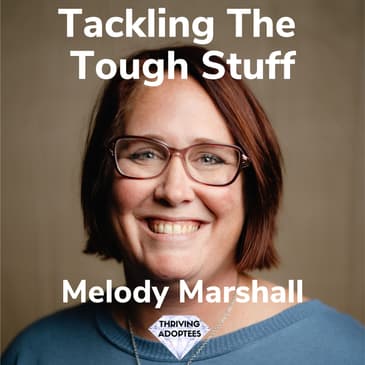
It takes courage to tackle the tough stuff in adoption. It takes courage to love our kids when that love isn't reciprocated. Listen in as Melody talks about courage, support from others and much more. Melody has five kids including one from adoption.
Melody Marshall is the Co-Executive Director of My Village Ministries, a local initiative focused on family preservation, and the Co-Executive Director of Upstream Collaborative, a nationwide network of family preservation ministries. After receiving a B.S. in Human Development and Family Science, Melody has pursued work that aligns with God’s calling to serve vulnerable families.
Melody’s professional journey has spanned various roles, from house parent for at-risk teens to paraprofessional for children with special needs. Her experiences have shaped her unwavering dedication to the marginalized, the orphan, and the widow. Guided by a deep faith, Melody has seen God’s hand at work in her life, leading her to a clear calling to mobilize the Church to preserve socially isolated families in crisis, helping them build sustainable support systems and pathways to healing.
https://www.linkedin.com/in/melody-marshall-1b19712ab/
https://myvillageministries.com/
https://www.facebook.com/myvillageministries
https://www.instagram.com/my.village.ministries/
Guests and the host are not (unless mentioned) licensed pscyho-therapists and speak from their own opinion only. Seek qualified advice if you need help.
Want to learn more about thriving for you, your kids, your families or your colleagues? Pick a time to talk here
[00:00:02] Hello everybody, welcome to another episode of Thriving Adoptees podcast. Today I'm delighted to be joined by Melody Marshall. Looking forward to our conversation today Melody. Me too, I'm really excited. So Melody is a mum, she's an adoptive mum, she's got five kids, one of whom has joined your family through adoption. And she also runs a family preservation ministry, that's what you call it now, that's right, ministry preservation.
[00:00:32] Yep. So we've come up with a slightly different format, listeners. We're going to look at the challenges around family preservation and a flow towards thriving. Because these are, as Melody is going to lay out for us, these are steps along the journey. Yeah.
[00:00:58] So, yeah, family preservation. First thing is, how did you come up with that? Well, so I'm not the one who coined the term, although it is still fairly new enough that if I say it, I often get a response of, I don't know what that is. It is what it sounds like it is, though. We're preserving that original family unit whenever possible.
[00:01:27] Or sometimes we are able to come alongside adoptive families too and help preserve when stress levels are getting really high in the home. So it might not be biologically that original family unit, but it's the family that is together. We are going to fight to put supports in their life so that they stay together. Yeah. And so crisis supports, this is all really tricky.
[00:01:56] Very emotive. It's a very emotive time, right? Yeah. Yeah. It is a very emotional time and not easy. You know, preservation or prevention are a really hard thing to measure or to know exactly how to step into. And so you have to have a decent understanding of what is leading to a family being in that place where they could potentially get broken apart.
[00:02:23] And I think adoption and the foster care system both come from a variety of stories. There's lots of things that could lead to a kid either being in the foster care system or adopted. And I would say those are pretty different. So if you're in the foster care system, you probably were as a child were experiencing abuse and or neglect. If you are in, if you are adopted, it could be a whole variety of stories.
[00:02:50] It could be that you, your parents are no longer alive, your biological parents. It could be that they made an adoption choice for you because they didn't feel they were in a place where they could care for a child. There are a lot more options, whereas usually if a child is in the foster care system, it is because of abuse or neglect. So one of the things we did is we studied what are the key indicators leading towards abuse or neglect taking place.
[00:03:19] And there are four, according to the National Clearinghouse on Childhood Abuse and Neglect, there's four key leading indicators. They are, well, the first two are really interesting. One is if there are two parents in the home and one overwhelmingly makes the decisions, that's an indicator that abuse and neglect will take place at some point. So it's kind of like a balance of power in the home between those two parents. The second one is the intergenerational transmission of violence.
[00:03:48] So what parenting style you learned from your parents, you are likely to pass down to your child. So if that was abusive, then you're likely to pass that down. But then the top two are really where we feel like we can have a big say. One is being socially isolated, meaning there's no supportive community around that family.
[00:04:12] And then when that's partnered with a temporary crisis, those two things lead to this boiling point in the home where a parent might make a choice like leaving a two or three year old at home alone so they can go get some money for food. And so go work for a few hours. And that's obviously seen as neglect. That child's too young to stay home alone.
[00:04:37] But man, that parent is not necessarily in any way a bad, quote unquote, bad parent. They are just in a time of desperation and at this boiling point as a family. And so those two things, the social isolation, temporary crisis, those are the two we feel most passionately that we could do something about if we help support that family instead of just waiting and see. We'll help you once it boils over. No, what if we helped turn the heat down some?
[00:05:07] Does that make sense? Yeah, it does. And as you're thinking about, as you're talking about that, I'm thinking about a trauma researcher that I interviewed a long time ago. Well, I didn't interview her, I just had a conversation with her. And this was PTSD, that sort of trauma rather than specifically adoption trauma. Yeah.
[00:05:28] And she said, or anything to do with childhood trauma, she said, well, the difference that makes the difference is the support. Yeah. And well, no, she didn't say the difference that makes the difference is the support. She listed a whole thing, a load of different things. And to me, they all sounded like support.
[00:05:52] And I said, those all sound like external issues to do with the amount of support that that person has. So, yeah. And she said, yes. I said, but what about the internal issue?
[00:06:16] So for want of a better word, well, first off, she said, I don't, she said, well, I don't really have a comment about that, which I thought was very interesting. Yeah, it is. And so on the back of that, internal resilience has become a kind of like a fascination of mine. Yeah.
[00:06:43] It's in terms of what, what, what's the, we know clearly that the support is key. And what else is in terms of resilience or mindset or ability to cope? You know, people talk about coping strategies and those sorts of things.
[00:07:06] So how do you see the kind of the, the inner, the, the inner dynamic here? Yeah. Well, I'm, I'm a, I know there's the whole like nature versus nurture argument and I'm a big believer in a combination of the two. You know, I'm raising five kids, so I'm seeing them have similar nurture to each other, certainly different nature. Um, as they're turning out to be quite unique individuals. Um, and I'm one of six kids as well.
[00:07:35] So I watched that in my own family growing up. Uh, but I think that, well, I think a few things, I think for sure, some of it is some of this innate quality that we have in ourselves. Maybe some of it is our faith. Um, if you have a faith journey, if you, if you're a believer in the Lord, but I also think some of it is the way we were cared for it. Very young that we might not even realize.
[00:08:02] So, um, neurologists say that we process information from our right brain to our left brain. And so if you have had received social cues that you are loved and belong by a face lighting up when it sees you or receiving warm, affectionate care, um, you have an intern at a very young age, even, um, actually they show that the first 300 days.
[00:08:30] And so, um, you know, the first 1,000 days is the most crucial for brain development. Um, so you might not remember how much your mom was crazy about you as a one or two month old baby or what her face looked like when she first looked at you when you came out of, out of the womb. Um, but your brain is already developing this sense of belonging and worthiness.
[00:08:52] And so as an adult, even if a whole bunch of things have happened that made you feel like unworthy or unloved, or you have PTSD or trauma of some sort, you still, your brain would still have this innate sense of I am worthy and loved. And therefore I'm able to be resilient beyond these circumstances because I understand my innate worth. Is that making sense a little bit? Yeah, for sure.
[00:09:17] I think there is the nature and nurture both, but I think some of it, there might be a little more nature going on than we realize because of those early, even in utero experiences where, um, there's a, like the tender loving care of a parent. Yeah. Yeah.
[00:09:34] I, I've interviewed a neuroanatomist who, who talks about the, um, the, the inner critic having a specific place in the left brain. Mm hmm. So this lady had a left brain stroke.
[00:09:56] And so the inner critic, what, one of the byproducts of that stroke was that the, the inner critic was, was gone. Oh, wow. Yeah. So when, when I think about this kind of area, I think about our, and the, I think about the inner critic, you know, like, um, I can't handle this.
[00:10:26] Mm hmm. Or, uh, I'm, I'm, I'm, I'm a, I'm a bad, what was I thinking of to, to adopt? Yeah. Or, you know, who was I to think that I could adopt? Mm hmm. Or, um, I'm a, I'm a, I'm a, I'm a crappy, I'm a crappy parent. Yeah.
[00:10:45] Um, I think about though, and I think, so I think about thoughts and, and belief systems and mindset. Yeah. Yeah. Yeah. So for me, the, the, the key is the, the see through that. Mm hmm. Yeah. Seeing the, seeing the truth. Yeah.
[00:11:13] Seeing the truth of, of, of who we are. So you mentioned, you mentioned faith and, and, um, some people I was, I was talking to a, uh, a Christian yesterday and he was talking about the importance of faith. And for him, it was identity in, in Christ. Mm hmm. Yeah. Uh, which is to do with worthiness. Mm hmm.
[00:11:42] And value. So I, what that means is he doesn't go from, or people with that faith, uh, they don't go from, I'm a bad parent. I'm a bad person. Mm hmm. Yeah. Yeah. Yeah. Because they have, right. They have a sense of, I was created for a purpose and I have a worth inherently to myself.
[00:12:11] So maybe I did really screw up as a parent today, but that does not mean, um, that I have no value in me as well. Give up. Yeah. Yeah. So for me, we can look at, yeah, exactly. So we can look at the, what this neuroanatomist says about the inner critic being in the, in the specific part of the left brain and the fact that that isn't true.
[00:12:39] And, um, uh, we can talk about, uh, attachment and how, how we were, how we were raised, how our parents reacted to us, our attachment styles and, and all, and all that. And the most salient point to me, to me seems to be about our ability to cope, our ability
[00:13:07] to rise above. Our resilience. Our, our, our resilience. Yeah. Our ability to see when the, when the inner critic is running amok. Yeah. Which happens to all of us sometimes, right? Yeah. Yeah.
[00:13:29] Um, so what's one of the most, so that's my, but that's just my, my take on it. What are the most important things that, that, that you see in, in terms of what, what's going on within moms and dads who are on the edge of breakdown? Yeah.
[00:13:59] Um, well, that's a great question. And I think that, I think one of the things that is important to remember when we think about having that community, that healthy community around you is not just, I have somebody to give me a ride somewhere or I have somebody to baby. It's not just the physical support of having a community or close friendships.
[00:14:25] It is the relational reminders of truth. And so one of the things that I think is a big deal when you are struggling with that inner critic and you are right at the edge of breakdown is you're receiving inside of yourself or maybe from voices outside, such a strong message of shame. You have messed up. You are not a good parent. You may as well give up.
[00:14:50] And so one of the things that strong friendships and relationships can do is remind you of the truth. Like verbally tell you, no, you are loved. Or I saw you do this great thing the other day. Or even, um, just a, a look of delight when you see your friend or give them a hug or whatever. It's these regular reminders that, um, that they are worthwhile and that there's truth beyond their shame.
[00:15:18] And so I think there can be such a strong shame message when you're right at the edge of disaster that you stop reaching out for help and you just start hiding more and more. So maybe you were already struggling a little bit with social isolation, but now things have gotten so hard and you're embarrassed about some of your decisions. And so you're just going to hide more and more and more. And so a lot of times when, when parents reach out to us saying, you know, we have parents who call and say, and they know if I don't get some help, I might hurt my child.
[00:15:49] And we tell them, man, that is the bravest thing that you could do. Cause that's such a hard thing to tell somebody you need help when you aren't sure if they'll help you yet. And so I think this commonality is you're feeling this desperation. Um, but that desperation is coupled with shame. And so maybe what you feel like you need is money for your next meal. But what you really need is someone to remind you that you can do it, that you can be resilient, that they'll stand by your side and cheer you on while you keep going.
[00:16:17] Um, and I think that that inner voice, whether shame wins or not can be a big indicator of whether or not you're gonna be resilient or not. Yeah. Does that make sense? It does. Yeah. Yeah. And I'm thinking also, I'm seeing some parallels with the adoptee community here. Yeah.
[00:16:39] That there is, uh, there is a relief when we realize that other people have felt like we have. Hmm. And there's, uh, so there's, uh, what, what can happen within the adoptee space is there's a, there's a relief around that. But if you're in a group that isn't mediated, like, so if you're in a Facebook group, I'm
[00:17:08] talking about specifically. Yeah. But if you, so if you're in a group where there isn't a leader, right, where there isn't a facilitator, then that, that validation can become stockness, right? Validation is a two-edged, two-edged sword. Yeah. So it first, the first instinct is relief.
[00:17:32] And, but then the second, uh, the second thing, implication might be stockness. Yeah. Yeah. But that's not gonna happen in a facilitated group where there is a leader, where there is somebody that has, uh, gone before us on the path. Mm-hmm.
[00:18:03] But that's what we, that's who we want to learn from, don't we? We want to learn from people that have been through the tough stuff and come out of it the other side. Yeah. And so that they, they can be about hope. Yeah. You can have some hope. Like, man, if we have the same story and you turned out okay, maybe I could turn out okay too. Yeah.
[00:18:30] So do you, do you find there's a certain age as an adoptee where you really start wanting to talk to other adoptees and hear their stories? Um, is there a stage? Yeah. Like, is it? Yeah. There is, there is a stage, I believe. Mm-hmm. So we, we call it, we call it coming out of the fog. Okay.
[00:18:59] So I'm talking here about babies that were adopted. Mm-hmm. Not kids that were adopted after, after neglect or, or, or abuse or. Yeah. Yeah. I'm talking about. Definitely different. Yeah. It's totally different. Because I'm talking about adoptees who can't remember their relinquishment. Yeah.
[00:19:28] And me, I'm in that group. Yeah. Right. So I, because we can't remember it, we're, we're kind of, we're in the dark, we're in the fog. That's, that's the, that's the challenge. Right? Yeah. Yeah. So what that, to give you an indication of what that means. Mm-hmm.
[00:19:55] I think of a, we, we have, we've got two dogs and they are dogs three and four. I, I think of our first dog and her crying for her mum on the first night that she was separated from her mum. Mm-hmm. Right? Yeah. Now, I can't remember whether I cried. Yeah. At a week old.
[00:20:22] Or, or however, however long, however old I was when I had my first night away from my birth mum. I saw, I can't remember that. Yeah. So, because, because we can't remember it, we, we're unclear and we, so it's, it's pre-verbal. We don't have any words for it. Mm-hmm. Um, we don't have any memory of it.
[00:20:51] And as Carl, Carl Jung was there? Jung said, until we make the conscious, the unconscious conscious. It will rule our life. Mm-hmm. And we will call it fate. So, I came out of the fog, as in, I became aware of the trauma that I'd been unaware of before. Mm-hmm.
[00:21:20] Around the teddy bear at 40. Yeah. Yeah. Yeah. Yeah. Yeah. So, when we come out of the fog is, I believe, the, it is when we, when we're looking for, when we're looking for answers. So, I rang, I rang, I rang, it wasn't quite there actually. It was a bit, it was a bit after that.
[00:21:46] Um, but I remember, you know, getting on the internet and, and finding a, uh, finding a post-adoption, uh, uh, charity. And I rang them just before, I think I just rang them just before Christmas. So, they pointed me in the direction of the book of The Primal Wood, which I, which I ordered. And that was a, that was my relief reading that was the validation that was the relief. Mm-hmm.
[00:22:15] But then there was the double-edged sword, which is, um, I'm stuck with this. Yeah. And if I'd gone into those, if, if when that had happened, there had been adoption books, adoption groups on Facebook and I, and I'd gone into one of those, then I see, I can see that my,
[00:22:43] my focus, my world would have got darker because I would have been more focused on, um, I would be more focused on my, on my trauma, but I wasn't in those spaces. Luckily, I didn't, all those spaces didn't exist. So you didn't have that like unmonitored group of people maybe saying unhealthy things that made you get stuck in ruminating. Indeed.
[00:23:06] And, and I discovered, uh, online groups that weren't, that were Zoom calls rather than keyboard warriors. Mm-hmm. You see what I mean? Um, yeah. This wasn't, this wasn't, uh, adoption specific. This was emotional intelligence or consciousness or it was, it was focused on that area.
[00:23:33] It was, it wasn't, it wasn't, they weren't adoptee, they weren't adoptee groups. They were broader than that. And being part of those groups helped me see the, the truth. So they gave me the relational reminders of truth. Yeah. Yeah. I think that's one of my prayers for my son. Um, I, I, you can correct me if I'm wrong, but I don't think it will be up to me at all,
[00:24:01] uh, when he's ready to process that or has some coming out of the fog or, or however, whatever the right phrasing is for that. Um, so I want to be someone in his life who's ready to talk to him about that anytime, always creating openness between us. But I, um, also pray that he finds healthy friendships and people to reflect back to him, their healing journey and, and reflect hope. And so those are some of the things that I really pray for him is similar to you.
[00:24:32] Um, how, you know, have, having had some significant experiences, people and things that were said to you to then help you process in a healthy way. That's what I pray for him too. Yeah. Um, so it's where they find, so we can find relational reminders of truth in our family, in our support, in our, in our support network. Yeah. At church, right.
[00:24:59] Or it might be, it might be broader than that. So the, the idea that was popping into my head is, uh, Spence Chapin, uh, over, I, sorry, I can't remember where, where, where you're, where you live, Melody, which, which stage are you living? I'm in Ohio. You're in Ohio. Okay. So there, there are, uh, Ohio, uh, adoption organizations, but the one that popped into my head was Spence Chapin on the, on, uh, in New York. Okay.
[00:25:29] And they have, they have mentor, they have young, young adoptee groups. Okay. Um, where they are, where there is a mentor, an older mentor, an older adoptee, an adult adoptee. Yeah. And that they are, that those places are where we can go, where, where, where, where kids,
[00:25:54] where kids can go for, uh, help and relational reminders of truth. Yeah. Which I'm thinking is vital. Yeah. I love that phrase. You know, it's a matter of where do we find, yeah. Where do we find the relational reminders? Yes. Yeah. Yeah. And we want to be intentional. And, and I think too, when we think, I love that you're talking about like you, you have
[00:26:24] this whole thrive framework in the name of your, um, podcast is thriving adoptees. And, um, so much of the work I do is in family preservation, which is kind of, we're standing right on the edge of the cliff. Um, and how do we get away from the cliff past sustaining, um, past surviving and get up to thriving. Um, but then I think I'm also passionate about how did those who are thriving go back to the
[00:26:53] cliff and help get some of the people, you know, people away from the edge, because you have, if you've gotten to the point of thriving and you have a real story to tell to come alongside somebody who's maybe just at the edge of being preserved. Yes. Well, funnily enough, the E of thrive is empowering others. Oh, really? Yeah. I haven't gotten to hear no framework yet. I'm really excited about that. So that's cool. But we've got to do that. That's the whole thing. Yeah. You know, I, I, uh, I don't know if I've mentioned this recently on the podcast list,
[00:27:22] and so I'm sure I've mentioned it to you, Mardi, but, um, my best friend died, uh, 25 years ago in a car crash and his wife was just eight weeks pregnant, something like that. Oh. And yeah, uh, and it was a terrible time for her and she, she found a mentor, like, like,
[00:27:48] like somebody that had, uh, somebody who had been a young widow, another young widow. Really? Yeah. Um, and the young widow had been through the tough stuff and, uh, was, was on the way out of the other side and she, she did it, she did the same. Um, so I believe Jake, after she'd been through it, she, she passed it on.
[00:28:14] And it's a bit, it's a bit like, I guess it's a bit like, uh, AA. There's, we watch a lot of American cop shows and British cop shows, but one of the issues between British cop shows and American cop shows is that there's more AA meetings in American cop shows, but they have, they have a sponsor, don't they? So they have a sponsor who has been sober for longer and who has been through the, been through, breathe through the darkness, come out to the end of their life and now helps others.
[00:28:43] And I think that that is quite typical for people that have done that stuff. There is that something happens that makes us want to give back. Yeah. Was that, was that your story to what extent? Um, no, I wish that was my story. I feel very admiring of, of those who have done that.
[00:29:12] Uh, my story is actually fairly different. Uh, I grew up in a, in a pretty safe, healthy family. We weren't without our trials and struggles. Uh, we filed for bankruptcy when I was young and lived in my grandparents' basement for a while. And, um, then lived in a house, a one bedroom house, our family of eight, because we had six kids and two parents and, um, my aunt and uncle and their daughter. So 11 of us in a one bedroom house.
[00:29:43] Uh, so we weren't without our struggles, but we always had a support system. And so it kept us from getting close to that edge of the cliff that I was talking about. Uh, but when my husband and I got married, he also had come from a safe and whole family. And, um, and wasn't without his trials and struggles. His dad had cancer his whole life, passed away when he was 17. So we both had like trials in our life, but we had these buffers of relationship and community
[00:30:10] and, and, and overall felt like we had had happy, safe child, childhoods. And when we had our second kid, um, we just were sitting and talking one day about how it seemed like too much goodness for one family that we had both been happy and safe as kids. And now here we were with two happy, safe kids and that maybe there was something our family could do
[00:30:35] that would just bring one more at a time, one, one at a time, join into this kind of little fold of happy safety is the best way to put it. I mean, it sounds kind of cheesy, but we really just felt this sense on our heart that it was too much for just us. So in the same way that you could say you steward your money or you, um, or you share your belongs with others, we felt like our family was something we could share.
[00:31:04] And so that kind of got us started on this journey of how do we bring one more at a time? Because, um, because there are so many, we actually sat on the couch last night together in tears. My husband and I just talking about, man, how, how are our kids so blessed to know, know such safety and love. And there are so many kids who are not getting to experience. It doesn't seem fair. And so what, what is it that God would have us do to bring in one more at a time to that,
[00:31:33] to that safety and that love. And so it really wasn't a story of hardship. Not that my life has been perfect or all easy, but it has been, there has been a through line of goodness that we, that I wanted to offer to others. Yeah. And, and, uh, the way it showed up was you ended up adopting your, your, one of your son's friends, right? That's, that's how it happened. But, uh, yeah. Yeah. I mean, there's, uh, it showed up in a lot of ways.
[00:32:02] We used to work for an organization where we were house parents and had at-risk teenagers living with us. And then we started being host parents for this family preservation ministry that I lead now. Um, but ultimately it was when the, when a story came into our life where a kid needed a family, it was like God had been preparing us all along to say yes to that. And so we gathered, uh, our son was seven when we adopted him.
[00:32:30] And so our biological kids ranged from seven to 15 at that time, the four of them. And we, um, gathered everybody on our bed. Uh, we lived in a really small house. We didn't even have a living room with a couch yet. We do have a couch now, but we gathered all the kids on our bed and we asked them what they thought. And we said, you know, this is not your decision to make. We don't want you to feel the weight of this decision, but it will affect you your whole lives. Uh, it will affect our family every day.
[00:33:00] And so we want to hear what you have to say about, about this adoption. Um, and then all of them said, um, yes, we can't wait. Um, they shed some tears. My 15 year old son shed some tears for his sorrow, knowing the transition he was going to make. And my, um, 13 year old daughter said, I not only do I think we can do this, I think it's going to make us a better family. And so it was like, it was like God had been putting all these pieces in the puzzle in place
[00:33:28] for all this time to prepare us to be his family. And then he came along. We didn't even know that was going to happen. And so, yeah. So as a, as a mom and as a, an adopted mom, what have been the biggest learnings for you and what continued to be the biggest learning from you?
[00:33:51] You said, uh, your, your daughter felt that, uh, adopting would make you a better family. How, how has that, how has that play played out? What is it that, what, what is it that you've learned do you think that has helped you become better? Yeah, that's a hard question because just like we were talking about the inner critic
[00:34:17] earlier, it's really easy to live your day-to-day life with your family and feel like you're messing everything up and just trying to keep your head above water. Um, I think, I think one of the big things I've learned is that, um, as a family, we're not going to get it perfect all the time and we, and it doesn't stop us from continuing to be a family and serve and grow together.
[00:34:43] And so we're, we're learning through grace for each other and, and we've seen our kids really be people who are quick to accept others in quick to share their things quick to now, don't get me wrong. They are not perfect. They make lots of mistakes every day. Um, but they care for others in a, in a way that we could not have taught them to do,
[00:35:10] but because we lived our life in a certain way, they became people who wanted to live their life in that same way. Um, I think our son has also, our adoptive son has also taught us a lot about resilience and courage himself. I mean, for him to have the courage to love us and, and, and choose us and, um, connect
[00:35:36] to us, you know, he could have very easily because of his story held us at arm's length and just tried to exist in safety, but man, he's fully opened his heart to us. And so there's this connection and attachment that is such a huge blessing. And I don't know if I could be as courageous and resilient as he is. And so I'm learning from him too. Um, and I, I, you know, I think he's 11 now.
[00:36:04] And so maybe ask me this question again, and in five or six years, and I'll have 20 new things to tell you, right, we're learning all the time as parents and as people. Um, but I, it's so easy to look back and picture us saying yes over and over and over again and, and saying yes to another kid, maybe someday, like God has just used this piece of our life to, to enrich and expand our understanding of the world and what's going on in it and who
[00:36:33] we should be as people. And I very much look forward to what all five of my kids will do with their lives and how they'll, um, go out and impact the world. Uh, funny, you talked about courage, courage to love us. Uh, I was talking to me yesterday, was it last, yesterday, last week? And she was talking about her, her adopted son saying, I hate you.
[00:36:59] And I'm like, um, that like how hard, how hard that must be to, to, to, to, to take. Um, so courage to love against, I hate you are too big bookends, two opposite ends of the scale, right? Yeah. I mean, that takes some courage to, to be feeling such a deep feeling as a child and
[00:37:29] to be able to be honest about it. Um, and it takes a, it takes a feeling of they're going to still love me, even if I say this big emotion. And so there's probably is something that that parent is doing well to create such felt safety that that kid could say that. Um, but yeah, obviously that would be a devastating thing to hear.
[00:37:52] And, um, the prayer is that they would then be able to ride that emotional wave and come back to an understanding of safety and belonging. Yeah. That was a long time ago, uh, I think for that particular birth parent, that particular adopted parent. And they were, they were bringing their kid, their son back from a visit from the birth month.
[00:38:22] So it was riding high off the back of that. Yeah. Um, yeah. I mean, you have to imagine that there's all kinds of complicated emotions coursing through them of, and can I push this person away and say yes to this person or I'm angry? Who do I, who do I aim that at? Um, and typically I would say kids are willing to show their hardest emotions to the person they feel the safest with.
[00:38:48] So even in that, there is some wind that you've created a situation where they felt safe enough to say the big emotion that they were feeling instead of always, always feeling the need to just win your love and affection by trying to be this perfect buttoned up version of themselves. Yeah. But, uh, and it's trauma talking, right? Yeah. Yeah. When we worked at, um, when we worked for this organization that where we were house parents
[00:39:18] for at-risk teenagers, um, there was often, these kids had been in like so many foster care placements that now they needed to be removed and put in a group home. Um, one of the girls in our home had lived in 33 foster homes and they, they would hit a point in time that was the longest they had lived anywhere, whether that was five months or six months or whatever. And it was like, they would be doing really well up until that time.
[00:39:46] And then they would just start to self-sabotage. And so you said it's trauma talking. Their body was keeping the score in a way that their mind necessarily wasn't even like their body recognized. This is as long as I've ever been loved before. And I'm going to start sabotaging it because I no longer feel safe, which is hard to understand if you haven't walked a mile in their shoes. Um, but the kids were able to push past that with and create a new feeling of felt safety to, to extend that period of time.
[00:40:16] Then they had a new level of understanding, unconditional love. I can throw my worst at you and you'll still love me tomorrow. I can, I can tell you, I hate you. Um, and when I'm ready, you're, you're going to hold me in your arms again. Yeah. Yeah. I want to dive into that word self-sabotage. Um, because to me, trauma talking feels, I'm only just coming, I only just come up with that word, right?
[00:40:44] And just like that idea that, but it is trauma talking. So, um, but the, uh, when we talk, when we, we use this word self-sabotage and we use this word, I'm getting in my own way. Uh, and they don't ring quite true to me. Like, or which self are we talking about here?
[00:41:08] You know, like we're talking about the, uh, the self that is in religious language, you know, a child of God, that, that's not the self that we're talking about here. We're talking about the, the, the, the, the, the ego self, aren't we? The little, the lowercase s self. Um, and it, it all goes to identity to me, but I'm making any sense.
[00:41:39] Yeah. So you're, well, I would love to understand that more. Um, I don't know that I have a deep thought or I'm coming from a strong place of learning when I think of self-sabotage, but would love to unpack that. I think what, what I saw was more of maybe self-sabotage the wrong word. It was more of like a, I, I no longer feel safe.
[00:42:08] I want to test the waters in a new way. Um, it comes, it ends up often sabotaging them, like hurting their place of safety. They were in, especially for these kids who'd been in so many, I mean, they were in that many homes, partly, partly because behaviors got really big at some point. Um, and so, yeah, I would love to unpack more of what, what you're saying and how that, how it does.
[00:42:34] So if, if, if I shortened your, what you just said there to kind of, uh, boundary testing, boundary testing or trauma talking, both of those would feel more truthful, more benevolent, more, um, yeah, just more true. Yeah.
[00:42:59] So when I think of self-sabotage, uh, and I mentioned it, I think of getting in our own way. Right. So we say that, don't we? I'm getting my own way. Right. Well, there's only one of you, right. There's only one of us, you know, self, self, self-sabotage. Like, how am I doing that to myself? Like, how, how, you know, like, yeah, I don't even want, um, like we can't get in our own
[00:43:28] way, you know, getting in our own way is it's like if I'm what we call, what you call the sidewalk, we called a pavement, right? Yeah. I can't get in my own way while I'm walking down the pavement. You know, I can't go one way and then do 180 degrees and come up against myself. It's, it's not, it's not me that's getting in my own way. It's a belief.
[00:43:57] It's a belief and it's a belief that I can't. Yeah. And then, and then we, and how does that stack into what we're talking about? And how does that bring, how does that link back to what you're talking about? This, this, this idea of, which I think is gorgeous, right? Like relational reminders of truth.
[00:44:22] When I think of that, I think of somebody else seeing in us what we can't see ourselves. Yeah. That's good. That, that's, that's what it's about. Right. So you're talking about, you got it. You can, you can do this. No, no. You don't, you don't believe in yourself. I believe in you. And then, you know, if we were bringing in a religious, um, uh, then as well, I angle as well, we say like God believes in you. God believes that you can do it. Right.
[00:44:52] God would have put you here. So, and, and then that takes you back to faith, which is mentioned. And I, and I think it's a really potent, it's, it's a really potent thing on any life journey. Yeah. So. I do like, really like that reframing of that phrase self-sabotage, which I think is easy
[00:45:19] to use carelessly, but the boundary testing, um, and even like safety testing, like, am I safe here? And am I loved? And the interesting thing is that often when they would hit that we've been here five months, we've never been loved or stable for more than five months. And so we're going to start testing all these boundaries. There were some times where everything in our house got broken or something pretty like aggressive or physical happened.
[00:45:49] Um, and when you got to the other side of that, like I was saying earlier, and you found out the next morning, I still have a home and I'm still loved and cared for. There was this super attached period of time that would happen then with that, with those girls where, um, it was, it was like they needed to test all those boundaries to then form the new bond. Um, and see like, oh, you're still here.
[00:46:19] Yeah. And maybe I, maybe I, maybe I'm starting to love you too. Um, and so that's really interesting when you think of that in the, in that new phrasing of that you're giving me of boundary testing. Like I'm going to test all the boundaries and then I'm going to feel safe again. Yeah. It is. I hate you a boundary tester. I think so. I don't, I'm not an expert, but it feels to me like, like, yeah, I'm going to see, can
[00:46:49] I say this big thing that should break our bond and then you're still there afterwards after I've tested that boundary, then now I feel a new level of safety. Yeah. And I want to circle back to something that you said, which was also a kind of a reframe
[00:47:11] to, to use your word that it's kind of good that your, your, your son or daughter said that to you because they're feeling something and, and they're sharing, they're sharing something
[00:47:39] even if it is pretty poisonous, but they're not going away. They're saying what they're feeling. Yeah. They told you they're not, they're not off saying it to everybody else. They told you they felt safe enough to tell you. And I think that is a true in lots of humans, whether you have trauma or, um, an adoption
[00:48:08] story, my, one of my first jobs was running a daycare out of my house. Uh, my mom and I did it together. We were babysitting, um, lots of kids and the toddlers, the really little ones, it's like they would get dropped off and they might be sad when their parent left, but then they would be pretty cheerful all day. And then sometimes when their parents walked in at the end of the day, they would just burst into tears. And you can find reels of this on Instagram too, like daycare workers showing a kid bursting into tears when the parent walks in.
[00:48:38] Um, it's like, well, why did they do that? It's because they, they're, they had some type of buttoned up version of themselves for the daycare workers where they were following the rules and, you know, they feel, I think there is a level of safety and feeling loved and cared for at a daycare. Um, but then when their parent walked in that person, they feel the most safe with, it's like, here come all my emotions about how I was feeling all day. And why weren't you with me?
[00:49:04] And, and so it, you know, that, and, and you see it right at that toddler age where they maybe don't have enough, as much control to go run into their parents' arms. Sometimes they did that, but a lot of times they would burst into tears. Like, just so you know, I'm really sad you were gone all day. I didn't feel like I could show anybody until my person I felt safest with walked in. And so there is something about even showing, you know, unwanted behaviors, if you want to use that phrase that shows, like, if you feel confident enough to show that behavior, that
[00:49:34] means you feel really safe right now. Yeah. It's incredible, eh? Mm-hmm. It is incredible. Attachment, I think. Attachment and belonging and, you know, unconditional love. They are really incredible things to watch play out in humanity around us. Yeah.
[00:50:04] What, what about, what about adoptive parents? Um, what, what about their inner critic? Hmm. What does it, you know, like, I was thinking about this this morning. Um, I, I hate you. And then what, what's the, what, what's the thought that goes, you know, what are the options?
[00:50:33] For the thought that comes to the adoptive parent, adoptive parents' head? I, maybe like, I love you, but I don't really like you in the moment, at this moment. Or, you know, like. Yeah. I mean, maybe. Maybe, I think there's, there can be, your inner critic might tell you a lie, like, maybe you shouldn't be this, maybe you shouldn't be their parent if they hate you anyway.
[00:51:03] Um, or you're, man, you're really messing this all up. Maybe somebody else could do a better job. Um, or a hopelessness of, I'll never, I'll never get this right. Um, I think that goes back some to what you shared about being in, in a group where people can remind you of truth. You know, I, I need to hear sometimes from other adoptive parents or maybe even grown adoptees. Some of the things that you and I were just talking about, that maybe that's boundary
[00:51:32] testing, or maybe that is good. They're feeling safe enough to tell you that, or something to help fight against what my own narrative might be telling me, man, you just aren't good enough to be their parent. They hate you. Um, and you need somebody to help you fight that in that moment, um, so that you can be resilient in going back and unconditionally loving them and continue to create that safe space when they are testing those boundaries. Yeah.
[00:52:01] I guess those are the times where we need the, uh, the friend that's going to be a critical friend, right? But they're not criticizing us that they are saying that what we're thinking and what we're feeling isn't true. Yeah. Yeah. And I think too, there's this. A cheerleader, a cheerleader. Yeah. We need a cheerleader.
[00:52:31] We need someone to remind us of truth to come alongside us. Um, I, hopefully this is not too controversial to say, but depending on a kid's story, it might not just be boundary testing. They might truly hate you in that moment because they just have had so many hard things happen. And I think we maybe have to ask ourselves as adoptive parents too, are we willing to love
[00:52:57] for as long as it takes, even if that love is not reciprocated the way we want it to be? Um, as our kid is healing. I don't know. You can cut that out if you think it's too controversial to say, I just think, is it presumptuous to say every single kid will be able to love us the way we want to be loved in return? And are we loving them just to get that love in return?
[00:53:24] Or are we loving them because they inherently deserve to be loved and they need to be loved, um, in order to thrive in this world? And maybe, maybe that will be reciprocated. I think that's why I say it was so brave and courageous of my son to love us is because we can't assume that he will. Um, he did and, and praise the Lord that we are getting to experience his love, but, um, he could have chosen to hold that at bay and stay in a wounded corner and hate us.
[00:53:52] Um, and, and, and I hope there are some things we did that help him to love us. Um, but I'm just saying we can, I don't think we can assume no matter our kid's story that we will earn the same level of love back that we are pouring into them. Are we demanding too much too early? Yeah, maybe.
[00:54:21] And, and every kid is different, I think. Like, but I think if we have this idea in our head that if I love you, let's say we gave it a numerical score. I adopted this little boy. I love him at a level 100 and he's going to love me at a level 100. But what if he only loves me at a level 10 or can't love me at all at first? Like, am I going to keep loving him at a level 100?
[00:54:53] I think if we have that resolve, that desire, um, and, and people coming alongside to help us, then we can keep loving at a level 100. Even when we have days where they say, I hate you. Um, even when the story isn't going quite how we want it to, uh, we can be resilient in our parenting and our love because we're not doing it to get a level 100 back. We're doing it because we chose to, and it's the right thing to do. And, and God says that little boy deserves a level 100 love.
[00:55:23] And so I'm going to give him a level 100 love, even, even when he has only 99 to give me. And even when he has only four to give me, that might be a really dumb numbers illustration, but. No, not at all. Yeah. I, I, um, I, I used to be like that with girlfriends. How'd that work out for you? Well, yeah. Um, I, I don't think it did really with that, with that mindset. I don't know.
[00:55:52] I used to think, uh, oh, well she likes more than me than, you know, my, um, it wouldn't be, it would liking, be liking rather than loving, but it, you know, and it wouldn't be, uh, you know, a one to 10. So people often talk about, you know, oh, she's a 10, right? So that's the, that's the film. You probably can't remember, which might be before your time, but with Bo Derek and Dudley Moore, the film, there's a film called 10. This was a girl. She was a 10. No. Okay. I mean, I've heard that phrase, but I haven't seen the film. Okay.
[00:56:22] So it's, um, so she's a 10, which is based purely on looks. Yeah. Yeah. Um, this wasn't, I wasn't doing, I wasn't doing this on, on looks. Uh, I was doing this like, well, who likes, who, who likes the other more than? Mm-hmm. Yeah. Yeah. I like her as my, my liking for her is four out of 10, but she's six out of 10 for me. Right.
[00:56:52] So she's keen on me than I'm on her. Yeah. Yeah. Yeah. Uh, it's definitely different, I think with romantic dating relationships than a child that you've chosen to be parent of. Yeah. I was thinking of saving that, uh, strange anecdote until after we'd hit the, the end of the record button. I think people will enjoy it. I just, I just blurted it out.
[00:57:18] Um, I, what, one thing does come to mind was the kind of, the lack of logic for love. Yeah. So I, so I've been with my wife for 32 years now and be married for 27.
[00:57:46] And I remember just after we kind of got together, I was driving along and I remember where it was. And this question came in, came into my head, which was what, why do I love Lynn? The, the, the best I could come up with was she does what she says she's going to do. You know, there is no logic. There is no logic. Yeah. I love that phrase. There's no logic in love.
[00:58:16] Yeah. I think too. And to go back to my whole number analogy for, for my son or for our kids, depending on their story, it might take them a lot more effort to love at a level 10 than it takes me to love at a level 100 even because maybe I have been safe and loved my whole life and they've experienced rejection or harm in some way in that area.
[00:58:45] Um, so they might be putting in a level 100 effort to loving me, but it only comes across as a level 10 because that is so much effort for them. Um, and so there again, back to that first comment, there is this courageous, um, thing that my son did to love me. Um, and I think that's another reason why we need people around us to remind us or people
[00:59:13] who understand that to remind us, man, he's working so hard and we got to celebrate that 10 that he's coming at us with, even if it's not the hundred that we want. Yeah. Beautiful. Is there anything that you'd like to share that I've not asked you about, Melody? Oh, that's a great question. I'm bad at thinking of things like that though, because I'm usually just caught up in the conversation. I will tell you that you almost made me cry several times.
[00:59:41] I don't think I've ever really unpacked some of the effort and the courage, um, that he is using every day. Um, and that a lot of, um, kids who've been through traumatic things use every day just to exist in the world around them and to love and be loved in return. And, um, so I think I'll be ruminating on that all day. Thanks for letting me talk about it. Yeah.
[01:00:12] Can I give you an opinion on that? On the trying hard? Yeah. I'll go with an esoteric one first. And if it doesn't make any sense, I'll try and unpack it a little bit more. Right. Okay.
[01:00:31] Uh, so a lot of us are looking for enlightenment when trauma has endarkened us. Mm-hmm.
[01:00:50] So I think that history is, trauma histories are like clouds, clouds obscuring the sky. It's a, it's an, it's a, it's an obscurance.
[01:01:19] It, it, it's some, the, the, the, the history obscures it. It's not that he's, he, he is, he is love. We are love. And cloud, uh, trauma obscures us like the, like the clouds obscure the sky. It's, it's not a, it's not a trying thing. It's a seeing thing. Hmm.
[01:01:53] I can't, I can't do any better than that. I love that. Not, not on, oh, you'd love that. Mm-hmm. I think that's helpful context for me. Well, that's good because I didn't think it was particularly, it was particularly good. Right, listeners, we're going to finish it there. We've got too much of this stuff going on.
[01:02:21] Um, thank you. Um, thank you, Melody. Thank you. Thank you, listeners. Uh, thank you for, uh, staying with us to the end. And we'll see you again very soon. Take care. Bye-bye. Thanks. Thanks. Bye-bye.