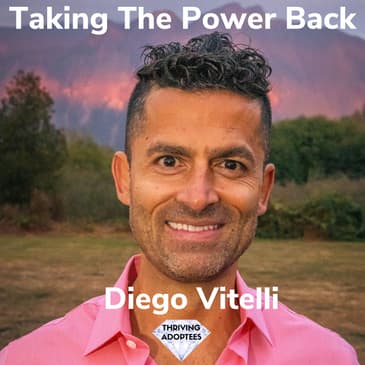
We didn't choose to be adopted. We had no power over what happened to us. So how do we take the power back? What can do to develop our identity on our terms? Powerful stuff from Diego.
Here's a bit about Diego from his website:
Hi, my name is Diego; I am an adoptee from Colombia, S.A. (5ish years old) who is a relationship and family therapist in the state of Washington. I am an adoptee-focused therapist, centering on adoptee voices and their adoptee identity development through their lived experiences; pre and post-adoption. I am also passionate about relationships regardless of their structure (hetero, consensual non-monogamy - CNM, polyamory, and LGBTQIA+); I believe all individuals in a relationship deserve to be heard and witnessed, opening avenues for a broader understanding of others and ultimately, deeper connections.
As a systemically trained relationship therapist, I am also intrigued by how relationships function and how they can be bettered through a greater understanding of the larger and smaller contexts connected to those in a relationship(s). I lean heavily on racial and feminist theory in working with relationships; owning white and male privilege is vital to the better understanding of those who hold less power; it creates pathways to empathy & connection.
It is a privilege to sit alongside those willing to be vulnerable in the name of personal growth. I offer virtual sessions for clients in Washington State; I look forward to the opportunity to work with you if you feel we would be a good fit and begin the journey to an improved sense of self.
Find out more at:
https://www.facebook.com/profile.php?id=1498807549
https://www.instagram.com/diego.vitelli/
https://www.linkedin.com/in/diegovitelli/
Guests and the host are not (unless mentioned) licensed pscyho-therapists and speak from their own opinion only. Seek qualified advice if you need help.
Want to learn more about thriving for you, your kids, your families or your colleagues? Pick a time to talk here
[00:00:00] Hello everybody, welcome to another episode of the Thriving Adoptees podcast. Today I'm delighted to be joined by Diego, Diego Vitelli. Looking forward to our conversation, Diego.
[00:00:12] Same here, thanks for having me.
[00:00:14] Yeah, so the trillion dollar question. What does healing mean to you, Diego?
[00:00:24] Healing, it's an interesting kind of concept as I've been thinking about it. I know you asked that question of everybody and I've listened to enough of your episodes to kind of hear other people's views and I just have always struggled a little bit with it personally.
[00:00:43] I feel healing has this connotation of some end result. That we get to something where things are patched up or fixed or people can move on and in the context of talking about adoptees, I think it's a really complex thing to achieve.
[00:01:08] I'm not to say that some don't, I think some do. For me particularly, and speaking of my own situation, I think it's a bit of a challenge because I have a lot of missing pieces around my adopt the identity that doesn't leave me feeling like I see healing as an end result type of thing if that makes sense.
[00:01:32] Whereas I see it as a journey. I see things as a process and a chaotic mess, so to speak, and getting to a place of trying to figure out who we are and maybe in that process you kind of get to feel better. I don't know if that's necessary entirely healing.
[00:01:58] Yeah. Have you got a word that you prefer to use?
[00:02:05] Yeah, I think right now I'm in a phase of a lot of personal identity development growth that is bringing more awareness into who I am or who I want to be, how I want to show up in the world.
[00:02:33] So I think more of that kind of personal growth kind of process.
[00:02:40] Yeah.
[00:02:41] Yeah.
[00:02:43] So, we had a fellow docty on the show last week, Tony Hines and he talked about processing trauma, rather than healing.
[00:02:53] He didn't like the healing word either, which is an interesting one.
[00:03:01] I guess we're having these conversations to shine a light on it and talk about what it is it gives us a framework to start.
[00:03:13] So you were talking about the missing pieces.
[00:03:18] So, and you talked about identity development growth.
[00:03:24] So, is this kind of really the missing piece?
[00:03:28] The missing pieces of the jigsaw in terms of heritage as a transracial adoptee. Is that what it's about or is it about something else?
[00:03:39] What does it mean to you? That jigsaw thing came to my mind but that might be completely the wrong metaphor.
[00:03:46] Yeah, yeah. No, I think it's definitely a huge component as a transracial internationally adopted person.
[00:03:54] We start from a very disjointed place.
[00:04:01] I mean, let's talk about it from the analogy of a puzzle.
[00:04:04] Like the puzzle is shattered and some of the pieces go with you and a lot of the pieces get left behind.
[00:04:11] And what pieces get brought with you are fragments of an understanding of something that was.
[00:04:19] And I think that has such a hard, you know, it's a hard lift mentally for transracially internationally adopted people that we spend so much of our life where we get here.
[00:04:38] Me in particular getting to the United States and just trying to survive and survival is assimilating.
[00:04:47] And in my particular situation, assimilation was the name of the game back in the early 80s when I was adopted outside of Boston.
[00:04:58] And I lost my language within nine months.
[00:05:03] I had my birthday changed again within that first year and lost complete touch in connection to a culture that I had spent at least four and a half, five issues years in.
[00:05:17] Not that I remember a lot of it, but you know definitely had language and definitely had, you know, experiences within that culture so all that gone and I spend the next, you know, 25 years of my life, 30 years of my life just to be able to live
[00:05:32] in the world and I spent the next 20 years of my life just being this persona that other people, I felt other people wanted me to be because I felt like that's how I needed to be and show up.
[00:05:45] When you talk about the missing pieces, it's the missing pieces of me. Who am I is really the biggest question at the end of the day and how do I solve for that with such limited information or limited pieces of a puzzle, you know, at my disposal?
[00:06:05] Yeah.
[00:06:07] So, to me you just, the first thing popped into my head is, is that you're talking here about both on a kind of like a thought basis, like questions having questions not having, you know, questions without answers.
[00:06:27] I think that part of this is quite rational, but then it's also, it's all very emotional as well. It's not, it's not thinking that you're not whole and feeling that you're not whole as well as both of those things.
[00:06:47] Absolutely.
[00:06:49] I think, you know, you can't, you know, you can't be, you know, one without the other.
[00:06:58] I think there's a lot of my, a lot of times especially for myself and I think for other adoptees as they go through life that they push the emotional stuff aside and stay in the cognitive and are only focused on this.
[00:07:14] I know, I come from this country. I know I don't have this information. I know I don't know my biology. You know, it is what it is and okay, I can't do anything about it so let's just move forward and make kind of the best life we have because we had this indoctrination into us that you're here for basically a better life, whatever that means but you're, that's what you know the messages in adoption so you show up trying to do and be this better life that everybody expects you to be.
[00:07:43] And a lot of us end up struggling through certain points in our life and a lot of age developments, developmentally.
[00:07:54] Okay, I can't get my words out of my mouth but at certain points of age development like in early teens.
[00:08:01] There's a huge period of time there where most teens all have that kind of experience of like figuring out and realizing who they are as they go through puberty and start to be characteristic of themselves that are no longer the baby child kind of vision that they've had and they become more of this moving into adulthood.
[00:08:21] And while biologically, you know connected people have that experience. We have that experience as well but we also have this added layer of like all of a sudden now we're realizing like, oh, who do I look like?
[00:08:37] Really, because I don't look like this father or this mother or this other sibling that's biological to them.
[00:08:46] I am right now on an island by myself and I don't know who that is. And you start to, you know, have, you know, a lot of questions and, you know, maybe exploring that in the back of your mind and then maybe that's the first time you start to tap into some of those emotions.
[00:09:00] And it becomes a little bit painful to kind of do that. So then we push them away. I certainly did that, you know, at that age I went to my mother and asked her if I could search. Basically, I was asking her permission or I think I told her I said I want to search for my birth mother or whatever and she was like, why would you want to do that?
[00:09:21] And that was a quick message to me that that wasn't an okay subject to talk about. So I shoved those emotions away. I did it again when I was, you know, in college got the same response, did it again shortly around the time my son was born and got a similar response and I just had that all the time so it's always forced me to push away my emotions.
[00:09:42] And it wasn't until I was 35 that I finally said, no, I'm not doing that anymore. I'm going to lean into it. And that's been, you know, I'm 48 ish now. And, you know, I say 48 ish, not to be facetious or any of that kind of stuff. It's literally because I don't know what my actual birthday is.
[00:09:58] So it strikes me that you've not, you've got the old puzzles being thrown out of the window. Right? So you've had four and a half, five years of figuring out who you are in Colombia. That's been thrown out of the window. So you've got not only figuring out the new puzzle, but putting the old puzzle and the new puzzle side by side.
[00:10:26] So that's kind of like even more confusing than it would be if you'd been transracially and internationally adopted as a baby or as a couple of months old.
[00:10:40] Yeah, I mean, it's, you know, it's one of those things, you know, this puzzle analogy is kind of really apropos in the context of the puzzle that I had in Colombia.
[00:10:53] The puzzle that I had in Colombia got shattered. Right? So that's the piece, those are the pieces you want to put back together to kind of create what is wholeness. Right? But in coming to the United States, I have this other puzzle that actually got developed as a result.
[00:11:10] And they're completely different pieces that in a sense were fabricated because of where I was. And you had to just make do and you make this other puzzle. But to try and integrate back, you can't make it whole.
[00:11:24] Not one way or another. Can you integrate those two to make it a whole puzzle? Because the pieces are never going to fully fit. You know, in some sense as a united kind of puzzle, they have to, there's going to be separation somehow.
[00:11:38] You either separate the Colombian parts of you or you separate the United States kind of, you know, persona that you developed in order to return back to this some semblance of this Colombian identity that you, you know, that I personally want to connect with and be more aligned with because that's who I think I am more at my core.
[00:12:01] And yet there's these other aspects that I've also developed because that's just what happens when you grow up. You develop a sense of self through the experiences that you have as well. That makes sense.
[00:12:13] I think so. So given the enormity of the challenge, is it, is the healing piece in inverted commas, right? We know we don't like that word, but we haven't got a better word for it at the moment.
[00:12:30] Is the healing piece really about being at peace with the unanswered questions, with the fractured? Is that what this is about? Because I can't see any peace with this stuff. I can't see any resolution.
[00:12:51] I was talking to a fellow adoptee just before today and she was talking about resolution. Now, like me, she's a white kid adopted by white folks domestically. So she hasn't got that shattering that you had.
[00:13:09] So perhaps it's an easier thing. But she talked about resolution. So what does resolution fit better for you? Is this about at peace with the shattering of the puzzles? What does the resolution look like?
[00:13:36] Yeah, I think that's the thing. That's the tough part is that there's, you know, we live in a very, you know, Western medicalized model of thinking that there needs to be some sort of endpoint fixing solution resolution, you know, whatever that might be.
[00:13:56] And in medicine, you can have that. You can break a bone and you can get it fused back together and they can, you know, heal and, you know, through time, it will cut you have that strength in that you can have ligaments that can tear and you can put them back and connect them and rehab them and all those kinds of things.
[00:14:15] And it can help to heal the body, right? Some of those things don't come without scars. You know, they in order to fix them, you have to cut in and create that. And so we that that spot will never be the same. Right? And you can have some semblance of feeling like, oh, I'm healed underneath on the surface is still a reminder that that's there.
[00:14:37] And so, you know, for me, as an adoptee and kind of think of this as a, you know, healing process is really challenging because it just has that connotation that something has to evolve or, you know, become something.
[00:14:56] And, you know, I don't know. I don't know for me, at least for myself at this point in time, I don't necessarily feel that that's something that is there. What I what kind of comes into my mind is and I don't like the word either.
[00:15:15] But it's, it's the only one that's come into mind. It might be something else that comes is like, I'm afraid to say because it's not the right word, but it's this idea of accepting that things are not okay.
[00:15:30] Okay. And not accepting that things are just the way they're going to be and you have to move on. It's accepting that they're not okay, giving ourselves the grace to lean into that and to not place undue expectations on ourselves to get to something.
[00:15:49] And that for myself, I'm, I'm, I'm learning to accept that this situation that I'm in and have been in is not an ideal situation. It never has been an ideal situation. I tried to make it some sort of an ideal situation.
[00:16:05] And now I'm realizing I was in such a performative state for so many years of my life that I got away from being able to be who I actually am and want to be. That now I'm coming back into that. And so I can accept that it's just, just a chaos really at the end of the day.
[00:16:22] And I'm trying to more so grow into my own authenticity as best as I can know it without having that influence of my own biology. Then I'm relying on deep rooted biology connection through that.
[00:16:41] I'm wondering who do I, you know, who do I represent in my family? That's kind of like me out there. And I'm just channeling a lot of their energy because I'm finally tapping back into that somehow. And, you know, accepting, accepting that it's not a perfect situation and that there may not be, you know, full healing at the end of the day.
[00:17:01] And that we're, we have, it's okay. And to give ourselves a lot of compassion. That's what I think about through this process is giving ourselves a lot of compassion, giving ourselves a lot of validation for the challenges that we have faced and their normative of doing something that no other human has ever had to do.
[00:17:23] That's not adopted, right? Us as adoptees are very unique and from a human species. Like it's just nothing like that. And yet it's not something that anybody talks about or acknowledges as being really challenging. It's just we're expected to kind of fit into society and live as if we're like everybody else. And that's just not the reality.
[00:17:46] Yeah. Yeah. So it's clearly the resolution thing is the wrong idiom. It's acceptance and peace and compassion. Being at peace. So this is too dramatic a metaphor, but I don't know. It's the one that's popping into my head at the moment. It's being at peace with the war.
[00:18:17] Yeah.
[00:18:18] Being at peace with the war.
[00:18:20] Being at peace with the war. So it is perhaps a little bit too dramatic. So one of the most important mentor I've had over the last 17 years and the most long standing one talks about if we're okay with not feeling okay, we're always okay.
[00:18:43] Yeah, I think that's a part of my brain that has a hard time conceptualizing those types of phrases to make sense of them. And I can't do this and I'm the type of person that will take that and then like three hours from now or two days from now I'm like, oh, I think that might be okay.
[00:19:03] So it's a bit like a boxing, the boxing analogies coming in for me. Right. So it's like throwing the towel in. Right. So we've been looking for the resolution. We've been looking for the resolution. And I think that's the thing that's really important.
[00:19:23] And then we throw the towel in because we're giving up the fight. We're giving up the fight to win, the need to win. If we're defining resolution and winning as one of the same things, then we're not going to be able to do that.
[00:19:43] We're giving up the fight to win, the need to win. If we're defining resolution and winning as the same one of the same things, similar kinds of metaphor.
[00:19:55] We were, yeah. It's like I'm, it's accepting that I'm not going to get what in the ideal world I would want.
[00:20:14] Yeah, see I would push back against. Yeah, I would push back on that just a little bit because that's not what that's what I wanted to get away from is that the idea that I'm accepting that we're not going to get the resolution.
[00:20:26] I'm accepting that there's a mess in this process. Right. Not accepting that there's just that there's like, I don't know, I can't use these words just tend to pop into vernacular and it's not the right situation here.
[00:20:45] But the idea of giving in to like a hopelessness, like I'm not talking about that. I'm talking about that there is a mess and we have to accept that.
[00:21:00] And we don't know necessarily how to clean it up or make it right because we likely haven't gotten the right supports. And, you know, I mean, the fact that we're just removed from our biology, let's just start there.
[00:21:12] That's just the basic thing. Like it's never going to be a mess that you can clean up. Everybody wants it to go away, wants the mess to go away and not to be centered or identified as as that because that makes everybody else uncomfortable.
[00:21:29] And so while we are catering to everybody else not feeling uncomfortable in the process, we are having to sit with that mess inside ourselves every single day of our life 24 7 and then heightened periods and depending on what situations you find yourself in where
[00:21:48] your your trigger because of what people say or environments that you're in, so on and so forth. So that we are carrying that mess around. And what I'm getting to, I think, is accepting that there's a mess and accepting that I don't need to cater to other people out there anymore.
[00:22:07] And trying to make them feel like they don't have to have exposure to that mess. You're going to be a part of it with me, regardless. And how do you want to sit in that with me? And a lot of people don't want to and they say, Oh, God, that sounds like a lot. I'm going to let you go do your own thing. And then that leaves us a little bit more isolated in that process.
[00:22:30] And that can be hard and painful through that. And so I want to acknowledge that for adoptees that secondary rejection, you know, we talk about it oftentimes than search and contact situations. But this is also happening constantly where we're getting that secondary rejection experience just in relationships with people connections with people within families, you know, within schools, within work, you know, in community where we are just continually invalidated.
[00:23:00] Because other people don't want to sit in the mess that we are carrying around.
[00:23:05] Yeah. Well, we've become kind of a motor phobic as a society. And whether it's UK or the US would become we don't like we don't like the dark stuff.
[00:23:18] We don't like the dust. We want to pretend everything is shiny and put what we sweep the dust under their carpet.
[00:23:34] Mm hmm. Yeah, yeah. I think that's a lot of the work that I try and focus on with adoptees and you know, in my practice and working with them to help them understand like this is the opportunity to do that with in a safe container and to not have to feel performative to somebody else.
[00:23:57] And very rarely do adoptees ever get that unless they, you know, get into good therapy. And I hope to provide that for people as an avenue to finally relax and sit and as much of their authenticity as they possibly can.
[00:24:14] I was just having a conversation previous to you with another adoptee myself. And she asked me the question about like, how much of yourself do you know? Like when you think about who you are and how much of your authenticity, so to speak, how much of that do you know as you?
[00:24:35] And I had to fit there. It kind of blew me away that the question first, but then I sat there for a good like 10 or 15 seconds and I came back with the answer of 5%.
[00:24:48] And it shocked me in my own internal system, what I was feeling around that. And I had a lot of, you know, just emotional feels about that. And I feel, you know, I'd be curious to know what other adoptees, how they answer that question themselves.
[00:25:08] Because I think that's the part of us that walks around this world, just really not knowing who we are. And then when we finally start to tap into, into that, and we offer that 5%, it's also not enough for other people.
[00:25:23] And it's not even enough for us, certainly because we want obviously to be more. And I'm not saying that everybody else is 5%. I don't know. I may ask that question to you when you think about that for yourself. How much of yourself do you think you know?
[00:25:38] Well, for me, identity is awareness or consciousness. So there's that phrase, I use it quite a lot on the podcast, not so much recently, I don't think, but you know, people say, it's a philosopher, French philosopher said that we're not the same.
[00:26:05] I think that philosopher said that we're not human beings having a spiritual experience, we're spiritual beings having a human experience. So I would, I identify as that, that spiritual being that, and there's, there's only, there's only one
[00:26:35] spirit, right? I don't know if these words might be a bit, are these, are these words making any sense to you that what I'm talking about? So I can, so I had this, straight to make it a little bit more straightforward.
[00:26:57] I had this strange moment when I got my, when I saw, I didn't, I haven't got my original birth certificate, but I've, I've got a document that says what I was named at birth. And it was David Anthony Flower.
[00:27:11] So as I read that piece of paper, maybe eight, nine years ago, something like that, I thought, oh, that's for me. I've had two names. I've had two names. And, and then I heard somebody a couple of years, and it's kind of stuck with me as a bit of
[00:27:35] curiosity. I didn't go to the next, I didn't go to the next question. Well, well, which one am I? I didn't, I didn't go there for some reason. But a few years later it occurred to me, well, we think that we are, Alan, I've had two names, right? The truth never, the truth never changes. So I've had two, I've had two names so I can't be,
[00:28:05] I can't be either of those. Those are just labels that other people have given me. So I'm, I'm, I'm, I'm disidentifying in this conversation from my name. So, so I've not always been Simon Ben, I've not always been, you know, I've not always been David Anthony Flower. So that's not who I am.
[00:28:29] I've not, have I always been an adoptee? No, I haven't. I wasn't, before I was adopted, I wasn't an adoptee. So that can't be who I am either because that's changed. I'm a podcaster now, but I've only been a podcaster for like three years so that can't be who I am.
[00:28:49] I'm a, I'm a husband. Well, I've only been married whatever it's 25, 26 years so that can't be who I am. I haven't always felt my trauma and I don't always feel my trauma. So that can't be who I am. So it's like, well, so, so what, what am I? And I am space for all that to happen.
[00:29:13] I am, I am the one that's aware of my thoughts and my feelings and my, my trauma. And so I talk about this being I am, trauma is a toxic cocktail of shame, shame, anger and insecurity.
[00:29:34] But, but where they, where the cocktail glass is not, where the cocktail glass not its content. So I'm, I'm, I'm identifying as consciousness. And can I put a percentage on that? No, I can't put a percentage on that because it's the whole, it's the whole thing. It's, it's infinite is, is conscious.
[00:29:58] So that was a really long answer.
[00:30:01] Yeah, I mean,
[00:30:05] yeah, it's, I think that's the, the unfortunate
[00:30:15] mental game, I guess. I don't want to call it a mental game necessarily, but the, the, the mental hurdles that we go through of
[00:30:27] trying to figure out what parts we accept of ourselves as being and not being.
[00:30:33] And anytime we get too close to thinking we're one thing, we're reminded we're actually not and pull away from that and redirect. And so we never set in this idea of wholeness is kind of what I'm hearing from what you're talking about.
[00:30:50] Because any, any one of those things actually doesn't feel entirely authentic to who we are. There are things that have come into our existence because of who we are. Does that make sense?
[00:31:06] Yeah, the, but if I'm, if I'm space for the world, I accept everything. And therefore I am whole.
[00:31:16] There's no, it's a bit far. It probably seems a bit far fetched, which I wouldn't normally go this, this far because it's a bit far fetched for most people.
[00:31:31] Super Zen, Zen master stuff.
[00:31:34] Well, yeah, I'm not into, I'm not into any particular religion, but this, this awareness stuff is, it's more like, yeah, space for the world we're all space for the world so I,
[00:31:57] I touch that space. I, well, I first felt that I first felt about that space reading a letter from my birth mother.
[00:32:07] And I'm feeling that that space as my essence
[00:32:15] in some, in some therapy actually at the moment. So it's not just a theory. It's an experience. It's an embodied experience.
[00:32:31] And it's peace and space, space for the space for the world. But yeah, it's almost if I'm hearing this right, it almost feels like we have to dehumanize ourselves in order to really kind of not deal with the parts of us that are the reality of who we are.
[00:32:58] So, to the feel then, okay, if I can dehumanize my experience a bit. I can feel more whole and connected to who I am because I'm just a, I'm just a part of everything.
[00:33:14] The identity comes at different levels. So on one level, I am consciousness and on another level, I'm Simon Ben and on another level, I'm the guy that gets cheesed off when somebody else smashes into his wing mirror and it costs 600 quid to fix it.
[00:33:37] It's a many layered thing is identity. But I'm going right down to the essential. I'm looking at that at a different level. So I'm looking at different levels.
[00:34:00] Is that is that where you go to feel more peace within yourself and feel healing? Is that what I'm hearing for you?
[00:34:09] This, this is the, I don't, I don't go there. I am it.
[00:34:22] You're embodying it through that.
[00:34:25] Well, it's, it's so my favorite guy on this stuff is guy called Rupert Spira. He says meditation isn't something we do. It's something that we are.
[00:34:40] We are.
[00:34:42] So that, that's
[00:34:47] That's where we're going. That that's where the eye is looking at identity and you kind of separate it allow and then then so through this netty netty approach. So I'm not this, I'm not that I'm not that.
[00:35:05] And then you and then you encompass it all. And we're encompassing it all. So there's two. It's, it's stripping everything back and then Bill putting it all together.
[00:35:22] For clarity on clarity on identity and I think one of the reasons that I went down to show my stuff was first of all, that you asked what percentage I feel.
[00:35:38] And also you talked about your own process of, I think when I said the word healing. You talked about going through a process. You said identity development growth.
[00:35:54] And when I was thinking about that, I was thinking about the process that I've been through and I go through is, I could call that identity development growth.
[00:36:09] Yeah, I can see that.
[00:36:12] What does it mean for you, Diego? What does that identity development growth? What does that mean to you?
[00:36:23] It's, you know, for myself, I think I have three relatively distinct identities that I sit in. And I sit in being an adoptee.
[00:36:38] And, you know, what does that mean from, you know, adopting identity development process coming into adoptive consciousness and what that journey has been like through that.
[00:36:53] My other one is my bisexuality and being a bisexual male and how that identity impacts me.
[00:37:04] And how do I present that and come into that in a more authentic and natural way versus what I was conditioned by in societal messaging around that and unpacking that.
[00:37:21] And then there's the cultural context of being for myself a Latino individual and that Latino identity.
[00:37:31] And how do I connect to that? Because I grew up disconnected from it, had it deconstructed for me.
[00:37:39] And now I'm having to reconstruct it and not knowing how to do it because I don't, I'm not Latino Latino.
[00:37:49] I'm Latino by looks. I'm Latino by my first name. As soon as I say my last name people are like what? That doesn't make sense.
[00:37:57] You know, Vittalia is Italian. You know, so there's a lot in that identity that I'm having to try and rebuild and started trying to rebuild that at 35 years old and still trying to figure out my way into that language being one of the biggest ones of them.
[00:38:20] And I can speak enough Spanish to be dangerous enough to get myself, maybe dangerous is the right word, but it can speak enough Spanish to make sure I'm not in danger in a Spanish speaking country.
[00:38:32] But I don't have the linguistic skills to do that on a conversational level. And that's hard. And language is such a part of culture, right?
[00:38:42] So how do I fit in as a Latino that doesn't know how to speak his native tongue is a challenge.
[00:38:52] So all those three identities are the things that I grapple with and I've been actually on the journey with all three of them very much hand in hand, you know, largely concentrated since I was 35.
[00:39:08] Of course, we come in and out of them talk about them at different places and spaces. But that's what it's been like for me. So I see them very similar in the process.
[00:39:20] And I'm experiencing maybe, you know, we use now the adaptive consciousness model of how we come into certain aspects and connections to our adoptive identity at different times and touch points and how we may revisit back to other touch points at different times.
[00:39:36] And I love that. I love that idea of that because it doesn't feel like we have to have this linear kind of process to get to something to an end result or whatever, we are just kind of being who we are, but gaining a little bit more understanding each time we kind of hit those touch points
[00:39:53] maybe have a little bit more clarity about who we are and how they how can we integrate that differently into the next touch point that we come into. And so I use that very similarly through those other two identities as well.
[00:40:06] Yeah.
[00:40:07] So you, you, you, they seem to be parallel tracks are they three kind of parallel tracks or you dipping in and out of
[00:40:17] I'm experiencing the development of them at the same time, but they're not at the same pace.
[00:40:25] Each one of them is happening at different like I would say I'm in like toddler infant stage with my cultural identity.
[00:40:34] I feel with my adoptive identity, I'm not, you know, much more of a mature, so to speak, age and understanding of it.
[00:40:43] And with my sexual orientation, I feel like I'm, you know, maybe more at that, you know, early 20s kind of process and trying to, you know, understand it and I've got, you know, more, you know, growing to do if we're going to put stages, ages kind of to it.
[00:41:00] There are different stages and
[00:41:02] Yeah.
[00:41:03] You know, on the process.
[00:41:06] So, do I mean you use the word integration, you want one words that use your integration and you also said, reconstruction.
[00:41:20] So are there particular moments that when that, that integration, you feel has has
[00:41:32] been accelerated or being more you're being more conscious of or
[00:41:38] Are there being certain certain moments where you talked about going rounder again are the certain moments that come to mind, where you can appreciate some
[00:41:53] integration or or reconstruction happening. Is it as clear as that or is it more
[00:42:02] No.
[00:42:03] I'm trying to be a bit more
[00:42:05] I, you know, I think that there's been so many times early on, especially my adoptive development that I thought like, oh my god, I feel so whole and connected to this huge columbian adoptee group and
[00:42:20] I'm getting so much awareness and connection and it was filling me up in such an amazing, amazing way that you would think like, oh my god, you've totally integrated and you're you're reconstructed who you are.
[00:42:34] And yet, so much of that has gone away in my process, maybe largely because of how I chose to go into the counseling profession and become a therapist.
[00:42:46] And there's more of a disconnect that comes from that process of not being overly present in, you know, these communal spaces to kind of leave that space for, you know, other people, potential clients, things of that sort that you just don't, you know, you don't
[00:43:02] You don't sit in that. And so there's a different experience now I'm experiencing something much different as an adoptee.
[00:43:10] And what I think I'm experiencing now that is most resonant is in the reconstruction process.
[00:43:19] What's actually happening is I come I'm completely deconstructing everything I've ever felt and known about any one of those identities.
[00:43:30] So it's a deconstructing process, what kind of what you're talking about maybe in some senses of undoing and unpacking all the nonsense that in the messaging the conditioning the societal influences of what shaped my how I thought I should be thinking how I thought I should be acting.
[00:43:51] How I thought I should be presenting what it meant to be like all those things. I'm just completely out of space in my life where I am completely deconstructing all of that and starting to recognize the injustice that has come from, in particular, the colonization of humans and that that deconstructing colonization and really sitting in that to get to the place where I think not only is we're going to be able to do that, but we're going to be able to do that.
[00:44:18] And that's the place where I think not only is we as adoptees, but we as humans in particular a lot of the people of color of the world out there that have been colonized that influence of that and how that has allowed so many other populations to also be disconnected from who they are.
[00:44:40] And so, I, you know, I said earlier like we as adoptees are unique in that experience of having that. But if we really start to really deconstruct the whole thing and colonize the whole situation we realize that there's a huge swath of the world humans that actually could probably relate in some sense to our situation if they gave themselves the ability to do that, but because the colonization.
[00:45:05] And so, you're told to not access that and to move forward with this idea that this is who you are. We're going to tell you who you are because of this or that and you and so you just embody it and you become that and you accept it and it's integrated into and you know you have this identity that's I'm an Irish person I'm a US American person or I'm a Latino or whatever that might be.
[00:45:29] But you and your whole entire ancestry is built on this idea that you have become something that somebody else wants you to become. And how do you get to the place of deconstructing that so that you actually figure out who am I really.
[00:45:45] Okay, so it's a stripping back of everything to then reconstruct in a way that's authentic and it's chosen and it's conscious and it's intentional and it's deliberate.
[00:46:06] Yeah.
[00:46:11] Yeah, so you can start to feel like whenever you show up in a space that you can be you.
[00:46:19] You know, and whatever that might be and I think for me as an adoptee that doesn't know who I am I'm creating me right I'm creating this kind of version of me but I'm also coming to tapping into my core roots that are in me there they are there they have been there.
[00:46:36] And I'm just needing to tap back into them I have to deconstruct the other shit that has been on this surface of me and blocking away this part of me.
[00:46:47] And as I connect with that this authentic part of who I am then I can start to show up more in the world the way I truly want to and not worry about what other people are thinking and so on and so forth.
[00:47:01] Now that's not super easy. Like that's a lot to do and I find myself like I have massive social anxiety when I go out in certain places, and it's really hard for me to even allow myself to show up authentically in that because I'm so still conditioned by so much of the pressures that I felt for so much of my life.
[00:47:21] So it's the goal, but it's not an easy process to get there.
[00:47:31] Feels like a good place to bring it in, Diego.
[00:47:35] Yeah.
[00:47:38] And, and sorry unless, of course, there's something that you'd like to add.
[00:47:47] No, I'm here for you and I appreciate the opportunity to share and get a little bit deeper on something that's, you know complex the whole idea of, you know, I know that, you know, but your podcast is so focused on the healing, and I just, I know I've sat in this for a long time I think you reached out to me like last maybe September and I sat on it and I was like I don't know if I'm ready to do that like it took
[00:48:15] a while before I could, you know, come into, you know, more of that fold of doing that and that's just a lot of my own personal growth that's continued to happen and a lot of it's more accelerated recently.
[00:48:30] I feel that it's good that we can, the whole point of the podcast is different perspectives. Right. So, I actually enjoy the fact you know you're a second person within a week to challenge the healing thing.
[00:48:47] And I think that's really great. You know, I have found the parts of this conversation tricky right and especially when I get into talking about my own stuff which I'm, you know, it's a bit it's a bit far out even for me sometimes right.
[00:49:03] But I think it's really good that we have that we can, we can have a different perspective because what we're looking to do is to open it up. You know, so I'm working at the moment on this healing framework and I was thinking this morning, framework is that, is that a good word and the other word that came to my head was roadmap.
[00:49:23] And I thought, no, it can't be a roadmap because everybody's every, every journey is different. So, it's a it's a framework framework it's just a different, it's a way of broadening it out if we, you know, like, there's, we're just, I think I'm just using healing as well.
[00:49:46] Well, I'm using a shorthand really, I mean it's just it's a way of opening the, opening the, opening the conversation up but we're focusing on, I guess moving forward we're focusing on development and what you brought to the table very clearly in the last, so I finally got to, maybe I'd asked the right question at the beginning.
[00:50:14] Maybe I'd asked the right question towards the end, right? Or maybe it just took us that long. You talked about deconstructing it for yourself. So at the start of the conversation, you were talking about the fact that this was taken away from you.
[00:50:33] And now you're stripping, the demolition work or the deconstruction work is being done by you. And that's obviously a whole lot more empowered than having the scaffolding, the scaffolding of four and a half years being ripped out from under you.
[00:51:00] And that must have been really freaking, do you know what I mean? I didn't acknowledge that in the earlier on in the conversation but inside I was thinking, geez, did Diego tell me that last time? Have I forgotten it? Or, you know, like, but deconstructing on your own terms feels, it's got to be.
[00:51:28] It's got to be more, it is authentic. It's you doing you, isn't it?
[00:51:39] Yeah, I think it's just, it's taking the power back for yourself instead of having it, having handed it over to somebody else or to society and having society tell you who you were supposed to be.
[00:51:56] And I, you know, and I want to be kind of conscious of it too, if I can just add this part is that even though who I was in Colombia for my first four and a half, maybe five years of being there, that was also conditioned.
[00:52:11] And that was also imparted by colonization of in that area. And so who I would have become had I stayed in Colombia would also have been conditioned by all these other factors.
[00:52:24] And the fact that I may not have been separated from my biology may have allowed me to feel more integrated into that identity and in a sense, more oblivious of all the things that actually are there.
[00:52:37] But because I didn't have the separation trauma wound that I'm now conscious of and feel every day of my life, it's a different thing.
[00:52:49] But in Colombia, I may have also been conditioned by that and likely would have like we know that that that's the case. And I'm in that if there's anything that comes out of this, I don't what you want to call it crazy experience of being forcibly migrated to another country is that I have a much deeper awareness of maybe some of the realities of the world.
[00:53:18] And how people are impacted because I sit in that and I focus on that and I look into, you know, how how those things work. I look in the you know how relationships work as a relationship therapist, I constantly I'm doing that I'm constantly doing that within my own relationship that has had its own challenges ups and downs for 14 years.
[00:53:39] And in a real pivotal space right now of really trying to figure out how do I show up more authentically in that relationship so that I can stop hurting the person that actually is trying to love me and give me security.
[00:53:54] But I can't accept it because I don't have any enough security within myself. So it's you know, that deconstructing process is what I feel is the most helpful has been the most helpful for me to start feeling like okay, now I can start to understand maybe, maybe start to understand who I am and that's why I landed at that 5% because I'm really, you know, still in that early journey of getting there.
[00:54:21] Yeah. Right. Thanks, Jogam. You've been a star.
[00:54:26] Yeah, appreciate the time. Thanks Simon.
[00:54:28] Thanks, Lissens. We'll speak to you again very soon.