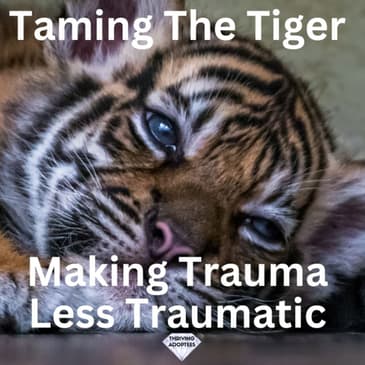
Trauma can seem like a terrifying predator stalking us... Our world is scary and dark. This podcast is fundamentally different because it brings lightness to this darkness.
· So you can see a dramatically different, friendlier world. And when you see better, you do better for yourself and loved ones.
· So you can forge a peaceful relationship with trauma. Because you see the light of hope as well as the lightness of understanding.
· So you can see a brighter way to a better life. Because there’s less fear, grief, shame and anger. Or of any of the other powerful feelings that come with trauma. ·
So you have the tools to help you along your way. Your wisdom wins out over the tiger. And the tiger becomes a cute and cuddly cub that just wants to play.
· So you can restore your connection with yourself and others. Because you’re mastering the trauma that’s been keeping you apart.
Click here to find out more about The THRIVE Course that goes deeper into Taming The Tiger and covers 5 more topics: https://www.eventbrite.co.uk/e/1054946014929
Guests and the host are not (unless mentioned) licensed pscyho-therapists and speak from their own opinion only. Seek qualified advice if you need help.
Want to learn more about thriving for you, your kids, your families or your colleagues? Pick a time to talk here
[00:00:02] Hi everybody and welcome again to what we hope will be a fun and informative webinar. Jude and I have been working on this for how long? I don't know.
[00:00:18] At least maybe three months.
[00:00:20] Three months, something like that.
[00:00:22] And then it's built off of our previous work so yeah, a while.
[00:00:25] Yeah, we've been talking like a year or so probably now.
[00:00:31] Yeah, it's been a year.
[00:00:32] Yeah. So are Jude's going to drive the presentation?
[00:00:39] Yes I am.
[00:00:40] Do they do they clicking?
[00:00:42] Yeah.
[00:00:43] Yeah.
[00:00:45] Do you want to start sharing?
[00:00:48] Sure thing.
[00:00:49] I think I've clicked the buttons I need to click so hopefully people can.
[00:00:52] Okay, awesome. Thank you Simon.
[00:00:54] Welcome everyone.
[00:00:55] Really glad to have you here with us.
[00:00:58] We are calling this webinar Taming the Tiger.
[00:01:02] So I'm going to kind of go on in and get it into presentation mode.
[00:01:09] If you guys will be patient with me.
[00:01:13] Oh, you know what?
[00:01:15] They have changed us a smidge so I'm hoping.
[00:01:20] We used to just have presentation mode right up here.
[00:01:23] Did anybody like a can of a freak like me and know how they changed it?
[00:01:31] No.
[00:01:32] Sorry.
[00:01:32] Is this big enough would be my question for people to see then because I'll just go with
[00:01:37] this.
[00:01:37] But they used to have a presentation mode right here.
[00:01:41] Oh, and I haven't since last time I did it they changed it.
[00:01:46] So is this okay Simon for can I read that text the next the next the next page might be a bit tight tight
[00:01:53] because the font's smaller, but I guess we just have to go with what we.
[00:01:58] Okay.
[00:01:59] Well, we're going to do our best here.
[00:02:01] Thank you guys for.
[00:02:02] Let me see if I.
[00:02:03] Is it down at the lower right?
[00:02:06] Lower right.
[00:02:07] Hold on.
[00:02:08] Those icons down there.
[00:02:10] I can read the screen.
[00:02:12] Thank you.
[00:02:13] Thank you.
[00:02:13] It was who said that.
[00:02:14] Thank you.
[00:02:15] You're an angel.
[00:02:16] Awesome.
[00:02:17] It's Jenny.
[00:02:18] Okay.
[00:02:18] Welcome to taming the tiger making trauma less traumatic.
[00:02:24] I'm Jude Hunk and I'm an adoptee.
[00:02:28] I am a transracial adoptee adopted at two days old a stranger adoption, you know, all the names all the things.
[00:02:36] And I have been facilitating trauma groups for adoptees support groups for five years.
[00:02:44] So that just gives you a little bit of my background.
[00:02:47] I'm a coach and a Reiki master teacher.
[00:02:51] You guys know Simon.
[00:02:53] So I'm going to go in with just a little bit of housekeeping to start us off.
[00:03:00] Let's see.
[00:03:01] Okay.
[00:03:02] So for all of us wild tigers, this is how we're going to handle ourselves during, during this presentation.
[00:03:11] So each of us that's here is taking time out of our lives to participate.
[00:03:16] And Simon and I value your time and presence, your voice and expression.
[00:03:22] And we honor the intensity of being vulnerable and seen by others in a container like this.
[00:03:28] We honor your feelings as real and valid, even though they may be different from what others are expressing.
[00:03:34] That's okay.
[00:03:35] We ask that everyone be mindful of keeping their selves aligned to these values by please stay muted unless you're sharing.
[00:03:43] And we'll have some, some short times of sharing.
[00:03:47] Um, there'll be some small windows for that during this class.
[00:03:52] We suggest or offer taking notes.
[00:03:55] We invite you to take notes about all the things that you might like to share or remember.
[00:04:00] Because there's really a great value in what you're experiencing and then being able to share and express it with others being heard, being witnessed.
[00:04:10] If this option is available to you and you feel comfortable, please leave your camera on as a way of showing yourself and others that you will honor the authenticity and vulnerability that's being shared.
[00:04:24] And as always generously or love into yourself and into each other, holding the intentional awareness that you are doing your best.
[00:04:33] And so are they, we're all here doing our best.
[00:04:35] And I set these guidelines up because this is a container that's talking about trauma.
[00:04:43] And it's likely that everyone here has an awareness of their own trauma or an intimate relationship with trauma.
[00:04:52] And it can be really sensitive.
[00:04:55] And when we talk about these things, we never know if there could be a moment or something said by anyone here that might activate somebody's nervous system.
[00:05:05] So with that being said, if you become activated and you need to pause or go off camera, please do.
[00:05:13] We invite you to do what you need to do to care for yourself and your system.
[00:05:19] And also because of that, I'm going to do like a really quick grounding.
[00:05:23] I'll just take a second just to kind of shift us from our outside world, you know, and all the busyness of life, just to right here being present and being anchored in the love that we have for ourselves.
[00:05:41] Because that often will give us a buffer and help us keep our nervous system calm and grounded.
[00:05:47] So with that being said, I'm going to, we're just going to do what I call like three heart breaths.
[00:05:56] And we put our left hand over our heart.
[00:05:59] And if you are not comfortable to participate in this, or you want to go off camera as we participate in this part, please do.
[00:06:06] Left hand over heart, right hand over the left hand.
[00:06:11] I'm going to go over the instructions real quick first so that we can do it together and I'll guide.
[00:06:15] We will take three nice deep breaths.
[00:06:18] And with those breaths, we're just sending a lot of love to ourselves.
[00:06:23] So we're breathing in love and exhaling any stress, any anxiousness, anything that we're coming in with.
[00:06:30] So go ahead and take a nice deep breath in through the nose.
[00:06:35] And exhale out the mouth.
[00:06:40] Love in through the nose.
[00:06:42] Out the mouth.
[00:06:49] In through the nose.
[00:06:53] And exhale.
[00:06:54] We're going to switch our hands.
[00:06:56] We're going to do three more.
[00:07:02] Just let yourself leave those loving breaths in.
[00:07:08] Exhale out.
[00:07:10] One more.
[00:07:12] Deep in.
[00:07:15] Exhale out.
[00:07:20] And then just bring yourself to this present moment.
[00:07:24] Be here.
[00:07:25] Know that you're safe.
[00:07:29] Let your breath take its normal rhythm.
[00:07:33] Wiggle your fingers.
[00:07:36] You can bat your eyes open.
[00:07:38] And welcome, welcome.
[00:07:40] Welcome to taming the tiger.
[00:07:45] There we go.
[00:07:47] Many of us.
[00:07:49] Many of us.
[00:07:49] And I'm kind of almost curious, but I don't want to get the chat like going.
[00:07:53] Many of us have have heard of Dr. Peter Levine and his book, Awaking the Tiger.
[00:07:58] He also has this book, Healing Trauma.
[00:08:01] And, you know, so that is where we got this metaphor from.
[00:08:07] And I'm going to read really quickly from.
[00:08:14] Chapter one.
[00:08:16] Peter Levine says, trauma is the most avoided, ignored, denied, misunderstood and untreated cause of human suffering.
[00:08:26] When I use the word trauma, I'm talking here about the often debilitating symptoms that many people suffer from in the aftermath of perceived life threatening or overwhelming experiences.
[00:08:40] And in my experience, that pretty much describes each person on the planet.
[00:08:47] There's a spectrum of trauma out there.
[00:08:50] Right.
[00:08:50] So the degree of what we are managing and navigating through is different for each of us.
[00:08:57] But trauma is like an epidemic.
[00:09:02] And it's really come into the awareness of science and medicine and even the masses.
[00:09:11] In the last 10 years, probably with Dr. Vander Kolb's book, right?
[00:09:16] The Body Keeps the Score.
[00:09:18] It was it was a huge shift for us in our awareness of trauma and how much it is impacting individuals and our culture and society.
[00:09:29] These are the signs of trauma.
[00:09:31] As I read through this, I just want you guys to think about, do I have any of these?
[00:09:38] You know, how much is trauma impacting my life?
[00:09:42] So irritability.
[00:09:45] Anxiety.
[00:09:46] Depression.
[00:09:47] Are these things that you use to describe yourself like I am an anxious person.
[00:09:52] I have anxiety.
[00:09:53] You know, I struggle with depression.
[00:09:55] I used to say that all the time.
[00:09:58] Difficulty concentrating.
[00:10:00] Flashbacks.
[00:10:01] This does not have to be visual flashbacks.
[00:10:05] As an adoptee, after I realized that I was carrying trauma.
[00:10:12] I gained the understanding that a lot of the emotional experiences I was having were emotional flashbacks.
[00:10:20] That's the thing.
[00:10:21] Like so we can, especially with nonverbal trauma, early, early childhood trauma, we have emotional flashbacks as well as those that, you know, have like the memory with visual visual and picture and sound and smell.
[00:10:35] We can have all sorts of flashbacks that happen when our nervous systems become activated or triggered.
[00:10:43] Avoidance.
[00:10:45] Difficulty sleeping.
[00:10:47] So our sleep patterns become interrupted.
[00:10:49] Nightmares and terrors.
[00:10:51] Intrusive memories.
[00:10:53] Disassociation.
[00:10:54] This is a big one, because trauma is a disconnector.
[00:11:00] It disconnects us from others, as well as maybe most importantly ourselves, our feelings and nervous systems.
[00:11:13] So, um, Simon.
[00:11:18] Yeah, I mean, it's that, that, uh, Pete, that, uh, the Bessel van der Kolk book only came out in 2014.
[00:11:26] Mm-hmm.
[00:11:27] 2014.
[00:11:28] In 10 years.
[00:11:28] The, uh, the Nancy Various Primal Wound only came out in 1993.
[00:11:33] So, you know, one, one of the challenges is with this stuff, it's newer and we're, we're, we're judging 21st century, we're judging 20th century parenting, I think a lot of the time with 21st century trauma knowledge.
[00:11:49] And that's, that, that's not just not there.
[00:11:55] Absolutely.
[00:11:56] Yeah.
[00:11:57] Yeah.
[00:11:58] Do you mind muting?
[00:12:00] Uh, and, and so for this picture, we start, you know, the taming the tiger, we have the really cute little baby cub.
[00:12:07] And then this picture is this fierce tiger.
[00:12:10] Tiger.
[00:12:11] And once we come into a conscious understanding or realization of our trauma, it can feel like this because I remember looking back and seeing that one moment in my life had impacted every moment from that point forward.
[00:12:29] It had such long tentacles and it seemed so big and it became my focus, you know, of like, Oh, how can I ever deal, heal, get over, uh, all of this.
[00:12:43] It felt really big.
[00:12:44] It felt like that big tiger.
[00:12:50] All right.
[00:12:51] Yeah.
[00:12:51] Peter Levine also says this trauma is a fact of life.
[00:12:56] It does not, however, have to be a life sentence.
[00:13:00] And Simon and I, like he said, we met a year ago.
[00:13:04] And when we had met, we already came to this conclusion.
[00:13:07] It does not have to be the life sentence.
[00:13:10] And so our passion is to give hope and to share what we have learned in, in hopes that others who feel like it's a life sentence realize that they have the power within them to, to shift and change and, and learn how to manage and navigate it so that it doesn't feel like a life sentence.
[00:13:40] We should, and can get to a place where we're enjoying our lives.
[00:13:46] That's my hope for everybody.
[00:13:49] The podcast that I released today was, um, do adoptees want to heal?
[00:13:55] That was, uh, uh, uh, Joyce, Dr. Joyce McGuire Pavo, who's been in, she's an adoptee 76.
[00:14:03] She used to have 26, uh, therapists working under her.
[00:14:06] So a leader in this, in this area should do adoptees want to heal.
[00:14:11] And, um, and I got from that, I got to the question, like, do, do we think healing is possible?
[00:14:18] Right.
[00:14:18] Do we think healing is possible?
[00:14:20] And, uh, the short answer is yes.
[00:14:26] Uh, but a lot of people don't believe that's possible, right?
[00:14:35] Right.
[00:14:36] Yes.
[00:14:38] Or they think they can only get so far, right?
[00:14:40] I I've seen both in the groups that I've facilitated and there's a reason for that.
[00:14:45] Yeah.
[00:14:47] Yeah.
[00:14:48] And I, I believe we're going to hit on it in just a moment.
[00:14:51] So, uh, but do we believe we can heal?
[00:14:54] That's a really great question.
[00:14:59] So saying that, how is your relationship with trauma?
[00:15:04] And we're asking each person here, you know, what is your relationship with trauma?
[00:15:10] How is your relationship with trauma?
[00:15:12] What are your beliefs that you are coming here to the today with around trauma?
[00:15:22] And, um, you know, what is healing?
[00:15:27] Yes, he has raised that question.
[00:15:29] So is there anyone that would like to share what their relationship with trauma has been
[00:15:37] like and where they're at with it today?
[00:15:40] I, I will, um, say that I was raised in a good home, but did sustain trauma myself.
[00:15:58] And then I raised, uh, two adoptees, one, uh, that was conceived in rape and one that we
[00:16:09] don't know who the biological father is.
[00:16:12] And, um, I didn't know what I didn't know, but, uh, strange things began to happen.
[00:16:19] And I think when, when we, um, don't deal with our trauma, it's really difficult to meet, uh, somebody else's.
[00:16:32] So that's, I guess that's, I don't know if that answers your question, but.
[00:16:37] It does.
[00:16:38] It does.
[00:16:39] You know, I think I'll, I'll just phrase back to you.
[00:16:43] What I'm hearing is that you had your own trauma that you were carrying.
[00:16:49] And then you had these children that had their trauma and it took realizing your own trauma and
[00:16:58] learning how to have a relationship with your trauma, resolve it to an extent so that you could, uh,
[00:17:08] Try to meet them.
[00:17:09] Support, support, right?
[00:17:11] Like support your, your children more fully.
[00:17:13] Right.
[00:17:14] Yeah.
[00:17:15] More compassion, more empathy, yeah.
[00:17:17] Um, more understanding and, and maybe more tools.
[00:17:22] Yes.
[00:17:23] Um, finally.
[00:17:26] I was slow on that.
[00:17:28] I was slow on that because, uh, I didn't know what I didn't know.
[00:17:33] And, uh, I'm still learning and may it always be, you know?
[00:17:39] Okay.
[00:17:40] Yeah.
[00:17:40] I think that the growth, I, uh, someone had mentioned in the chat that Simon's question around
[00:17:46] healing.
[00:17:47] And as he and I had talked, it has shifted.
[00:17:50] Cause I did, I had, when I met him, I was like, I don't like the word healing and I'm
[00:17:55] a healer, right?
[00:17:56] Like that I've been a massage therapist and that's been the realm that I swim in.
[00:18:02] And, uh, I was like, I don't like that word anymore.
[00:18:06] And so for me, it's growth and transformation, growth and transformation.
[00:18:11] Healing to me is something that's more like an acute wound.
[00:18:15] So growth and transformation, but we all get to choose that.
[00:18:18] What, what words work for us and empower us.
[00:18:23] Um, if does anyone else want to share?
[00:18:26] And please use your zoom hand.
[00:18:27] I should have put that in the housekeeping.
[00:18:29] It makes it easier for us.
[00:18:31] If not, I can jump in and share my relationship with trauma.
[00:18:36] It's it's yes, Joe, please share.
[00:18:40] Um, I find that I discovered, I mean, I always knew I was adopted, but I, when I realized that
[00:18:51] being adopted in and of itself is traumatic, which was only when I started looking into this
[00:18:56] in my, you know, couple of years ago, my early fifties, that I discover that I have trauma.
[00:19:03] And, uh, so discovering that is, is jarring and, um, validating in a strange way, but it's, it's kind of discovering that this is part of you.
[00:19:16] That that's quite confronting in itself.
[00:19:18] And so I sort of, um, via from, um, processing it to then thinking, how am I going to deal with it?
[00:19:28] And just to go back to what Simon was saying, um, how do you get through this?
[00:19:34] How can you get through this?
[00:19:35] But, uh, so that's, that's really, sorry.
[00:19:39] I'll lower my hand.
[00:19:39] Um, that's really my relationship with trauma.
[00:19:43] It's very new.
[00:19:44] It's a new thing.
[00:19:45] I didn't, um, see myself as traumatized as adopted people.
[00:19:49] I think often we don't want to make trouble.
[00:19:51] So by, um, being vulnerable or being, uh, you know, having needs is something you want to avoid at all costs.
[00:19:59] So, uh, yeah, I'm in process.
[00:20:03] It's in the process.
[00:20:07] So.
[00:20:08] Yeah.
[00:20:09] Sorry, Simon.
[00:20:10] I can't lower hands.
[00:20:11] I was looking for it and then, then it was making the presentation go back and forth.
[00:20:16] I'm sorry about that, Joe.
[00:20:18] No, that's fine.
[00:20:18] I could do it here.
[00:20:20] Um, so yeah.
[00:20:23] Uh, so, uh, Susan is asking, um, Simon, you've also raised the question in the past.
[00:20:29] What is healing?
[00:20:31] I, um, and what, what is healing as in how do we define it?
[00:20:37] And what heals?
[00:20:41] Two different things.
[00:20:44] And what I've discovered.
[00:20:46] So for the last 10 months on the podcast, I've been asking people about healing and everybody's got a different definition of it.
[00:20:55] Um, and, uh, everybody's had to find their own way through their own way to heal.
[00:21:04] Um, or in, are in the process of finding their way to heal.
[00:21:12] So what we're talking about here today is the first element of a framework, uh, a framework for thriving.
[00:21:24] And, and, and in thriving, I'm, I'm, I'm going to lump that with healing, growing, and, uh, trans transformation.
[00:21:34] Yeah.
[00:21:35] So what, what is healing?
[00:21:37] How do we, how do we define it?
[00:21:38] And what heals, what helps us heal, what helps us heal, what helps us grow, what helps us transform.
[00:21:45] Those are kind of key questions.
[00:21:48] So.
[00:21:50] Yes.
[00:21:52] Well, and I'll, I'll just piggyback with that and then ask Susan to share, cause she's got her hand up, but I think there's feel into the difference between pursuing healing and pursuing thriving.
[00:22:10] Uh, Susan, please share.
[00:22:12] And if you don't mind lowering your hand, I don't have that ability or Simon can't.
[00:22:16] Thank you.
[00:22:18] Uh, there we go.
[00:22:19] Um, so thank you so much for this.
[00:22:23] Um, and Robin, I also want to thank you for sharing, um, you know, pointing out that we bring our own, or I brought my own stuff.
[00:22:33] I'm an, um, adoptive parent.
[00:22:34] I'm also a birth grandparent.
[00:22:38] Um, I'm also a child of an alcoholic.
[00:22:40] Um, and also lost my brother.
[00:22:44] I had a lot of traumas before I was age 10, um, in my own life, not related to adoption.
[00:22:51] Um, but I think I did not realize myself what that I may have been trying to heal myself through being a parent.
[00:23:01] Um, and so I needed to recognize that.
[00:23:05] And I'm still learning about that, but I, and I also wanted to just, um, echo this notion of thriving.
[00:23:12] Um, when I got therapy for being a child of an alcoholic.
[00:23:18] One of the things that really helped me was this notion.
[00:23:21] Um, and I was, um, that I had created all these survival skills that worked for me until I was an adult.
[00:23:27] And then they kind of fell apart, um, in terms of protecting myself.
[00:23:31] And I was just in survivor mode.
[00:23:34] Um, and then when I, and I didn't even allow, I remember use, I would have these breakdowns, um, and dramas, if you will.
[00:23:45] Um, but it's because I didn't think I deserved any attention unless I was in some kind of crisis or drama.
[00:23:54] Um, and so I used to use the word need, and then people would disappoint me.
[00:23:59] I never allowed myself to want.
[00:24:03] I just didn't think that word could ever apply to me because I didn't, the notion of thriving was so foreign to me.
[00:24:12] Um, so on this journey, um, I, I think you're, we're on the right track here.
[00:24:19] And I think this is lifelong.
[00:24:20] I'm 70 and I'm still dealing with stuff.
[00:24:22] Um, and I'm also trying to help, um, my adopted daughter and my birth granddaughter with just to head off that, as you said, trauma is a fact.
[00:24:33] Um, and it comes in lots of ways, not just through adoption.
[00:24:37] I mean, there's going to be a lot of trauma in life.
[00:24:39] Um, and then I final thing I just wanted to say is, um, something popped up in, um, my Facebook today, which was, um, I don't need therapy for healing my trauma.
[00:24:52] I need, because I'm used to that.
[00:24:54] I've been dealing with, with trauma all my life.
[00:24:58] I need help in dealing with accepting good things.
[00:25:03] It's it's that's where I don't have practice.
[00:25:06] And I just wanted to throw that out and sharing that with my family.
[00:25:10] I love that, uh, that notice that awareness and part of resolving.
[00:25:18] I also use the word resolving or trauma there because it has a lot of components.
[00:25:24] There's a body component, right?
[00:25:26] And an energetic component.
[00:25:27] We have to release it from our body.
[00:25:30] And we, because that disassociation, that disconnect, we have not built connection to the higher frequency feelings.
[00:25:40] Those good feeling feelings.
[00:25:41] We have been in survival, Susan.
[00:25:43] And so we have to build our capacity to hold joy.
[00:25:47] And practice awareness around joy.
[00:25:50] Uh, and I, I'll just share very quickly my relationship with trauma.
[00:25:54] And if Simon wants to add his, and then we'll just move forward for the sake of time.
[00:25:59] Uh, I knew something was wrong at 17 and I started my healing journey then.
[00:26:05] And I didn't realize it was my adoption trauma until 2019.
[00:26:11] I was 51.
[00:26:13] So I'd done a lot of healing work and growth work and all of this.
[00:26:18] And yet I still didn't connect this very obvious thing, uh, probably because the stories around it.
[00:26:25] And I, you know, and all this, and then like Joe, once I realized I had trauma, like, I was like, oh, this is all new.
[00:26:33] And I, I had, I, as a massage therapist, I did read the body keeps the score and didn't see myself on the pages.
[00:26:39] That's how disassociated I was.
[00:26:43] And, you know, and then I dove into trauma education and, and learning.
[00:26:49] And, you know, what Simon likes to say is there's a lot of, how do you say it?
[00:26:55] There's trauma education is not, how do you say it, Simon?
[00:26:59] Please help me.
[00:27:00] So I say trauma education helps us understand trauma.
[00:27:05] Yes.
[00:27:07] Healing education helps us understand healing.
[00:27:11] Right.
[00:27:12] Today we're talking about healing.
[00:27:15] We're going to focus on healing education or growth education or transformation education.
[00:27:20] That that's what we're here to do.
[00:27:22] Are we going to heal?
[00:27:24] Well, no, healing is doing the work.
[00:27:26] Healing is doing the work.
[00:27:28] Hopefully there'll be some aha moments today.
[00:27:33] But they're like foundational points.
[00:27:36] They're a, they're a pointer.
[00:27:40] They're grounding.
[00:27:43] And yeah.
[00:27:45] And my, my relationship with trauma is, well, it used to be a, it used to be a villain.
[00:28:00] And now more often it's, it's on my, it's a pointer.
[00:28:08] It's, it's, it's rumble strips.
[00:28:12] For me going off course.
[00:28:17] It's rumble strips.
[00:28:18] Yeah.
[00:28:19] I'm going off course.
[00:28:20] And 17 years in after coming out of the fog, I'm still coming out of the fog all the time.
[00:28:27] So I, I, I'm doing, I'm, uh, this year I've been doing some somatic experiencing and I had a hell of a breakdown with the somatic experiencer woman two weeks ago.
[00:28:40] And more trauma comes up to the surface and is seen and doesn't become so scary anymore.
[00:28:53] Yes.
[00:28:54] Yeah.
[00:28:57] All right.
[00:28:57] Thank you.
[00:28:58] Thank you everyone for sharing.
[00:29:03] Hold on.
[00:29:05] All right.
[00:29:06] Trauma is like a layered cake.
[00:29:09] Can you name the layers?
[00:29:14] And I, we, we created two cakes for this presentation, two pieces of cake.
[00:29:21] Simon, do you want to go into the layers?
[00:29:24] Yeah.
[00:29:24] I've just finished my wife's apple cake.
[00:29:27] Right.
[00:29:28] So it's a cake day.
[00:29:30] Um, maybe on your piece of paper, if you're taking notes, write down what you think the layers are, and then we'll, we'll, we'll go to the next slide.
[00:29:37] I, the biggest thing that's going on for me right now, Jude, is that I'm looking, we're, we're 33 minutes in and we're on slide.
[00:29:47] And I'm feeling under a bit of pressure about like, how are we going to get through all this?
[00:29:52] We got this.
[00:29:53] We got this.
[00:29:53] Yeah.
[00:29:54] Um, so yeah, um, we, we, we're talking, we're working base up, right?
[00:30:00] So generational trauma, my birth.
[00:30:04] I found out that my biological father was, was in care.
[00:30:09] Right.
[00:30:10] His, his mum died in childbirth.
[00:30:13] Uh, the birth of his younger sister.
[00:30:16] So I found that out a couple of weeks ago, a couple of months ago.
[00:30:20] So there's generational trauma.
[00:30:22] Um, and we're, we're going to see that that's in the adopted parent trauma as well.
[00:30:29] Right.
[00:30:29] We've got the trend generational trauma, right?
[00:30:32] We we've got for us adoptees, we've got in utero trauma.
[00:30:35] So I talk, talk about being pickled in cortisol, pickled in stress hormone.
[00:30:41] Um, there's the relinquishment trauma, which most people would focus in on that one.
[00:30:49] If, if, if they didn't see the trauma is a layer cake, they would pretty much go for that.
[00:30:55] Relinquishment trauma, you know, it is, it's what people call the primal wound.
[00:31:00] And I have to say that I feel that like my primal wound, if I got one right, is a paper cut compared to a lot of people out there.
[00:31:13] Uh, so I count myself very lucky on that.
[00:31:17] Um, life and our, our experiential trauma.
[00:31:21] I, I can talk, I can talk a lot about being bullied as a kid, not for being adopted, but for all different things.
[00:31:29] And then the, like having buck teeth, like, um, going to a posh school, you know, being left out, being different, you know, being made, being made other.
[00:31:40] And the big one for me here that we, that nobody's talking about is re-traumatization.
[00:31:47] So I spend a lot of time looking at what the, what people are doing on Facebook, what adoptees are doing on Facebook.
[00:31:53] And, uh, in the name of our advocacy, we are quite keen.
[00:31:58] We're keen to get other people to recognize our trauma because it's so unrecognized by so many.
[00:32:05] Um, and about three months ago, I felt the weight of all the, all that on landed on my shoulders on a, on a Monday afternoon.
[00:32:16] When I realized that me looking at all this stuff about trauma was reminding me of it.
[00:32:27] So re re-traumatization, um, I, we're, we're going round and round and round with this stuff.
[00:32:33] And I, I consider myself to have a, quite a good filter and yet it's getting through.
[00:32:41] Um, and, and, and I, I, I really, really concerned about that.
[00:32:49] Um, uh, okay.
[00:32:50] So adoptive trauma and then we've, we've got a, we've got a cake for adoptive parents.
[00:32:56] We don't want you to be left out of the cake.
[00:32:58] But he gets a slice.
[00:32:58] Yeah.
[00:32:59] Everybody gets a slice.
[00:33:01] Yeah.
[00:33:01] Uh, you can't have my wife's cause that's gone, but, um, so generational trauma.
[00:33:07] We've, we've touched on that already early childhood trauma.
[00:33:11] It might have some, um, Susan was talking about, um, I'm thinking about, uh, Jude's, uh, mum, dad got divorced when you were five.
[00:33:23] Right.
[00:33:24] So early childhood trauma, um, the people talk a lot about infertility.
[00:33:29] Uh, adopted parents, um, you know, coming to, coming to adoption through infertility and that being a trauma.
[00:33:36] I was thinking about that.
[00:33:37] Um, last week, as we're looking at these slides together and what it hit me like, uh, it hit me another, another, like I'm a sensitive guy.
[00:33:46] Right.
[00:33:46] So it hit me like a, a stream friend.
[00:33:48] I was thinking about miscarriage.
[00:33:50] How many of, uh, my friends have, have lost their, lost their kids, lost their babies.
[00:33:56] And then, and some of them had to, I'm getting scary bits.
[00:34:00] Right.
[00:34:01] Uh, some of the fact that give birth to them.
[00:34:04] Mm-hmm .
[00:34:06] I'm like, wow.
[00:34:07] How, how, how, how, how, how painful that enormously.
[00:34:12] I, no way I could put that into words.
[00:34:15] Other life experience of trauma.
[00:34:16] Um, and then the other one's secondary trauma.
[00:34:19] So by secondary trauma, I mean, um, the trauma that adopted parents get from their, you know, uh, from raising hits with trauma.
[00:34:31] Uh, the, how, how, how that kind of rubs off on them.
[00:34:34] Um, uh, so yeah, nobody, nobody, uh, get, everybody gets a slice of cake as she's saying.
[00:34:47] So why are we hopeful?
[00:34:49] Yeah.
[00:34:49] Why are we here?
[00:34:50] Why is there any hope?
[00:34:52] Right.
[00:34:57] I, well, I'll just speak for myself.
[00:34:59] I, I have come, I've come to a place personally where I feel very whole.
[00:35:04] That doesn't mean that I don't get activated or have work to do or things come up, but.
[00:35:12] I'm enjoying my life, which I never imagined, honestly.
[00:35:16] And so I'm not special.
[00:35:19] I'm normal.
[00:35:20] And if I can and get to that place, you know, I know we all can, that it's possible.
[00:35:27] It's possible.
[00:35:28] Trauma does not have to have that front road driver seat of my life forever.
[00:35:38] Right.
[00:35:41] Well, yeah.
[00:35:44] So this is it.
[00:35:47] This is a quote from Simon.
[00:35:48] So Simon, can I hand it to you?
[00:35:50] Yeah.
[00:35:51] Um, so we, we, we're saying we're coming this metaphor of trauma.
[00:35:56] So trauma is a cake, but where the cake stand.
[00:35:58] So what I'm getting at here is we are not our trauma.
[00:36:15] So I can give you a gazillion metaphors.
[00:36:19] Let me give you another one.
[00:36:22] And trauma is a toxic cocktail of insecurity, fear, shame, and terror.
[00:36:34] But we're the glass with a cocktail glass, not its contents.
[00:36:43] We are not our trauma.
[00:36:49] It, and you can get that as a, that can be a bumper sticker, a nice bumper sticker.
[00:37:00] It can be a, a, a theory or an idea that lands in our heads.
[00:37:09] It can be, uh, something that we get in our hearts or it can be something that we get in our bones.
[00:37:20] This separation.
[00:37:22] Getting in the head doesn't do anything.
[00:37:27] Getting in the heart.
[00:37:28] Now we're starting to talk, but getting it in our bones is the game changer.
[00:37:35] We are not our trauma.
[00:37:43] Yeah.
[00:37:44] Yeah.
[00:37:45] That, that, that aha is truly a game changer.
[00:37:51] And for me was a huge shifting moment.
[00:37:56] Um, I call it, you know, especially for those that have early childhood trauma, we go into our survival mode.
[00:38:06] Fight, flight, freeze, and fawn.
[00:38:08] And the earlier that those are invoked in our life, the, the more likely that our identity gets tied and tangled up with our trauma.
[00:38:18] And so it becomes very challenging to separate out that we are not the cake and the cake gets really mushed into our narratives and our belief systems.
[00:38:28] So that aha is huge.
[00:38:30] And, uh, in my experience is a key to really stepping into thriving.
[00:38:38] So it's not, it's not just me that's saying this.
[00:38:42] Sorry about that.
[00:38:44] It's not just me that's saying this.
[00:38:47] Um, so I, I, I credit Richard Schwartz, Dick Schwartz, the founder of IFS internal family systems, great book, no bad parts, right?
[00:38:59] Internal family, internal family system, internal family systems.
[00:39:05] There's the uppercase S is untraumatized.
[00:39:12] The trauma is in the parts, right?
[00:39:16] The trauma is in the parts, not the uppercase S self.
[00:39:20] So when I say we are not our trauma, I mean uppercase W we.
[00:39:27] When I say I am not my trauma, I mean uppercase I, we're talking about the uppercase S self, right?
[00:39:38] That, that is concealed by our trauma.
[00:39:48] It feels like trauma has consumed us, but actually trauma has concealed us.
[00:40:00] It's hidden us.
[00:40:02] It's, it's, it's, it's hidden us.
[00:40:05] It hasn't harmed us.
[00:40:11] Thank you for that clarity.
[00:40:14] And it's, it's really important because the impact of it does, does show up in our lives and it is felt in the body, right?
[00:40:22] Yet our self is separate.
[00:40:26] And so it's reconnecting to that self.
[00:40:35] All right.
[00:40:35] So how does understanding that we are not our trauma benefit us?
[00:40:47] You want to share some Simon?
[00:40:50] Hope.
[00:40:50] Real quick.
[00:40:51] Just hope.
[00:40:52] Hope.
[00:40:53] Hope.
[00:40:54] It gives us breathing, breathing space.
[00:40:58] It's, it's, it's a glimpse.
[00:41:02] It's a glimpse of peace.
[00:41:09] It's a glimpse of calm.
[00:41:13] It's a glimpse of happiness.
[00:41:15] It's a glimpse of security.
[00:41:20] And, and it opens up.
[00:41:22] The gap opens up.
[00:41:26] The deeper we get it.
[00:41:30] Yeah.
[00:41:31] I listen to this sort of stuff, right?
[00:41:34] Two hours a day.
[00:41:36] Every day.
[00:41:38] So, and I'm still learning.
[00:41:40] I, so it, it, it, it gets on.
[00:41:43] We, it keeps on getting bigger.
[00:41:46] But what, what I'm trying to do just today is to give you a glimpse, a glimpse of the difference
[00:41:54] between the trauma that, the, the, the trauma that you feel, the trauma that your kids feel.
[00:42:02] Let's deal with you.
[00:42:03] I'm giving you a glimpse of between the trauma that you feel and the essence of who you are.
[00:42:10] Because the two completely different things.
[00:42:14] Yes.
[00:42:17] It's this, it's a beginning to connect with the capital self, S self.
[00:42:24] So.
[00:42:24] To identify, I would say.
[00:42:26] It's.
[00:42:27] Yeah.
[00:42:28] Right.
[00:42:29] So.
[00:42:29] Yeah.
[00:42:30] Let me give you another one.
[00:42:31] We asked the question, what's your relationship with trauma?
[00:42:36] Relationships are only possible between two things or two people, one P one person, one thing, right?
[00:42:43] You couldn't have a relationship with your trauma.
[00:42:46] If you were your trauma.
[00:43:03] Till you make the unconscious conscious.
[00:43:05] It will direct your life and you will call it.
[00:43:08] Say.
[00:43:08] So.
[00:43:10] What our journey toward self often is, is, and with trauma, it is a journey of taking what has been unconscious in us and deriving our life and making it conscious and bring it into our awareness so that we can shift and make changes and, and make different choices that lead us toward thriving.
[00:43:35] This.
[00:43:36] This.
[00:43:37] I'm going to read this.
[00:43:37] So I'm going to move our little faces to the, this iceberg.
[00:43:41] Um, is our conscious and our unconscious or subconscious.
[00:43:46] So above the water represents the conscious mind.
[00:43:49] It is 5% of our perception and behavior.
[00:43:53] Just by.
[00:43:54] It goes at a speed of about 130 miles per hour.
[00:43:58] And about 2000 bits per second.
[00:44:01] So that's information.
[00:44:02] Yet below.
[00:44:05] That water line.
[00:44:07] Represents our subconscious or unconscious mind.
[00:44:10] That controls 95% of our perception and behavior.
[00:44:15] When it goes at a speed of about a hundred thousand miles an hour.
[00:44:19] So much quicker.
[00:44:20] And 400 billion bits per second.
[00:44:24] So, you know, we think that we have all this awareness around our choices and that these behavior patterns and.
[00:44:31] But we don't.
[00:44:32] So making.
[00:44:34] And bringing things that are unconscious into consciousness.
[00:44:38] Right.
[00:44:39] Like.
[00:44:39] Even this fact that we are not our trauma and bringing that to our consciousness.
[00:44:44] Yes.
[00:44:46] And empowers us in our choice making and putting us in more and more in the driver's seat.
[00:44:52] It's a process.
[00:44:55] So that's part of it.
[00:44:57] Okay.
[00:44:58] Metaphor.
[00:45:00] I'm gonna let Simon share a little bit about the power of metaphor.
[00:45:03] He's the metaphor king.
[00:45:05] So, yeah.
[00:45:07] The metaphor.
[00:45:09] This, this idea, you know, this.
[00:45:12] We're going to talk about coming out of the fog.
[00:45:14] That's a metaphor.
[00:45:15] Okay.
[00:45:16] So coming out of the fog is a metaphor for.
[00:45:20] The movement of something that was in our unconscious mind into something that's in our conscious mind.
[00:45:27] So Joe, Joe, Leah talked about coming out of coming out of the fog.
[00:45:33] So it's becoming aware of becoming aware of stuff.
[00:45:36] Once we come aware of stuff, then we can do something about it.
[00:45:40] Whilst it's unaware, we can't.
[00:45:43] Metaphors are a way.
[00:45:45] I use a metaphor to explain the metaphor.
[00:45:48] Right.
[00:45:49] So the metaphor, think of the metaphor of the invisible man, right?
[00:45:53] The movie, the invisible man.
[00:45:57] Things like trauma are abstract concepts and our head can't get there.
[00:46:03] We can't get heads around something that isn't concrete.
[00:46:07] Metaphors make the abstract concrete.
[00:46:13] And that, and then we, we can get our heads around them.
[00:46:20] So the, the, the, the primal wound is a metaphor.
[00:46:25] And that's a metaphor.
[00:46:27] When I heard about the primal wound, I thought this explained everything.
[00:46:32] And, and, but the big transformation for me was when I shifted from, I felt primarily wounded.
[00:46:45] And then at a point I had this shift to realizing that I was fundamentally unwoundable, right?
[00:46:54] So it's a, it's an insight, a shift, an aha moment.
[00:46:58] So the metaphors make what is abstract concrete so that we can talk about the cake is a metaphor.
[00:47:11] The trauma or hair cake.
[00:47:19] Normally we talk about adopt, adopt, adoptees coming out of the fog.
[00:47:24] But Beth Syverson, fellow podcaster, she's an adoptive mum, unravelling adoption, great podcast.
[00:47:31] She's been on mine.
[00:47:33] I've been on hers.
[00:47:34] She talks about coming out of the adoptive parents fog.
[00:47:37] So that's when, when, so pet parents become aware of the fact that their kids traumatized, right?
[00:47:47] So I like to extend metaphors.
[00:47:52] So on the left hand, we're here.
[00:47:54] We've got this woman here is she's in the fog.
[00:48:00] When the fog lifts, what do we see?
[00:48:05] We see the storm that is trauma.
[00:48:10] Okay.
[00:48:11] We see the storm that is trauma.
[00:48:15] That's a metaphor.
[00:48:17] And then there's a lightning bolt of insight when we realize that we are the cloud.
[00:48:31] Sorry.
[00:48:31] We are the sky, not the cloud.
[00:48:36] Right?
[00:48:36] So we are the, another metaphor.
[00:48:40] I'm telling you in many, we're telling you as many ways that we can, that you are not your trauma.
[00:48:48] The trauma is the clouds.
[00:48:52] You are the sky.
[00:48:54] The sky is unwoundable.
[00:48:57] The wound is in the cloud.
[00:49:00] However, before you came out of the fog, you couldn't see the trauma clearly.
[00:49:09] Lightning bolt of inspiration inside epiphany moment takes, takes us from the shift from primarily wounded or believing that we are our trauma to seeing that we are not our trauma.
[00:49:33] We'll do our stories really quick.
[00:49:36] We just wanted to share those lightning bolt moments, right?
[00:49:40] That changed our lives.
[00:49:41] So for me, I referenced it 2019 is when I came out of the fog.
[00:49:46] That's when I recognized that I had this in utero and relinquishment trauma.
[00:49:53] I had done 23andMe.
[00:49:56] I wrote my biological mother as a result of being able to contact, you know, get information.
[00:50:03] And on June 4th, I got a letter from her.
[00:50:08] And two days later, I began bawling and crying.
[00:50:12] And out of my 51 year old mouth came, I want my mommy.
[00:50:17] And because I was doing the work that I do, I knew I started Googling adoption trauma because I knew then and I found quite a bit and it was astonishing.
[00:50:28] So that was my aha moment.
[00:50:31] And what that what the body keeps a score moment is I was relinquished at two days old.
[00:50:36] So it makes sense that it was two days later.
[00:50:38] Right. So that was my aha.
[00:50:40] And then that shifted me to really begin looking and studying trauma.
[00:50:45] And then in 2021, I had my aha, like my identity is not this.
[00:50:51] It's totally separate.
[00:50:52] And so these aha moments and the power of metaphor to bring them and and help us with them is really potent.
[00:51:00] Right. Because those are things that begin to shift our perceptions of our reality.
[00:51:05] And that shifts how we interact with life.
[00:51:08] Simon.
[00:51:10] Yeah, I mean, I've been sharing lots of stories and I think we tight.
[00:51:14] I would say last last year's big aha moment was all these adopt adoptees who are therapists kept on telling me that it's pre verbal.
[00:51:24] It's pre verbal.
[00:51:25] So that's when I went back into that, when I dialed up my learning activities and yeah, and and continue to do that.
[00:51:37] You know, it is a lifelong journey.
[00:51:39] And that's a good thing.
[00:51:42] Does that mean it just gets better?
[00:51:47] Indeed.
[00:51:47] So how does seeing your unwoundable essence benefit you?
[00:51:54] I can name a few.
[00:51:56] Right.
[00:51:56] And Simon can piggyback for me seeing that part began a journey of connecting.
[00:52:06] With recall, like my wild self, my most authentic self more and more.
[00:52:12] And so then I could make choices that align with that make me feel bad things that make me feel better, you know, that were aligned my life to be more true with who I am and.
[00:52:27] And to feel more whole and connected and have healthier relationships.
[00:52:33] It's actually shifted and benefited me quite a bit in a relatively short amount of time, 2021 to now.
[00:52:43] So, Simon, what do you have to add?
[00:52:46] I would say it's, it's an ever increasing felt sense of security.
[00:52:57] Yeah.
[00:52:59] Yeah.
[00:53:01] So, yeah.
[00:53:02] You know, one thing I'll hit on really quick before moving on is the first two things that happened for me after that was I immediately understood I needed to connect with a felt sense of safety.
[00:53:16] And then cultivate a felt sense of belonging.
[00:53:19] And I don't think I could have done that until I had this realization.
[00:53:27] So, and those were powerful changes for me.
[00:53:33] Okay.
[00:53:33] So thrive.
[00:53:35] Really, we're inviting you guys to thrive.
[00:53:37] Right.
[00:53:38] Literally and figuratively.
[00:53:40] So what we're running is a six week course, webinar a week, right?
[00:53:53] On Thursdays.
[00:53:56] And today we've looked at, we've looked at, we've skipped through a bit of taming the tiger.
[00:54:05] So next week we'll go deep, taming the tiger.
[00:54:09] Okay.
[00:54:10] We move on to looking at, at healing.
[00:54:13] So that's the healing education part.
[00:54:16] The next bit is resilience.
[00:54:20] So the resilience part is all about bouncing back better.
[00:54:27] The fourth bit is about our identity.
[00:54:32] And this is not, this is understanding our uppercase our self.
[00:54:38] And it's also about self esteem.
[00:54:42] Because the biggest challenge, or one of the biggest challenges that adult adoptees have, is that we don't feel that we're good enough.
[00:54:51] Right.
[00:54:51] So the diamond is the antidote.
[00:54:54] It's the opposite of the trash can, garbage can, bin.
[00:55:00] V is vision for the future.
[00:55:02] So whilst we are firefighting with our trauma, we haven't got a vision for the future.
[00:55:11] So V is about creating a vision for the future that's going to, that's going to move us forward.
[00:55:19] So Robin's talked about being a, you know, she's a, she's a life coach.
[00:55:25] Coaching is about visions and helping people achieve, achieve vision.
[00:55:29] Right.
[00:55:29] So this is a vision for the future.
[00:55:32] And then E, the last one session is about empowering others.
[00:55:36] So for adoptive parents, that's about empowering our adoptive kids.
[00:55:41] And for, for, for adoptees, that gets to a point, we get to a point on our, on our growth journey, our healing journey, our transformation journey, transformative journey, when we want to help others.
[00:55:55] Right. So that's why Jude and I are here.
[00:56:01] Right.
[00:56:02] So the last one is all about empowering others.
[00:56:09] That's it.
[00:56:11] Next one.
[00:56:12] So six webinars, 90 minutes each.
[00:56:16] So we've got more with today.
[00:56:17] We're running in 60 minutes.
[00:56:18] So we've got more time to breathe more time for a conversation.
[00:56:24] 60 minutes of teaching stuff, some Q and A's at the end.
[00:56:28] Want to make it really affordable.
[00:56:30] So it's, it's $99 or 78 pounds.
[00:56:33] That's for the, that's for the six webinars, right?
[00:56:37] Every Thursday for six weeks.
[00:56:38] So we start at 4 PM UK next week, and then it moved to 5 PM.
[00:56:43] Our clocks change differently in the UK to the US.
[00:56:47] And if you want to book your place, go to thriving adoptees.com.
[00:56:54] And I put a link in there.
[00:56:56] Oh, I thought I'd done that.
[00:57:05] Lincoln.
[00:57:12] Yeah.
[00:57:12] And while he's looking at that, I'll just say the, the taming the tiger or that you guys have just experienced.
[00:57:18] It's a taster.
[00:57:20] So it is a brief, it's, it's different than the taming the tiger that we would be doing together in Thrive.
[00:57:27] So there's a little overlap, but it's different.
[00:57:30] So if you want to book a place, go to thriving adoptees.com.
[00:57:35] If you scroll down, you'll see a picture that says thrive course.
[00:57:42] And then there's some descriptions of the six webinars.
[00:57:45] So you can get a feel for what's involved in each of those weeks.
[00:57:52] And then there's another, there's another picture and it's got little, it says thrive course.
[00:57:57] If you press that button, click on that button.
[00:58:00] Now it'll take you through to event bright, right?
[00:58:05] So event bright and you, and you're, and you can pay the 78 pounds or the $99 there.
[00:58:13] And that's for the whole of the six week course.
[00:58:15] It doesn't quite look like that with event bright because I couldn't figure out how to set it up.
[00:58:21] It's not, it's six, it's 78 pounds for the, for all six courses.
[00:58:28] Cause we wanted to make it really.
[00:58:31] Yeah.
[00:58:37] Um, so.
[00:58:39] Is there any, anybody wants to ask any questions?
[00:58:44] Yes.
[00:58:44] Just to make sure I did put it in the chat, but it's probably hard to keep track.
[00:58:49] Um, if I register and pay, uh, and travel, which I do quite often, am I able to access all of the classes?
[00:59:00] Yes.
[00:59:01] All, all the webinars are recorded.
[00:59:05] Perfect.
[00:59:06] Thank you.
[00:59:06] All the webinars are recorded and they will be shared.
[00:59:10] So you will get a copy of today's webinar.
[00:59:14] Um, tomorrow when I've, when I've uploaded it to YouTube and stuff, and that will be public.
[00:59:20] So everybody can view that.
[00:59:22] When you pay for the webinars for, if you, if you sign up for the course, the Thrive course, those webinars will be private.
[00:59:30] So people that are good.
[00:59:34] That have paid for the course will be to, to, to visit those.
[00:59:38] And we'll also send along with the webinars.
[00:59:41] We'll also send you the slides from today.
[00:59:44] So you get the Thrive, you'll get the slides for every session.
[00:59:48] So.
[00:59:49] Thank you so much.
[00:59:50] This has been very helpful.
[00:59:52] Great.
[00:59:52] Yeah.
[00:59:55] Thank you everyone for just coming and being with us and, and for sharing with us your time and your experiences.
[01:00:06] Yes.
[01:00:07] Thank you.
[01:00:09] Lovely.
[01:00:10] Thank you so much.
[01:00:15] Oh, appreciate.
[01:00:16] Annie says that she appreciates.
[01:00:18] Thank you.
[01:00:19] Yeah.
[01:00:20] That's great.
[01:00:20] That's why we're here.
[01:00:23] Sorry.
[01:00:23] Thank you.
[01:00:24] Yes.
[01:00:24] Thank you.
[01:00:25] All right.
[01:00:26] Well, we look forward to seeing you guys again soon.
[01:00:29] Have a good rest of your day.
[01:00:31] Thank you.
[01:00:32] Thanks a lot.
[01:00:34] Bye.