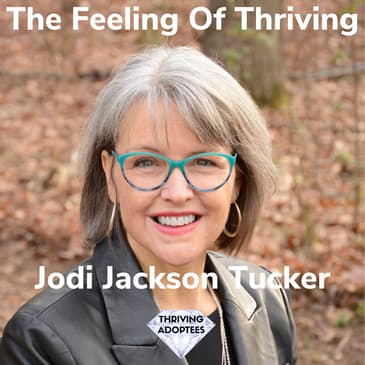
What help us feel that we are thriving? Feeling it. Not thinking it. Not judging it. Feeling it. Listen as Jodi and I dive deep into the feeling of thriving. Insights aplenty on peace, purpose, people and more. You are going to love this...
Jodi loves being a wife to Jerry and mom to her large family of world-changers, including eight children, five adopted. In 2009, as she faced the orphan crisis worldwide, God gave her the dream to unite the women everywhere who love and serve the orphan. She served twelve years as Global Director of Orphan Sunday for the Christian Alliance for Orphans (CAFO), is a seminary graduate and Certified Chaplain. She is the author of three books, including Healing for Every Heart in Adoption, Second Mother: A Bible Study Experience for Foster and Adoptive Moms and Fasten Your Sweet Belt: 10 Things You Need to Know About Older Child Adoption.
https://jodijacksontucker.com/
https://www.facebook.com/jodijacksontucker/
Guests and the host are not (unless mentioned) licensed pscyho-therapists and speak from their own opinion only. Seek qualified advice if you need help.
Want to learn more about thriving for you, your kids, your families or your colleagues? Pick a time to talk here
[00:00:02] Hello everybody, welcome to another episode of The Thriving Adoptees Podcast. Today I'm delighted to be joined by Jodi Jackson Tucker, sometimes known as JJT to a few of her friends. And listeners you're in for a real treat today because Jodi is absolutely lovely, a diamond, like The Thriving Adoptees diamond, a lovely diamond. So welcome to the show Jodi.
[00:00:25] Hey Simon, thank you for having me on your show. I'm very excited and humbled and a little bit nervous. You have a big viewership. I was just telling my husband, you got to be quiet. This man's recording me and he's a big deal. Yeah, we're coming up on 600 episodes. Wow, God bless you. That is awesome. That's a lot of work and faithfulness.
[00:00:55] That is a lot of sticking at it. Yes. Tenacity. Yes. Persistence. Yes. Good stuff. So, ladies and gentlemen, boys and girls, Jodi is a mum to eight. She's got eight kids, five through adoption. Is that right? That is correct. Right.
[00:01:14] And so she is an adoptive mum. She also runs a non-profit called Second Mothers. So, and before that you were at CAFO, which is the Christian Alliance for Orphans.
[00:01:31] So, a huge bank of wisdom to dive into today. So, without further ado, let's dive straight into that. So, what does thriving mean to you, Jodi? What comes to mind when you hear that word?
[00:01:49] You know, I've thought so much about that question, Simon, because honestly, isn't this the struggle of so many people in our world today? We're all trying to thrive. Are we not?
[00:02:03] I think the reason we're talking about this concept about thriving is because the way our society has accelerated and things have gotten faster and faster and faster with technology and the way we all live these days, connected but not connected. I think the basic way that we're created.
[00:02:29] I think the basic way that we've been formed and created to thrive, which is in connection with other people and with nature and fulfilling our purpose. I think a lot of us have strained by the pressures of the world and kind of moved away from thriving. So, you know, thinking about thriving, I have to get up every day and work on that. Yeah. And I really think all of us, all of us do.
[00:02:59] I don't think that's specific in any way to the adoption community. It's the state of our humanity now. We've lost touch with each other. And so we've moved away from what I believe are the things that drive thriving. Yeah. So, so much there, right? So much there. Connected but not connected. And this is clearly all about community for you. That's a big part of what you do.
[00:03:29] Right. I mean, you've got your own community. Eight kids, you know, you've not. Yes, just our family as a community. You know, you can. And now we're all getting married and having kids. So, you know, we walk into a restaurant and it's like, we'd like a table for 15 and three high chairs. And they look at us like we're insane. That's the way it goes. That's the way it goes. Yeah. So, so with 10 of you, you know, eight kids and just you and your husband, that that's not a soccer team.
[00:03:58] So I guess the is there a grandchild that's old enough to kick a football yet? Oh, yes. Okay, right. So you can have a soccer team now, right? You can. Yes, I can. Yes. There's a lot of poor kicking of the ball going on in the backyard at Nana's house. Okay. You're a little. It's still being poorly kicked, but we'll see. You'll see. Um, so how many in an American football team? Like 30 or something, is it? I don't know.
[00:04:26] You know, I don't even know, Simon. And honestly, I'm married to a former football player, but I don't follow it at all. So, yeah. Okay. Back to it then. So you said that you work, work at it every morning. What does that work look like for you, Jodi?
[00:04:45] For me, I have specific habits that I try to do every day to set my mind and my soul at peace. I do not sleep with my phone in my room anymore. And I sleep so well. When I wake up, I briefly look at it just to make sure there's not an emergency text from one of my kids. But then I set it.
[00:05:15] I don't, I don't pick it up. And I get a cup of coffee and I go sit outside. Unless it is freezing cold, I immediately go to fresh air and nature. And if I have to be inside, I sit where I can see trees or the sky. And because I'm a person who tries to follow Jesus, I begin my day with prayer and reading scripture.
[00:05:44] And after that, sometimes I exercise. Otherwise, not enough. But I know that my body was designed to move and be out moving across the earth, not just sitting. I was talking to a gentleman yesterday who was talking about how walking activates both sides of the brain and stimulates creativity.
[00:06:11] So building those things into my day for me, starting my day the right way are so important. If I get up and my feet hit the floor and I'm just rushing and nervous and charging towards the next thing, my whole day feels off. And then, of course, the other thing that we've touched on that you are doing so much excellent work with is connection.
[00:06:39] How am I connecting with other people in a meaningful way? And really thinking about that, I think in today's culture, we have to be very intentional about that. So what happens if we're not intentional? Well, I mean, isolation is the state of all of us in 2025.
[00:07:04] You know, this little device in my hand doesn't really connect me to people. If most of communication is our body language and our eye contact and our tone, you're not getting any of that through a device. You're not getting any of it. Seven percent, I think, of communication is the words that are actually said.
[00:07:30] All the rest is something that can only be experienced in person with an individual. Like we're talking now on Zoom. You live in the UK. I live in the US. We haven't met in person. We like each other. We're connecting over Zoom. But when we meet sometime in the future, and I'm sure we will, because that's my goal in life now, we'll feel much more connected.
[00:07:57] You know, maybe you're taller than I think you are. Or maybe we enjoy each other's company in a different way, or I connect in some way with your wife. It's just a whole different thing to truly be connected. And when we look at thriving in our community, I think this is the thing we just really have to fight for. Yeah.
[00:08:25] Well, I don't think you said before we started, or just now that your husband is an ex-footballer. Ex-American footballer, clearly. I'm not as big as that. There are some smaller ones, smaller guys that do that. I just finished a series on Netflix about the Dallas Cowboys. Oh, my. Oh, my. Oh, my. Don't consume too much American culture, Simon. No.
[00:08:54] It's a slippery slope. Yeah. I mean, it was a good show. I enjoyed it. But it was a lot to do with the personalities and a lot to do with the community that he created. Yeah. The guy, yeah. And then he, then he, then he chucked his, he got rid of, he sacked his, one of his favourite guys who was, who was the, the team manager. Right.
[00:09:22] So he's the owner, the owner, the owner sacked the manager or pushed him out. I can't remember. And, yeah, what a splintering that was of people that had been friends in college in the same football team at college, you know. So anyway, by the by. Next. Broke connections are kind of the opposite of thriving, don't you think? Yeah. Yeah. Yeah. I do. Yeah. They are.
[00:09:51] And as you know, we, I was in Orlando last week and I met three people that I've interviewed. Oh, great. That was, that was, yeah. And wasn't that, didn't that have a deeper feeling of meaning for you meeting them in person? Yeah. Right. The, the meaning. And funnily enough, one of them was smaller than I thought it was going to be.
[00:10:17] So yeah, meaning and, and, and space and not the words you said so that 77, 77% of communication is the words and all the rest are nonverbal things are tone and our body language that can't be understood through a screen. So it's about a feeling. Yes. Yeah.
[00:10:45] So what, what is the feeling of thriving to you? Well. Because you describe actions. Yes. Yes. I mean, I think we were designed as humans by our creator with a soul and with emotions for a reason. It's in our best interest to connect with others.
[00:11:11] Um, you know, a small child wants the warmth and embrace of a family of parents. This is just how we're created. And if we think we can move away from that design and be the best version of ourselves, I, I just think that's foolhardy. Yeah.
[00:11:34] You talk, you talk about embrace and, uh, as soon as you did that, for some reason it, uh, a thought popped up, uh, of, about me and my wife and I, cause I used to, we used to work together. Right. So we met together in work, uh, in work back in, well, yeah, early nineties.
[00:11:58] And, and, and I, and I used to, uh, so there was, there was me, there was my, my wife, my, my, the lady, Linda's now my wife. And there was another woman called Karen and we were kind of a tight team of three of us at work. And I used to bristle slightly when touched.
[00:12:24] And when you said about embrace, I, I thought about that. I thought about that bristling and, uh, and then the creative, my, my, the creative part of my brain can go straight to, okay, so that's something to do with, uh, being touched by a strange body. Right. In infancy. In infancy. Yes. Yeah.
[00:12:52] And, and I think that's one of the challenges when you've got a creative brain is it can go straight to that stuff. Right. So it can, and it can put, you know, I can point my finger. Oh, that's a, that's a trauma response that, but not trauma response. That, that, that's a, that, that's a response. Yes. Being touched by. Yeah. Did you, did you have any, I mean, cause I know.
[00:13:21] You, you adopted older kids, didn't you? Uh, I adopted one infant and it's interesting, uh, that we're talking about this because she struggles with that feeling of being touched. And, um, I do attribute it to her, her very early infancy because she was born, um, as a preemie.
[00:13:47] And she was in the neonatal intensive care unit. And hooked up to a bunch of machines. And I'm there, the lady who's adopting her. And I'm so eager to hold her and rock her and feed her. And back in those days, the, you know, we didn't have the science that we now have around the baby's need for that kind of tactile stimulation. And so the hospital literally told me I was holding her too much.
[00:14:17] And then I needed to put her down and put her back and, you know, just sort of leave her be. So here's this vulnerable little baby, you know, just lying there exposed in this, you know, box, this plastic box in the hospital. And, of course, we know now, we think about it now, she's 30 years old and we think, well, how, how, how ridiculous is that, that we thought that was the way to do it. But we didn't really know the things that we know now.
[00:14:46] And so even in those very infancy, early stages, everything that happens to a child when it's born is so significant and important. We think it isn't, but it is. And, you know, to this day, I have to say to my daughter, you know, can I have a hug? Of course, I want to, I still want to hug her, right? But it's something she's had to overcome a little bit.
[00:15:15] She's married now and she has a son and, you know, obviously she's thriving now. She's doing awesome, but it was hard for her. Yeah. Yeah. As you were describing that story, I just thought, you know, that there was the doctor or the nurses went to a book or produced a calculator and said,
[00:15:40] okay, okay, Jodie, Mrs. Jackson Tucker, you've had four minutes, 20 seconds now. Exactly. How did you know? They would time it. How did they know? Were they there with the stopwatch? Yes. Or was it just they wanted to go on their tea break, coffee break, right? They wanted to go on the coffee break. And you know what?
[00:16:04] Now that you're saying that, Simon, what they would say is like after five minutes, her heart rate is going up or something. But actually, I'm thinking now that was probably a good thing, right? She's responding to being touched, to being rocked, to being cuddled. Like it's just so interesting what we've learned now about human development and attachment that I think all of us in this space, you know, can really heed.
[00:16:34] And of course, now things are different and volunteers go to these places and rock the children when the nurses can't. And, you know, thank goodness we've evolved from that place. So much has changed. But we can't know during early infancy for a lot of adults like my daughter and you and others, you know, it's one of those things that they thought they were doing their best, right? They were doing their best to care. Yeah. Yeah. Yeah.
[00:17:02] And everybody's kind of doing their best, aren't they? Right. All the time. One of the things I find myself talking about quite a lot these days is that it's unfair to judge 20th century parenting on 21st century trauma knowledge. And yet. Wow. That'll preach, Simon. That is good. That is a good word.
[00:17:30] Like that body keeps the score. Yes. We didn't have it. We didn't know. How old do you think that? How long ago do you think that book was published? Well, during my lifetime, you know, I'm 63 years old. And in the last 20 years, I became an adoptive parent 30 years ago with that little NICU baby. I didn't know anything. I didn't know anything. Well, 30 years ago, you're two years after the primal wound is published. Right?
[00:18:01] Nobody gave it to me. I didn't know about it. How? Do not read it, listeners. Right. Or, yeah, don't read it. I don't know how big it was. It was published in 93. I don't know how big it was by 1995, which is clearly 30 years ago. The Body Keeps the Score. That book is just 11 years old now. Right.
[00:18:28] So, you know, I want to go back to the feeling of thriving and that, the feeling, and you talked a lot about your early, your morning, your morning routine. So, what is the feeling that is, or the feeling, the dominant feeling of feelings, what is it that you're getting through the way you start your day?
[00:18:58] I think it centers me. And I would say the feeling of thriving is when you have a sense in your soul that you are operating in your purpose and in peace and harmony with those around you. There's a scripture in Ephesians that's, I think it's in Ephesians, it says, as far as possible, be at peace with all others.
[00:19:27] And, you know, if only we could live by that. And I also think each of us is created for a purpose. And that's Ephesians 2.10. And that's our family scripture because look at you, Simon. I know you haven't had this career or job or purpose or calling on your life all your life, right?
[00:19:52] But you started doing this show and look at all the people who've been impacted by this show. You are operating in your gift and you are operating in your purpose. You are doing the thing, I would say, and we don't know each other very well, but I would say looking at the influence that you have and the number of people who are being impacted, you are operating in the purpose for which God created you.
[00:20:18] And you can feel that and you don't, if you were to go do some other job, be a bank teller or something, your life would feel very different. When we get in that place where we're operating in our purpose, we can feel it. We feel it in our souls and we just know, oh, this is the thing. And if you're really lucky, you know, it happens when you're 18 and you figure out your life's work.
[00:20:44] But for most of us or many of us, it takes a lot longer. For me, I was in the middle of my life before I started really operating in my purpose. But I would never want to go back to that first half of my life because I wasn't doing the things I'm now doing that give me that feeling of thriving. And so I think that's just the journey of this life. Why are we here?
[00:21:12] What were we created to do? And moving towards that. And when you hit it, you'll know it. That's, you know, it just seems that way to me. And I've seen it with some of my kids who really walked into their purpose at an early age. And it's quite beautiful to see it happen.
[00:21:38] And I know we'll probably get to this part of the discussion, but they have defined themselves by their future, not their past. And they have set their identity in positive things rather than negative things.
[00:22:04] And, you know, I struggle with that every day. Every day I have to remind myself who I was created to be and the work I've been given to do and to go do it in faith and courage and, you know, not beat myself up. If I think I haven't done enough or yesterday could have been better. That's not what people remember about us, right? They don't remember the little mistakes.
[00:22:34] My husband's a musician and he'll come down from the stage and he'll say, oh, did you hear that one note that it was off? I said, no, honey, nobody heard that note. And yes, he's a football player and a musician, which is why I married him. It's a very cool combination. It is. Yeah, yeah. And very rare, I would imagine. It's quite rare. That's right. That's that's right. So. So it's the good things that we do in life for others that people remember.
[00:23:06] So we have the have you ever done any? This is a silly question. I don't know. I know the answer to this question, I think, before I answer it, but I've started so I've finished. Right. So have you ever done any marketing? Have you done any marketing education? Any marketing studies? Yes, I worked in marketing before I left the marketing world to go into ministry. Isn't that really weird that I my gut told me to answer that question? You're a very smart guy.
[00:23:34] I'm not surprised at all. You got me figured out. So you've got the you remember the four P's of marketing. Tell me. I can't remember them, but you've given us three P's. I know what you're talking about. Yes. You've given us three P's. Purpose, peace and people. Yes. Purpose, peace. And for the four P's are price, product, place. Yeah. Promotion. Right.
[00:24:04] I didn't like those. I got tired of doing those. I got tired of helping the rich get richer. And with the support of my husband, who was incredibly supportive. I was sitting on our upstairs couch crying one night telling him that I didn't want to do my job anymore. And he said, so quit. And I couldn't believe he was saying it, but he did. And I went in the next day and quit.
[00:24:32] And I'm just so thankful to my husband and to God for that opportunity. And I just walked away from that world. But you've got me peg, Simon. Yes, I was in marketing. Okay. Anyway, well, I was going to ask you about the turning point and you got ahead of me on that. What about when purpose, you know, something, if you were talking about purpose, something popped up for me that it's like purpose is a luxury.
[00:25:02] You know, we're lucky. We're lucky to be able to do what we do kind of full time. What helped you get to that? Yeah. Well, you bring up an important point because many people have to put food on the table, have to do the work that they're in.
[00:25:29] And so I don't mean to be dismissive, like, you know, just go follow your dreams because I understand that's not always possible. But for me, I'll be honest, I was so caught up in the things of the world. I really had to get to a place where I was just too miserable.
[00:25:59] And that isn't good, right? I... What my son, my oldest son, he just received an email that he got a big opportunity to do something international through his work. And he does amazing work in addiction recovery. And I said, he said, should I do this?
[00:26:28] And I said, absolutely, you're going to do that. He said, but, you know, there's this aspect and this aspect. And I said, you know what? That'll get worked out. My philosophy, honey, I'm talking to him, is when God opens the door, you walk through it. You walk through it. And he'll work out the rest. And I realize I'm speaking as a person of faith, but I've just seen it happen over and over again.
[00:26:56] And so in my case, my husband opened the door for me or helped me close it. But I knew there was something more meaningful to the world that I could be doing than helping pharmaceutical executives get better cars. No offense to any pharmaceutical executives listening to this podcast. But so I stayed home for like six months. We went broke.
[00:27:25] My husband quit his job too. We both ended up quitting our jobs. He was in the corporate world also. And we started selling things and liquidating things. And we both made a big life change and started operating in our purpose. And we're just now we feel we're thriving. We were not thriving before. We were surviving. I want to take you back to the feeling of thriving.
[00:27:54] And I want to do that on the back of this very clear statistic that you brought up. Right. In terms of the words. The importance of the words. Seven percent of communication is the words.
[00:28:14] And I'm thinking how much of you talked about body language and things like that and tone. And how much of our communication is in our feeling, is in where we're coming from, the feeling that we're at, the feeling that we're in. Well, and that's where we get into our identity. Right. And how we see ourselves.
[00:28:48] And this is where my faith has really been life changing for me. There's a there's a concept in the Christian faith called the Imago Dei. This is a Latin expression. Have you heard this? You probably have. You're a very learned man. Can you say it again? The Imago Dei. Imago like image. Yeah. Image of God. God. Yes. The image of God.
[00:29:17] And the concept is that the Bible teaches that we are created in the image of God. So we can look at ourselves and we can look at our faults. We can look at how the world looks at us. I'm too skinny. I'm too fat. I'm too short. I'm too tall. I have wrinkles. I have gray hair. You know, I'm describing myself now.
[00:29:45] We can look at our faults. We can think about the one note we played wrong, you know, using my husband's example. But if I remind myself that I'm created in the image of God, well, God is beautiful and loving and all powerful.
[00:30:05] And if I'm his child and I can ground myself in that no matter what I've done, no matter what mistakes I've made, then I can thrive. I can operate in my purpose. And as an adoptive mom, I can't speak for adoptees. And, you know, I wouldn't endeavor to do that. And I would endeavor to do that.
[00:30:25] But as an adoptive mom, that was one thing I just really tried to remind my children of over and over again was you're created in the image of God. And he loves you and he made you for a purpose. And as your parent, I want to support whatever journey you're on to find that purpose.
[00:30:51] And so for our kids, we would, you know, if they're good at cooking, you go to cooking school. And if you love photography, you go to photography school. And whatever gifts, you know, you've been given move in that direction. You're very well-educated, Simon. You're a good thinker. You're a great interviewer. You ask incredibly deep questions. That's a gift. Not everyone's good at that.
[00:31:19] That's a gift that you were given that's uniquely yours. And you're using that gift. And so for me, seeing my adopted children now as adults thrive, it's really been seeing them having the courage and the support to move in that direction and to have that feeling. Yes, I'm operating in my purpose now.
[00:31:46] I'm not following the world's rules, which might have said you'd be better off to be a stockbroker or, you know, who knows what. Yeah. You're moving me to tears, Jodie. That's a good thing. Tell me more. There's just a lot coming out for me on this.
[00:32:09] I think that identity is described in some areas as really complicated. Right. Right. And I just think we've got to bust that complication. Yes. Yes. It's not like it's not complicated.
[00:32:38] It depends. The complication depends on our perspective. Right. Yes. Yes. You know, people say it's complicated. And we believe them. Do you know what? Do you know what? Like it's people say it's simple. Do we believe in that? Like the.
[00:33:09] Have you heard of Richard Rohr? Yes. He's wonderful. Yeah. Have you read The Immortal Diamond? I haven't read that. But I can tell you that Richard Rohr knows that he's a child of God and he's operating in his purpose. Yeah. Yeah. And his book, one of his books is called The Immortal Diamond. Oh. Okay. I need to get that.
[00:33:34] You know, if we, as long as we are trying to create our identity through the world's rules, it will always be too complicated. And the world will never satisfy. It will never satisfy. But you know what the thriving adoptee's logo is? Tell me. A diamond. Oh, yes. That's your. Yes. Well, you all are diamonds. But. We all are. We all are.
[00:34:04] If we can. People say, right. Identity is complex. Right. It depends which level you're looking at identity. Right. So it is the fact you're a diamond. I'm a diamond. Everybody in the world is a diamond. Even Vladimir Putin. He's a diamond. Right. You know, it's not down to personality. And diamonds get covered in stuff. Yes.
[00:34:34] Yeah. Right. It is the suggestion. It is the identity of a child of God. Is that complicated? No. That is not what it is. Okay. So. Carrie. Take. Take us on from. From. From that. Take. You riff on that. With. With me. And. And help.
[00:35:04] Cut through. This. Because you were. And brilliance. Right. Well, let's take. Since your space is. Adoption. Let's take that example. I think part of where. We might go wrong. In adoption. Adoption. Is. Is.
[00:35:33] Focusing. Too much. On. External. Circumstances. As. Identity. And I don't know. If this happens. In the. UK. But. I can tell you. In American culture. Which is completely driven by. Media. An external appearance. Imagine. An adoptee. Coming into a family.
[00:36:02] I don't look like my family. I look different. I sound different. Am I going to identify myself. By my race. Or. Socioeconomics. Am I going to identify myself. By how we live. Am I going to identify myself. By my birth family. Or my adoptive family. This is a huge struggle. Right. Where do I belong. Where do I fit. Who. Who.
[00:36:33] Who are my people. Right. And. Am I going to identify myself. By my achievements. My children. Were. So focused. On their grades. And doing well. And showing the world. How smart. They were. And when my kids. Got to college. They would be so upset. If they got a poor grade. And I would say. Honey. Nobody.
[00:37:02] Will look at your transcript. Once you graduate. No one will ever ask you. In a job interview. What grade. Did you get in biology? Did you get a B minus. Or a C plus. You know. Just get the diploma. That's needed. And so. You know. These examples. Could be endless. Right. How many likes. I get on Instagram. You understand what I'm saying. How many listeners. I get on the podcast. Oh. There we go. Okay.
[00:37:32] True confession. Simon. Good job. Good job. Not enough listeners. Please tell your friends. About the. Well. Same for me. Right. I write books. Why is someone else. Selling more books. Than I'm selling. You know. This is. This. Is what we do. To ourselves. And. We all. To thrive. We have to. Put our identity. In something. Internal.
[00:38:00] All of those things. I just named. Are external. I have children. From. Multiple different races. In my family. But. We didn't. We didn't. Set our identity. In race. For our family. So. We have to. In my case. And I recognize. There may be people. Who don't share my faith. But in my case. In my case.
[00:38:31] It's. It's. So. Overwhelmingly. Evident. To me. That I am. A created being. And that the earth. Was created. And that there is. An intelligent. Creator. Who brought us. All. To life. And. Everything in science. Continues. To support that. The more we learn. In science. The more we see. How were we. We were created. How does the bible begin? We were created. In a garden. To eat fruits. And vegetables.
[00:39:01] And walk around. In the sunshine. All the things. We're now told to do. Right? So. We have to. See ourselves. As a child of God. And. Every day. I have to tell myself. I'm a child of God. My son. Who's going to. Go do this wonderful. International thing. I hope. He is walking. In his purpose. He's overcome. So much. In his life. But now.
[00:39:31] At the age. That he is. He is. He is. Walking. In his purpose. And he's sharing. The message. Of what he's overcome. To bless other people. Why? Because he's not looking at his past. As his identity. If he looked at his past. As his identity. He'd never get out of bed. Much less out of the house. Terrible things were done to him. But. He sees himself now. As a child of God.
[00:40:01] We are not our story. Correct. We're not. We are. The story that was. Meant to be for us. The purpose for which we were created. And we all have one. And. Life will come against us. And terrible things do happen to children. And please. Please. I don't mean in any way. In any way. To minimize that.
[00:40:33] And when I look at people who thrive. And so many adoptees thrive. I mean. You know all the famous. People. Who are adoptees. Who've done extraordinary things in the world. They look to the future. They didn't. They didn't define. Define themselves. By their past. Or by brokenness. Or by something. Hard that happened.
[00:41:02] I had. Some traumatic things happen. In my childhood. If I define myself. By those things. I wouldn't be talking. To you. Because. I wouldn't be doing the work. That I'm doing. Because I. Every day. I would think I'm not good enough. And I still fight that. But I have to tell myself. I'm a child of God. He created me. This is the purpose. He has given me. And the work. He's given me to do. And if I do that.
[00:41:31] I will have that thriving feeling. So. One of the things. That clearly. That you're outlining. Stops us. Having the feeling. Of thriving. Right. It is. Putting our. Putting our. Putting our. Investing our. Identity. In external. Circumstances. Yes. What other things. What other things. Do you. See. As. Obstacles.
[00:42:02] That get in our way. Of. Of thriving. And. And. And the feeling of thriving. I think I'm onto something here. Coming on. Nearly. 600 episodes. For me to really talk about. The feeling of thriving. Rather than just. Edible. The language of it. But don't you know it. When you feel it. Yeah. Right. So that has to be spiritual. Because we're struggling. To even define it. But we know it. When we feel it. Yeah.
[00:42:32] It's a soul feeling. There's a movie. Way back. About these runners. I think they were British. You probably know this movie. And. Charity Sophia. Yes. Thank you. Okay. You know. Sometimes I bring up examples. And I. Every. You know. I work with a lot of young people. And they look at me like. What is she talking about? Charity Sophia. And isn't there a quote. From that movie. Where the.
[00:43:01] The runner says. When I. When I run. I feel the pleasure of God. And I've never forgotten that line. Because. He was in his purpose. He was doing what he was created to do. I can't run like that. You know. And. He had the feeling of thriving. He had that feeling. It's. And maybe that's what it is. The pleasure of God. When we're. When we're operating as God's children.
[00:43:30] And we're doing the work he gave us to do. We feel his pleasure. I just thought that was a beautiful. It is. And I was young when I heard it. And it stuck with me. Yeah. But it stuck with you. But it didn't turn you into a runner. It didn't turn me into a runner. You found your soul feeling. In different. Yes. Spaces. Yeah. Yes. Yeah. I remember doing the first. Like.
[00:43:59] The first kind of athletics thing. At school. You know. Summer. In the summer term. So. It kind of starts in. When it's done. April. Starts in April. And. So. The sport. In the UK. Probably the same in the States. The. The. The sport rotates with the turn. Right. Right. Or semester. Yeah. And. I remember thinking. So we're doing athlete. Athletics. And.
[00:44:28] You can do. You can do 100 meters. Or you can do 200 meters. Or you can do. I don't know. Something else. Long jump or whatever. And I thought. 100 meters. That's. That's not long enough. I'm going to do the 200. And I was absolutely. Knackered. Running the 200. So. It didn't. It didn't make. It didn't make a runner. Out of me. I'm a. I'm a swimmer. Not a runner. 100. And.
[00:44:58] We're coming upon. Time. And. It is. The time of the evening. That I usually. Call my. Mum. So. I'd like to. Ask you. What. You would like to share. With the listeners. Anything you'd like to share. With the listeners. That I've not asked you about. Oh. Wow. That's a lovely question. I would say. If you have. Listeners. In the adoption community. Community.
[00:45:28] The single most. Important thing. That I would. Want to share. Is. For parents. No matter what age. To find community. And for adoptees. No matter what age. To find community. And. To find real connection. You know. Years ago. Simon. We were going through. A hard time. With the. One of our children. In particular. And I was so. Heartbroken.
[00:45:57] And dealing with so many things. And. I thought to myself. If I don't get some people around me. I'm not going to make it. I am. Isolating. And I'm going deeper. And deeper. And deeper. Down this. Well. And. I. I had to get people around me. And so. I asked. Three other couples. If they would. Meet. Once a month. For supper. For.
[00:46:28] Which is. Our evening meal. Dinner. A supper club. And. And we started meeting. They were all adoptive parents. And then our families connected. Our kids connected. And. In February. We will. Observe. Ten years. Of doing this. Ten years. And. I can't. Overestimate. The impact. That it's had. Because people simply don't. Do these things anymore.
[00:46:56] It seems like such an ordinary thing. But. People. Aren't connecting. In those ways. They're not going into each other's homes. Maybe in Europe. More than in America. But in America. We're all inside our. Homes. You know. Talking to each other. On little. Metal boxes. And. So. I guess that would just be one thing. That I would say. Is.
[00:47:25] If you feel you're struggling. If you feel you're not thriving. Sometimes you need other people. To look at you. And say. Jodi. Get over yourself. This is not what you were created for. Go do the thing. You were created for. You need those friends. And that community around you. Yeah. Fantastic. Loved it Jodi. And I hope you loved it too listeners. We will speak to you again very soon. Take care. God bless.