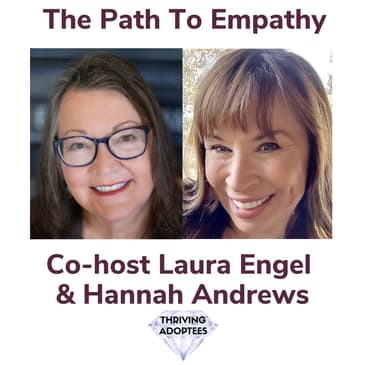
Another episode with a difference courtesy of two ladies with huge hearts. Empathy for others in the adoption constellation is foundational to thriving and communication. Listen in as birth mother Laura and adoptee Hannah explore the path to empathy.
Hannah Andrews was born in Chicago and was adopted as an infant during the Baby Scoop Era. She was raised on a Midwestern farm with two older adoptee brothers. In 2018, a chance meeting with author birthmother Laura Engel sent Hannah in search of her own history. She found more questions than answers, but found guidance and community from fellow triad members. She joined the AKA board to provide that same support to others. Hannah is a writer, pianist & pet enthusiast . She lives in San Diego, CA with her dog Josie and three Pussycats .
https://www.instagram.com/hannahshannonmashup/
https://medium.com/@writingsbyhannahandrews
https://www.facebook.com/profile.php?id=100074619925818
https://www.adoptionknowledge.org/our-board-of-directors.html
Here's a bit about Laura and her book from her website:
My book is about Laura, a woman who lived her life with her secrets finds her greatest secret unearthed at age 67. The child she was forced to give up for adoption when she was 17 in an Unwed Mothers Home in New Orleans unexpectedly sends her an email. Meeting her 49 year-old son rocked her world and cracked her soul wide open. She found the acceptance and love she had always denied herself had been with her all along. My book tells an incredibly sad story but ends with a story of grace, hope, and extraordinary joy.
https://www.facebook.com/lauralengelauthor/
https://www.instagram.com/storytellerlaura/
https://lauralengel.com/books/
Listen to Laura's previous interview here https://thriving-adoptees.simplecast.com/episodes/goodby-shame-with-birth-mother-laura-engel
Guests and the host are not (unless mentioned) licensed pscyho-therapists and speak from their own opinion only. Seek qualified advice if you need help.
Want to learn more about thriving for you, your kids, your families or your colleagues? Pick a time to talk here
[00:00:02] Hello everybody, welcome to another episode of Thriving Adoptees Podcast. Today I'm delighted to be joined by Laura Engel and Hannah Andrews. Welcome to the show ladies. Thank you. So Laura's going to be co-hosting today, right, so she's going to be asking most of the questions. And I might chip in a little bit, but just a couple of words of introduction.
[00:00:27] So, past listeners, people listened in the past might have heard of the name of Laura Engel. She has been on the show, a birth mum from San Diego. And coincidentally, Hannah Andrews is also from San Diego and she's an adoptee.
[00:00:46] And I had this conversation with Laura about co-hosting and she came up with this great title, great theme for today, which is the path to empathy. That's right? Yes.
[00:01:06] The path to empathy. So that's, that's the kind of the, the theme for today, but I'm going to pass it over to Laura and leave it in your capable hands. Thank you. Thank you. It's so good to be here again with you, Simon. And as we talked before, there are so many people that I know that I thought you would really enjoy getting to know. We've talked about that.
[00:01:36] And one of the people that I thought of right away was my friend, Hannah Andrews. And the reason I thought of her, she is an adoptee and I've gotten to know her in the last few years. And we met in a very synchronistic way, I think. And I just want to introduce her right now. First, I'm going to say a little bit about Hannah.
[00:02:00] Hannah. She is a baby scoop era adoptee born in Chicago, adopted and raised on a farm in central Illinois with two older also adopted biological, but biologically related brothers.
[00:02:16] And she began searching for her birth mother in 2018 after a chance encounter with a birth mother author, which was me and her search story brought her to a, to community of adoptees, adopted parents and first parents in which she is now very active.
[00:02:38] She serves as the current president of adoption knowledge affiliates, which provides education and support for the entire adoption and foster consolation. She's also a published essayist. Her work has been featured on stage in print and digital digitally. Most recently, she was awarded publication in the annual 2025 annual gold man review West Coast literary journal.
[00:03:07] And was a runner in wows women on writing creative nonfiction essay contest. She lives and writes in San Diego with her dog, Josie, three resident felines and a revolving crew of foster. That's. And I want to add one quick thing. And she is one of the most gracious, kind women. And I am honored to know her.
[00:03:37] So I'm going to ask you, Hannah, can you tell us about how you got started in this journey that. I feel feel left both of us with a totally different feeling about adoption and first parents, adoptees and gave us empathy for the whole community that we had never really experienced before. Sure.
[00:04:06] Well, I think you said I want to just make one little correction that my brothers were biologically related. We are not. So I did grow up with there were three of us adopted in my family. None of us are biologically related. But as for empathy, that is the absolute perfect word, because I didn't meet you serendipitously. I spent 50 years.
[00:04:35] I had a what we would call a good adoption. Nice brothers, great parents. And I also thought that adoption had no effect on me other than I didn't look like anybody. And I felt a little bit like an alien. But, you know, whatever. And then after I was I had spent my most of my life in the bar nightclub industry. And when I kind of semi retired and moved to San Diego, I started writing again.
[00:05:04] But I was writing fiction. I wasn't writing about adoption because, again, adoption was not a thing. And then one day, just by chance, I went to a convention. I decided to look into memoir. And there was Laura. She was the guest speaker because she had just won a local competition. And they introduced her and said, this woman put a child up for adoption, put her infant up for adoption. She was forced to.
[00:05:33] Many years later, she found her son. And I thought and I had grown up every once in a while, especially back in the 80s. Donahue and those shows would have birth mothers on. But I would just kind of always like click the channel. Hmm. That's whatever. Blah, blah, blah. So I didn't really think that birth mothers were real. I didn't really think that they existed. And if I thought they existed, I didn't think they really cared.
[00:06:03] I thought they were like, OK, here's my baby on with my life, which coincidentally turned out to be the name of Laura's memoir. You'll forget this ever happened because she didn't. And it was just in meeting her. And I didn't even realize it at the time. But that very day, I was like, huh, a birth mother. I guess they do exist. And she was sad and she found her son. I should go find my birth mother.
[00:06:30] I should just go, you know, put a little bow on this, like, you know, get some closure for everyone. And I just didn't even really think that that would be such a big thing. But it was. And it was it was realizing that birth mothers were real, that they existed and not just that they existed, that they were they were. I don't know how to put it into words. They were women. They were people that cared.
[00:06:56] They were not just like these soulless people that handed their babies away. Like I started having empathy for them. I started reading more, studying more like the girls who went away, like that learned more about the baby scoop era, learned eventually that my own birth mother had been in a home for unwed mothers, which I didn't know, which my parents didn't know. And it was just hearing other people's stories.
[00:07:25] And eventually I met other adoptees. And, oh, wow, that sounds like me. And, oh, that didn't happen to me. But, wow, I understand how you feel because it was it was the empathy. And that's that's what stories do. When we tell our story, we connect to other people, other people. You can never walk in someone else's shoes. Not really.
[00:07:52] But you can try them on and get a feel for them and learn so much about yourself, about them, about the world. And that's I don't know. I have a tendency just to cut me off any time. But it really was. It was the empathy. And it also gave me empathy for myself, like for things that I didn't think mattered that really did. So it's just like it completely, completely changed my life. Like her story brought me to my story, brought me to community.
[00:08:22] Like everything is different from that one. That one day. I think it's incredible because, like you just said, when we tell our stories, it's magical. And I I've always been an avid reader. I never realized how much telling our stories really meant. But like you said, you can try on other people's lives. I think maybe readers do that a lot when we're reading. But what really.
[00:08:52] Just got me was when we finally did connect. And you and I talked and you told me that by telling my story, it made such a difference in your life. And I realized the empathy that I had never really had not, you know, purposely. I just didn't know the other side of the story.
[00:09:14] I didn't know the adoptee side of the story, because even though my son and I had connected, he wasn't as forthcoming with with exactly what he had gone through. He was kind of secretive about it. And even though he said, you know, I never hated you or anything, I always thought he would hate me. I don't know if you experienced that thinking your birth mother might hate you for giving you up because he didn't know the circumstances. But he said he never had.
[00:09:44] And that was like magical balm to my soul. That was like, oh, thank God. He never hated me all these years. I worried about that. But when I hear an adoptee like you or Simon or any of the one, the people that I have met, the ones that I have met who have gone through being an adopted person and wondering about their birth mother.
[00:10:08] It it it just fills me with a love that I can't explain that I want to reach out to other adoptees like. Like. Like mothers do care or something like that. I don't know. It's just like you said, I can't put it into words, but it opened up. You opened up a world for me, too. And I read somewhere that when when we have secrets, where in my case it had been such a secret, that secret holds the power over us.
[00:10:37] But when you speak out loud the secret. Or write it down. The words have the power. And that's exactly I think happened right before my very eyes with you. And I know when you did start searching, you have quite a story there, too.
[00:11:03] And can you tell us what exactly happened when you did start your search? Well, I am one of the first things I Googled was birth certificates because I I also didn't quite I knew that I had sealed records somewhere there. My parents were always as upfront and honest as they could be. But, you know, over time, you forget things or you don't know. So I knew there was something sealed away.
[00:11:32] And my mother a couple of times had said, you know, we could write them and see if they would unseal it and find out some medical information. And I was like, eh, not a big deal. But I went and I looked that up that very day. And it turns out I actually looked it up a year before when I was my mother had worked for the state as a teacher. So I had been on Illinois.gov getting some paperwork for her. And I had seen that and I had even printed it out like this is this is my brain going like, no, no. No, you're not ready. No, just tuck that in a drawer.
[00:12:02] So not only did I already know and had forgotten that Illinois had. Opened their birth certificates, so to speak, I had printed out the form, but I had never it had been a year since my mother had passed away and I still hadn't sent it in. And I was like, OK, I'll send that in. So I got my original birth certificate, saw that I had had a name beforehand that I was not just this space alien floating about.
[00:12:27] And and Illinois gives you Illinois when they allowed adult adoptees to have their original birth certificates. They also said, OK, well, we'll give you searchers through the state state appointed people that can dig through the records that you're not allowed to have still and find all this and then see if there's a connection. See if see if those people will make a connection with you.
[00:12:56] So she it took her about a year. She was very nice. But she'd say, OK, I have I have everything here, but I'm having trouble getting in touch with her. I think she might be deceased. And I said, no, I don't think she is. I think you're wrong. Like I can feel her. You're wrong. And alas, she she had died. And she said, but you have a sibling.
[00:13:25] You have a younger sibling, younger half sibling. And I can reach out to that person. It's a you have a half brother and I can reach out and see if they will make contact because I'm not allowed to tell you when your mother died or how your first mother died without his permission. Unless it's something that we deem genetically like important for your medical, you know. And I said, OK, like I actually am the next of kin because I'm the oldest. But OK, whatever, Illinois.
[00:13:55] So she reached out to him and he lived. So I was born in Illinois. Moved eventually, like lived all over, but eventually moved out here to California. And it turns out he lived here in San Diego. So he's 18 years younger than me. You have to fill out all these forms saying like, oh, like, you know, here's a release like we want to meet, blah, blah, blah. We want to talk.
[00:14:23] And when I called him, I said, oh, this number like he's like, oh, I live in I live in San Diego. And I said, I live in San Diego. So we met the next day for lunch. And it was really pleasant. He's a very nice person. It was the first time I'd seen anyone that looked like me. She had she had died about 10 years before. So she died when he was 21, which is pretty devastating. And his father had actually died before he was born in a car accident.
[00:14:52] So he was very he's like, I understand not knowing things like that's so I wanted to make sure that and he had heard about me. But she also had this. She said, I think my mom, I think our mom just kind of partied until it was time for me because she used to run around with like rock stars and all of this. And she was, you know, she's like kind of one of those rocker like, you know, from the issues. I'm with the band, one of those.
[00:15:22] And I said, oh, that's kind of cool, actually. He said, yeah. So but, you know, she's a good mom and she's very bright. Like she worked really hard, but she has this best friend. And that best friend told had told him about me. But I guess she had my mother had looked for me in the 80s, couldn't find me, hired a private detective, couldn't find me because, you know, the names are changed and stuff is sealed away. And she then she got cancer.
[00:15:52] And as she was about to die, she told her best friend, she's like, you tell him that he's got a sister out there in case she ever comes to find him. So then her friend in her grief at the memorial service was like, and you have a sister out there somewhere. So he wasn't even quite sure if it was all real. Um, anyway, I found him. He's a very nice person. We're not super close or anything, but we did meet and I saw pictures and like, and then I met her friend, too.
[00:16:22] And and her friend actually gave me part of my mother's ashes, which is really which was really sweet. So that's very special. So I didn't, you know, it wasn't the reunion that I'd hope for, like it wasn't like, but it was, it was, it was answers and more questions and, you know,
[00:16:43] And I think that's, it's so important because even if a reunion isn't what we expected or hoped for, prayed for, I know how I felt about the reunion with my son. It was like, I always wanted it to happen. It was something that I thought would be the most glorious thing.
[00:17:06] But when it started happening, I was scared to death because I thought, wait a minute, I didn't ever plan what happens after the reunion. I didn't know, you know, okay, now that we've connected, what happens now? Oh my gosh, this big secret has been exposed or has to be exposed now because who is this guy, you know, but in your case, it's a little different.
[00:17:30] But still, I feel like even though you didn't have your mother, at least, you know, who she was from her friend, which is sometimes our friends know us even more than our families. So I'm glad that she was able to let you know about your mother and who she was and how she felt about, you know, the fact that she searched for you had to make a difference in the way you felt.
[00:17:55] Because I think that if you know that, I know my son didn't search for me. I searched for him and when he finally did reach out, he said, I never wanted, I never planned on meeting you. And that was kind of like, it hurtful, but at the same time, honest. And, and it didn't matter anymore anyway, because we had found each other. But I think if he had said, I've been searching for you, it would just make me happier than what he did say.
[00:18:25] But in your case, it had to have been helpful for you to know that. And then to know that you do have a half brother. And whether you're close or not, a lot of us aren't even close to, you know, our brothers that are, you know, biological brothers. So you just know he's there. And that's important. I know that you, you got involved very quickly, which is a good thing with other adoption groups.
[00:18:53] And I was just wondering, were you as surprised as I was at how many groups that were out there and how much support was out there? There were just people out there talking about adoption. And I just couldn't believe it. And I, it's not like I didn't know about the internet. I, you know, I, I know, like I've been on the internet since it was invented.
[00:19:18] Like I, but it, I had never once like Googled like adoption except for, no, even when I, like, when I found the birth certificates, that was just chance. Like, no, I had no idea. And I was very fortunate in that this was 2018, 20, the end of 2018 is when I met you.
[00:19:37] It was the very end of 2019, actually the beginning of 2020, that she called and said, we have verified that your, your birth mother is deceased. And at that same time, I had just found cub concerned United birth parents, and they had a support group here in person in San Diego. So I had gone twice.
[00:19:59] And I'd even said in front of this room full of adoptees and birth mothers, basically, well, they think she might be deceased, but I think they're wrong. And they all kind of looked at me like, honey, okay, all right. And then the next month I was like, yeah, she's deceased. But I got, I think two, two or three sessions in before everything went online, where I got to see people in the flesh, like talking about adoption.
[00:20:27] I'm like, I can't believe y'all just sit around and talk about adoption. Like, this is amazing. Like, I was, and then everything went online, and then I found adoption knowledge. And, and it, the one of the good things about COVID was that when everything did go online, it, it brought some of us closer together that may have never met to, you know, like, all over the world. I agree. I agree. I agree. I agree with that. I agree with that.
[00:20:55] You know, there were so many negatives, but at the same time, there are so many good things that happened to and came from it. The support groups that I never would have connected with. I don't think if I hadn't, you know, been locked in my house, I was blown away, just like you. It's not like I'd never Googled anything. I'd never Googled birth mothers. Never. I just sat in my own world. My own little secret world.
[00:21:24] thinking, you know, I don't know if I thought I was the only one on earth, but we didn't talk about it. It was something that you just don't walk up to other women and say, Hey, are any of you a birth mother or first mother? You know, did you ever have to relinquish your child for adoption? You just don't do that. And then when you would hear somebody was adopted, I would hear some of my friends say, Oh, I don't know how a woman could ever do that.
[00:21:52] And it would always make me feel even a little smaller because I never, never said anything in defense of women like myself. And I thought, as long as I don't say anything, it's, you know, nobody's going to know. And if they know, what will they think of me? So for me, it was just like you, it was just the cub and other birth mother groups. And then from there, when I was writing my book,
[00:22:20] one of my friends, you know, Jennifer Thompson, she was helping me with my website. And she said to me, do you know who your readership will be? And I said, I'm sure it'll be other birth mothers. And she said, I think you're wrong. I think your biggest readership will be adoptees. And I said, really? I honestly was stunned. I said, why? And she said, because they probably want to know
[00:22:49] about their birth mother, or if they haven't found them, you know, you know, they probably have questions. And some of them want to know what an unwed mother's home was like. And she had read parts of my book. And it really, I was so naive about it. I was like, adoptees, and then I even thought,
[00:23:11] or adoptee is going to read the book and be upset with me. That's how much pressure and shame were put on us women that I carried that for what, 50 years, thinking that, and beyond, I still have moments like that. So it's just, it's kind of crazy. But then getting to know other adoptees, I realized
[00:23:35] we're all human. Adoptees had a different kind of grief, a different kind of loss. But the fact that they could be kind to me after what I had done, and see me for who I was, and not just that label, really made a difference in my life. And I feel like you're a great example of
[00:24:01] someone who joined these groups. And in this very short time, you've been become quite a leader in these groups. Really? And you're like my child. I'm very proud of you. It's just, I don't know, but I think it's great what you've done. Tell us a little bit about that, how you got involved with
[00:24:25] the groups. Well, it's kind of funny. There was a woman, Marcy Purcell, who is also an adopted person. And she was at all the support, the online support groups for adoption knowledge. And it's always easier. Maybe this is a woman thing. Maybe it's an adopting thing. Maybe it's just a human thing.
[00:24:51] It's easier to speak up for someone else than for yourselves. Sometimes. So sometimes an adoptee would say something and they'd be like, well, I don't. And I'm like, no, that's your right. That's, you know, I wouldn't necessarily say that for myself. I'd be like, hi, excuse me, could I please have my original birth certificate? And can I please know what my name was before you changed it and locked it away? But for someone else, I'd be like, no, you write that letter because that's
[00:25:20] yours and you deserve it. And so she reached out to me one day and she said, you know, I think I've been with them like a year and a half or so. She said, we're electing new board members. And I just really think that you, you're such a strong voice. Like, I really want you to like, apply to be on the board. And I said, oh, well, is that like an application form? Like, I don't think I want to do that. Like, I don't, I don't do that. I don't fill out forms. Like,
[00:25:46] nope, nope. She's like, yeah, come on, just do it. Like you're really, because it is easier for me. Like, I don't seem shy because once I start talking, I go and go. It is easier for me to speak up for other people than for myself a lot of times. And I think that's probably pretty common for people in general. But, but that's why it was because Marcy pushed me. If she wouldn't have pushed me, I wouldn't have joined the board. And then I started helping out with the education
[00:26:15] committee, which we, we do the book clubs and the speakers, because I, I mean, I read constantly anyway. And once I started reading about adoption, I couldn't stop reading about adoption. And then eventually just this past year, our president had served her term. And I said, well, maybe I could do that. You make it sound like I'm this go-getter and I'm not such a go-getter. I'm just like,
[00:26:44] no, you are, you are, you don't give yourself credit. I think you're not. And I also do not think that everybody is like, I don't think it's a human thing. I think there's certain people who are meant to be leaders and people who are almost like just born to it and people who are the voice for others. And I know that, um, it's a special kind of person that can step up and do that.
[00:27:11] And I've seen you do it. I've watched you do it over the years and, um, I think it's great. I wondered, I wanted to ask you about this. I don't know if we've talked about this before, but did you feel this? Did you feel the shame or secrecy of being an adoptee that a first parent or a birth mother, did you feel that same kind of, I don't know, it's not exactly the same,
[00:27:37] but did you feel uncomfortable that you were an adoptee? You said you had a great childhood and experience. I had really wonderful parents, but yes, absolutely. Um, and especially people knew that there were, there was no secrecy in, in my adoption, you know, but also had my parents tried to keep it a secret, it would not have been because I absolutely did not match at all,
[00:28:04] did not look. And I like, especially as a child, I looked tremendously different than like my, my adoptive mother had like pink skin and freckles and red hair. Um, and my father had brown hair, but like still like, and my, like, I did not like when, when they brought me home, in fact, my middle brother who was seven at the time said, Oh no, she's going to talk Spanish because he didn't,
[00:28:32] because he was a little kid and he was not racist, but he just didn't even think like, Oh no, they brought the wrong baby home. Like, how are we going to understand her? Um, so there, you know, yes, I did not match. I did not match my town. I did not fit in with my family. And that was always like a quiet uncomfortableness. Um, and I have a theory that the shame that is thrust upon the,
[00:29:05] it's not a theory, it's called generational trauma, but, um, I like to, I like to think it's my theory that like the shame that our mothers feel, especially if they are shamed, which many, many were, uh, I'm sure there are some that weren't, but let's just say probably the majority were, and sometimes still are that, that shame like seeps it. Like you share,
[00:29:30] you share everything with your birth mother when you're in the womb. I have this theory that this, that shame just like seeps into you. Like it's, it just, it's in there. It's, it's in the, our DNA. Um, so yeah, I think that's, in fact, I, that was the, one of the essays that I wrote is called the state of grace. And it was about, um, my grandmother was still living. My biological grandmother was still living, but she refused to acknowledge me. She said, I don't remember,
[00:30:01] I don't remember candy being pregnant. And of course she did. I said, you know, she had actually, they had actually fought about it in front of this best friend that I met. And she's like, oh, they used to fight about it. And she's a, she's a wonderful woman. She's just set in her ways. She's product of her time. She's set in her way. And I found out through DNA, actually, that she had placed a child for adoption too. And that her mother had died young. So it's just
[00:30:29] this cycle of like being shamed. I agree with that. The more I learn about that, I can, I can see how that would happen. And if you trace generations, you do see that, you know, that continuation of some type of shame and it must be just passed on somehow, some way. Um, I know that when I,
[00:30:55] I wrote my book and was finally able to talk about my story, I, I felt a lot of that shame released. Um, but like I said earlier, there are moments that I still go through, you know, that I think, how could that have happened? Even though I've written it and I've talked it and I've been in
[00:31:20] support groups and I've heard it from other mothers and, and, you know, intellectually, I know that none of us need to be ashamed or feel unwanted because we're blessed just because we are, just because we're alive. But at the same time, emotionally, I still go through those moments.
[00:31:43] And, and I, I, I feel like, um, I don't give myself credit and I don't think you do either or any of us do for being, for having the courage that we have to speak about it because how deeply it did affect us. But because we put this smile on for the outside world and we're tough, you know, we're the kind of people that are resilient. Um, I think only each other who have lived through this,
[00:32:13] this triad of us, this, and especially the adoptee birth mother thing. I think not only do we help each other to understand, but we make each other even braver and able to talk about it more, able to write about it more. And I know some of your, um, essays have been so, so powerful because they hit at every
[00:32:38] nerve and you do it in either a humorous way or a, um, light way that as you're reading, you don't even really, you have to go back and just kind of go, why am I holding my breath while I'm reading this? So I, I think that's exceptional. Um, and I, I just wondered, um, do you feel like when your word
[00:33:06] goes out there to others, have you felt like, oh my gosh, what have I done? I've exposed myself because I think that's something I felt. Sometimes I will say this, um, full disclosure, uh, Hannah Andrews is not my real name. And I write under a pin name and, and I didn't start because of adoption. I started, started because I was writing about my first husband, um, who,
[00:33:33] who is also deceased. And I just didn't, I didn't think there was any chance his family would stumble on it, but I just didn't want to be disrespectful because it was like a funny, it wasn't a bashing essay, but it was anyway. Um, and then I found it so much easier to be honest. Maybe it's an adoption thing. If I just started with this fake name. So when I do write, I not only change my name,
[00:33:59] I change everyone's name. Um, and I get that there's a dishonesty just in that. And I totally respect people that write under their real names and that they, you know, do those memoirs with all that, but I find it easier and just less stressful to just change everyone's name
[00:34:21] and tell my story. Good. Well, I totally understand that. But when I start with a lie, but I mean, whatever my real name is fake anyway. Right. I know it's not even your name. So no, I do respect that a lot because there are times that I've even thought, well, while I was writing it, I thought, should I use another name? And then I go, by God, I'm going to use my real name.
[00:34:50] And then of course, when it came out, I was like, Oh, what have I done? But it's, I think that's a common thing when a person writes. And especially when I thought like, well, first of all, like my birth mother was written about in a book about a very famous rock band. So she was, her name was already out there. I just didn't know what her name was. But when I wrote about my grandmother, I, I changed
[00:35:15] her name to grace. That is not her name. And I say that in the essay. And she has since passed away, but she didn't want her story told. And I hate that she held that shame and that shame passed on. But it was, it was my way to tell her part of my story and how it affected me and is still,
[00:35:39] in fact, I changed her name to grace to remind myself to give her grace, because I think many of the decisions she made weren't really her decisions to play. She, she was a product of her time too. And she passed on those same, the same lack of decisions she had. She passed on to her daughter, like there's just a lot, there's a lot of layers. Nobody's it's, it's, there's so much gray in that.
[00:36:05] And so I have nothing but empathy for her, even though it hurt very much that she did not want to meet me. Yes. And the fact, the fact that you can, that you can sit there and say, even though she didn't want to see me, that you have empathy for her, you're so wise. One of the most important things I feel is, for me, was telling the story of how women did not have choices. And I lived in
[00:36:34] that time. And I think so many adoptees would say to me, um, is it true? You thought of your son every day? And that really touched me because I did. I still do think of him every day. And I, I wanted to be able to give that to anyone who wondered that after they were adopted, because I do honestly feel
[00:37:02] like the majority, I can't even imagine not thinking about a child once you have a child, no matter what the circumstances were for the adoption. I know you think about that child, whether it be every day or every week, you never forget that child. And, um, I think that's, uh, that was important for me to share that with adoptees as well. I just know that you have been a shining
[00:37:30] star in the adoption community. You've, you've done so much to help and things that you probably don't even realize you've done. Um, you helped me in ways that you don't realize. Um, and you're just a really special person. Um, I think that we probably covered pretty much everything we were going to cover, but if anyone ever wants to reach out to you, do you have a website, Sally?
[00:37:58] Um, I don't, that's okay. Um, I don't have a website. I am on medium under at writings by Hannah Andrews and I am on Facebook under Hannah Andrews. I don't know if there's like an extra and Instagram is at Hannah Shannon mashup. But if you just, if you just like Google, whatever Hannah Andrews,
[00:38:24] you'll find me. And I, and I also do the AKA blog so I can always be reached on that as well. Yes. And if anyone is interested in a fabulous group, the adoption knowledge affiliates is an amazing group. Uh, I think that things, the organization, the things they've done fantastic. I like it so much and it's so supportive in, in every kind of way. Um, and I just think it's
[00:38:54] great that you've met Simon now because you're two of my favorite people. He writes me letters all the time. Signs of love Simon. I know what I have to tell you, Simon, I was in, um, actually on the cub online group the other day. And one of the women, one of the adopted women, I said, Oh, I'm going to be on Simon's show with Laura. And she's, Oh, I always get, I always get notes from him. And, uh, and I said, well, I think probably
[00:39:22] on his mailing list. She said, no, he signs them love Simon. Like she was just playing, but it was so cute. She's like, no, he always signs them love Simon. And they're just for me. What can I say? That's true. He's very special. So, well, thank you so much. So great. Thank you. I really appreciate this. Thank you. Thank you ladies. And thank you listeners. We'll speak to you again very soon. Take care. Bye-bye.