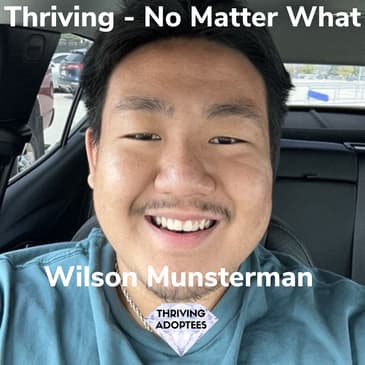
Can we thrive despite what happened in to us? If so how? Listen in as Wilson describes how he turned his life around after some difficult years in his mid-teens. It's an incredibly uplifting interview from the youngest guest we've ever had on the show. Wilson is just 19!
Here's a bit about Wilson..
"Hi! I’m Wilson. I’m a transracial international adoptee with a deep appreciation for history, tradition, and the values that shape us. Growing up, I was always told I was an “old soul,” and honestly, they weren’t wrong. My love for classic country and rock ‘n’ roll records, as well as old Western films, has always made me feel connected to a time before my own.
Being adopted from China and raised in America has given me a unique perspective on identity, belonging, and the legacy we leave behind. I believe in honoring the past while building a better future, and for me, that means leading with hard work, respect, and kindness. I want to be a positive example—not just for adoptees, but for anyone trying to navigate who they are in a world that doesn’t always make it easy.
I have faith that we are more than just where we come from—we are also what we choose to do with the life we’ve been given. I find so much inspiration in the people who came before me, and even more in those who are writing their own stories now."
https://www.facebook.com/wilson.munsterman.3/
https://www.instagram.com/wilsonmuns/?hl=en
https://www.linkedin.com/in/wilson-munsterman-09782732a/
https://www.amazon.com/dp/B0F2ZW5CVK
Guests and the host are not (unless mentioned) licensed pscyho-therapists and speak from their own opinion only. Seek qualified advice if you need help.
Want to learn more about thriving for you, your kids, your families or your colleagues? Pick a time to talk here
[00:00:01] Hello everybody, welcome to another episode of the Thriving Adoptees podcast. Today I'm delighted to be joined by Wilson Munsterman. Looking forward to this conversation today, Wilson, my friend. Yes, I am. Thank you so much for having me on. It's an incredible honour. Honours all mine, right? So Wilson's got to have the coolest name that we've ever had on the show, right? Wilson Munsterman. Munsterman, how do you say it? How do you pronounce it?
[00:00:26] So I was trying to build it on the spot. Okay, cool. And Wilson has incredible wisdom for a lad of just 19, right? He approached me on LinkedIn, I checked him out and I thought, this guy cannot be 19. He has, there's a real depth to the guy, which is great. I think it's going to make for a great conversation today.
[00:00:51] So, so what, you know, when you heard, when you first spotted the, the podcast, Wilson, and you saw this name, Thriving Adoptees, what, what did that bring up for you? What did you think of that? It brought up a lot of hope. You know, I don't know how many of your viewers know kind of what the messages in the adoptees space, but there's a lot of negative kind of connotation with adoption. And a lot of people might hold their adoption in a negative way or a positive way.
[00:01:21] But I just saw the word thriving. And I think that's what the goal is for everyone in the adoption space is to be thriving, whether you had a good or bad experience, let's learn how to live with it and thrive from that experience. And I really related with it because I'm an, I'm an adoptee and I'm thriving right now with my life. And so that really just stuck out. It looks like a really positive thing with adoption.
[00:01:41] And I wanted to reach out and really wonder one kind of where that name came from and then just get to know you because you have, you know, you, I've looked into other podcasts and just, it was incredible to see your platform and you wanting to give others a voice. Yeah. So I'll, I'll answer that and then I'm going to come back to some of the questions for you. Right. So I went on a course on creating courses about four and a half years ago.
[00:02:11] So I read, read, read, it was led by an adoptee in the sense that her stepfather adopted her. A Brit called Sammy, a lady, Sammy Blindell. She just moved to Texas, I think. And so the course idea was thrive. And then the podcast came out of that, the name for the podcast came out of that. Right.
[00:02:38] So she, she was, she was mentoring me at the time and she was the one that suggested to have the podcast and okay, so what, what I'm going to call it. And so I had the name of the course thrive. And then I thought, well, the podcast is going to be called thriving adoptees.
[00:02:55] And it, you talked about giving people voices. So what was clear to me is I had that, I, I had, I knew what I'd learned in terms of what had helped me thrive, but I wanted to explore what, what had helped other people thrive.
[00:03:17] So to fill out the framework, to fill out the thrive course, which I am have now done and I'm now doing. So that does that tie the things together? Yeah, absolutely. It's an incredible story. I mean, just to not only, you know, want to help yourself, you know, but you want to help others and listen to other stories.
[00:03:40] Just, yeah, just that alone kind of checks, checks, checks all the boxes. I'm now even more glad that we've got connected. And Wilson, do you, do you call yourself a transracial adoptee? Is that because people have these different terms, right? But yeah, I mean, to me though, at the end of the day, I'm just adopted, you know, my parents are white and yeah, there were not, there weren't too many, you know, heritage, you know,
[00:04:07] you kind of hear about the how to, how does he balance his culture, but my parents did such a good job with it that I kind of just took a bit more of the, I'm just an adoptee, not so much the transracial part.
[00:04:18] Okay. And the, the, the big, the big thing that you said at the start of the conversation is you talked about hope and negative, negative connotation, negative experiences, but you said it's about thriving, whether you've had a good experience or a bad experience. Oh yeah, absolutely.
[00:04:42] So what's, because most people would say, well, I can't thrive because I've had a negative experience. I mean, they might not put it like that, right? But that's what they might be thinking. Okay. I mean, here's what it is, is that adoption at its base to me is the transferring legal responsibility of a child from one person to another. Now that how person views adoption usually depends on their experience.
[00:05:09] I had a great adoption. So I view it in a positive way. That doesn't mean someone else had a poor adoption experience and doesn't like adoption. Does it make my way the right way or her the way the wrong way? No, they're just experiences. They shape our views. What's important is to realize that adoption isn't going away. It's not going away in the world and it's not going to go away in our lives specifically. I'm not going to wake up tomorrow and not be adopted. I'm not going to wake up 10 years from now and not be adopted.
[00:05:36] So it's how do I live with being adopted? Especially if I've had a negative experience with my adoption, how do I make sense of it? Because our time is limited in the world. And I don't know about you, but I'd rather have something that isn't going to go away. I'd rather probably try to learn, like I said, learn how to live with it and minimize that time feeling bad about it and kind of not dwellings the right word, but thinking about it and focus my time and energy on positive things and other things.
[00:06:06] aspects of life.
[00:06:39] And then I thought, well, and I can't be unadopted. So I'm kind of, I'm stuck with it. Right? So I'm stuck with this. I haven't been aware of the problem because it's been subconscious. It's pre-verbal. I am now aware of the problem and I'm stuck with it. That's kind of what took me down for a bit.
[00:07:02] But luckily I wasn't hanging around in spaces that kind of emphasised that stuckness. I was hanging around in spaces where it was a little bit more about choice and rising above the maybe shit that we've been through or the shit that we're going through.
[00:07:29] And I often think if I'd been hanging around in spaces that had kind of confirmed my stuckness, then I would have been stuck. But luckily I wasn't.
[00:07:45] However, how can, how can we, you're talking about distinguishing between our experience and our view. How can, that doesn't, it doesn't seem logical. Right? At one level.
[00:08:06] Yeah. No, I mean, but that's life. Life, you know, isn't logical. And my thing is, you know, bad things are going to happen. Things that we don't really like, whether it's getting fired from a job, having a relationship and fights, these things happen. And it's all about how do I kind of take a step back, focus on what I can control and make the most of it. Like, like we both said, you know, we can't, we can't change the cards we'll tell in our adoption or we're, we're stuck with it.
[00:08:36] And so my whole thing was, there was a time where, you know, I had it, I had a down space growing up where I didn't think I was anything. I attributed my worth to my birth parents. I thought that I could have found a cure for cancer wouldn't have been enough because I was enough for my birth parents. And, and, you know, growing up with that and having that low self-worth, it's not a fun place. And I think all adoptees can kind of relate to that on some level. But then I realized, like I said, you know, it's not going to go away.
[00:09:04] And that instead of having this thing be a kind of a negative thing in my life, I want to be able to learn how to live with it. So if I start feeling down about myself, I know now that, okay, I'm going to go for a walk. I'm going to call a friend. I'm going to text someone. It's all about how can I minimize my time feeling bad about the situation and focus my time on feeling positive and put my mind on other things.
[00:09:27] Because if, if, if, if I can't change what's happened, the only thing I can focus on then is what my response to that action is. And I'd rather focus on my response being positive, uplifting, helping others, because no magical wands out there to change your adoption. No one's known, there's no magical wishing star that you can, that you're going to wake up and not be adopted. This is all just about how do we make sense of what happened in your story and make the most of it.
[00:09:56] If it means cussing out your birth parents for you to get an edge in life, great. If it means writing them letters, if it means anything, just find some way to move forward. That doesn't mean that it's not going to be, you know, easy and that there's, you know, there's going to be no pain, but it just, it's all about how do I keep moving forward? Because I don't want to get stuck in life.
[00:10:18] Like you, you said that you had those, you know, people around you that helped you overcome and have a higher, you know, higher kind of uplifting mindset instead of getting stuck. Like that's all my goal is. And that's kind of what I did is that's, let's focus on how do we really make sense of it and how do we kind of overcome the situation? Yeah. Can you tell us a bit about the wobbly bit? Yeah. Yeah. Was that, was that the word I did? Did I just make that up or did you say wobbly bit?
[00:10:48] Well, I think you've said it, but now I'm using that. I'm going to steal that now. I like that word. Of course. I don't have a trademark, so. But, so, I mean, we can just start. My story is I was found under doorstep in China. No forms of identification. Ads ran in the paper saying, hey, we have a young baby boy here. Nobody stepped forward. Bounced around the orphanage systems we know, but when, where, how long and what happened to me during this time is unclear.
[00:11:16] We know the paperwork that we have could be faulty still. The, the, the kind of government and what, what kind of happens in China, you know, it's a little, little gray area. It's a little shaky. But I do know at 10 months I was adopted by my parents here. And that wobbly era area in my life was, I really attributed that. If I wasn't good enough for my birth parents, would I be good enough for anybody?
[00:11:39] You know, I'd grow up and I'd hear stories about, from family, about as soon as we looked into that baby's eyes, you know, we knew that we would do anything for her, for him. And the love at first sight. And I just really put that to my self-worth going, okay, well, why didn't my birth mom see this? What was so wrong with me? Was it the way I looked? Did I do something? Was it my fault? What was so wrong about me that I wasn't wanting, that I wasn't kept?
[00:12:08] And to kind of really live with that, I, I, I really just attributed it, like I said, to my worth. And so there were days where I didn't want to do anything. I didn't want to get up because I felt that nothing I would do would be good enough. And how old were you at this time? This was a big time during my middle school and high school life. So around 14, it became really real for me. 14, I'd say, to about 16 or 17.
[00:12:34] And so, yeah, it was all just about that time about kind of just really, I just went over the paperwork multiple times in my head and just kind of kept rethinking about my story. And then kind of one day I got tired of it. I really got tired of it. And I realized that, okay, if I'm feeling this way right now at 16 years old, I got about 60 years left in my life, 67 years. I don't want to feel like this the rest of my life. So it's how do I control what I can control?
[00:13:02] How do I look at my story from a different perspective? And then how do I, after I've helped myself, how can I help others? Because I know I'm not the only one who's felt like that. No, I mean, I'd say it is the theme song of adopting, right? If we have the theme song.
[00:13:24] So where were, what was happening around you in terms of the validation or disvalidation of that belief? What was going on? Who was in your life that was important at that stage? I mean, my parents were always open to talk. They're, you know, they're adopted themselves. So really just a family of adoptees, which is super cool.
[00:13:50] And, you know, they have always left that door open saying, hey, if you want to talk, we can talk. But, you know, I'm a teenage boy. I don't want to talk to my parents about feelings like this. And, you know, I had my pride still with me. So it was a lot of friends. I didn't have a big family. I had an aunt that I would always talk to about, but I didn't have a big family where I felt comfortable enough. So for me, it was my friends. And no matter how awful I felt, no matter how many times I had the I'm not worth anything conversation with them, they were always there.
[00:14:18] And it really just spoke to me as I was talking to this one particular friend one day. And I said maybe for the hundredth time, I'm sorry I'm having this conversation with you. I know it's getting old. I know I'm bugging you with this. And they kind of snapped at me and said, hey, we choose to be here for you. And that really stuck with me because I realized that nobody is friends with people they don't like. I don't know about you, but I don't have friends. I'm not friends with people I don't like.
[00:14:44] And it's the fact that they choose to show up every single day through the hard bits with me and keep being there. That's what I realized was kind of one of the things my adoption gave me. It gave me great friends that chose to be here for me through the thick and the thin. You know, it's the similarities alike of why people come together. But it's how they learn to love the differences for why they stay. And the fact that these people learned to love the differences we had in life. And no, not too many of them were adopted. I have a few.
[00:15:13] But the fact that they were there to empathize with me and want to go and want to ask me, how did this? How does this feel? What can I do for you? And just that caringness they had to want to see me thrive. I mean, I couldn't if I wasn't going to get better for me, then I was going to get better for them. Because as much as that they were putting into my life, I knew that it was my responsibility to put that same effort into my own. Yeah. So were you hiding how you felt from your parents?
[00:15:42] I mean, not too much. There was a little like, you know, we had, I remember a third, fourth grade kind of early spits. I'd be like, oh, you know, what's my story? And kind of a little what happened? And, you know, I remember asking to see the paperwork and stuff. And they're like, if you ever want to talk about what happened, we can. But in my mind, it was what good is talking going to do? It's not going to change it.
[00:16:10] And so, you know, my parents knew how I felt. And they did a great job always leaving that door open. It's just my pride of being a teenage boy. I didn't want to talk to my mom and my dad about my feelings. So you just acted as if everything was normal? Or did they realize that, you know, to what extent did they realize that you were going through some tough stuff? Oh, yeah. They absolutely realized it and stuff. And, you know, I was always really hard on myself. And, you know, I'm a pretty high achiever. I always wanted to be in the best classes. I always wanted to get a straight A.
[00:16:41] And they realized that, okay, well, this is probably isn't all just because he's, you know, hard work. And there's probably some underlying tone to this. And they were quickly to figure that out. But so they've always told me, you know, growing up in life, we don't care what your grades are. We don't care what you do. All we care is that you try your best and you're happy. And they wanted to see the F. Like they wanted just me to be happy and to try my best and stuff. And so it wasn't ever about the result. It was about the kind of just we're happy for you. Like we're here for you.
[00:17:10] We're not going to add any pressure because we know the reason why you're doing it. But it was always that we're always proud of you. We're always giving me extra support, giving me extra love. And it was that unspoken rule. I knew that they knew what was going on with me. And they knew that I knew they knew what was going on. But they didn't try and change it though. It was one of those things where you don't really know how to change it, you know? No, but they didn't know how to.
[00:17:38] They didn't try and change you. They didn't say book up your ideas or therapy or... Completely open book. They offered therapists and they did everything great. They're like, do we need to, do you want to maybe someday go to China? Do you want to talk about it? Do you ever want to, if you ever want to see the paperwork again, you let us know. They were 100% open with you do this experience, you be an adopter, however you feel. Because they kind of went through that. But, you know, they're a little bit older.
[00:18:06] So they are also then from that generation that didn't talk about things. But they just let me kind of handle it however I wanted to. And I always knew that door was open. It was just me going, you know, I don't see really any point of talking about what happened if it's not going to change it. And so that door is... They opened the door, but I'm the one who kind of kept shutting it. Okay. So I haven't picked up on this fact that both your parents... Both your parents are adopted. Both of my parents are adopted, yes.
[00:18:37] So they... I'm just making this up, right? Yeah. In terms of asking a question, right? So I guess they... They knew how you felt. Because to some extent, they felt some of that at some point. So... But they didn't try and kind of make your... So the difference, I would say, to... Into other...
[00:19:05] Into other households, right? They didn't try to... They didn't make your feeling wrong. Yeah. No, they didn't make me feel wrong at all. They didn't make your feeling wrong. So... And maybe that... Because I was thinking about this... I'm getting goosebumps, actually, at the moment, Wilson. That's a good thing. I was thinking about this... A few...
[00:19:34] Kind of a few weeks ago. This... This feeling... If the parents... If the parents are coming from a... Rainbows and unicorns... Perspective on... On adoption... And the adoptee... Is not feeling that... Then... That's the fundamental clash, isn't it? So...
[00:20:03] Parents don't know what's going on for their kid. The kid doesn't know what's going on for him or her. But he or she knows there's a clash... Between... We're not living up to... We're not living up to... What our parents expected... Of us. And... Is that the... Is that the fundamental challenge? Where... If... To sum it up really, really simply...
[00:20:31] They expect us to feel good... But we're actually feeling bad. And there's this clash... And that's why... We feel so... We adoptees... Feel so invalidated... At some point... Because... Parents coming from this perspective... Are expecting us to feel good... And we're feeling bad... And... And... And never the twain shall meet, right? There's this fundamental clash... Between... Our view of the circumstances...
[00:21:01] Does that... Does that track... Is this... Am I making any sense? Yeah, you're making total sense. I... You know... My parents... Your parents didn't do that... Because... Yeah, no. They had an idea... Of what was going on. So they didn't make your feelings wrong? Yeah, no. Not at all. They kind of said... The only wrong way to... Have these feelings... Is to not have them. And that they're like... You have them. Whatever you need... Whatever you want to do... You want to go... Shout...
[00:21:30] You want to go... Smash a bunch of stuff... We'll do it. You need to have these feelings though... Because they went through that. And you know... In that olden days time... You weren't really... Supposed to kind of show... Come on. Olden days, Wilson. I'm going to have to... Call you up on that, right? How old are your parents? In their 40s, right? No, my parents were born... My dad was born at 69... And my mom was born at 65. They're... They're old. Yeah, so... Well, they're just the same age as me, right? I'm in the... In the middle between them. I'm 60... I'm not 60... I was born in 67.
[00:22:00] So I'm just... You know... Yeah. You're right in the middle. But you know... Just that kind of that... Old school kind of time. I mean, you know... Feelings weren't really openly as talked about. And so they're like... Okay. You're not making me old. You're just saying that it's... We had an old... Just kind of like the shift of how, you know... Feelings have been talked about. Old's a mindset. You're... Okay. All right. Thanks, Wilson. Thank you. You let me off the hook. You kind of let me off the hook. Yeah. No.
[00:22:30] Okay. So let's go back to this choice thing then. Let's go back to this choice. This... You're... It's between... You're between the ages of 14, 16. So this is a two or three year period. You're feeling not happy with the world. You're... I guess... It sounds a bit like... It kind of sounds a little bit like depression to me. No. Definitely mental health. So...
[00:23:00] So you talked about your friend and your friend saying... You know, we're here because we like you. We stick with you because we like you. Was that... Was that one of the turning points? Was that the turning point? What other turning points were there? What else was going on? And... And how did... How did this change for you? What did the change look like? I was probably the cherry on top. You know, there were other things building up just with the parent... Parental support.
[00:23:30] I had a great school system behind me that I was able to always kind of talk to my counselors. And my favorite counselor was actually adopted herself. It's kind of cool if you meet someone like... Hey, I'm adopted too. So there was that underlying of like... I'll always be able to go in her office or email her and be like... Hey, having a tough day. And then just having that same conversation over again. I probably had the... I don't think I'm worth anything conversation maybe a million times. Wow. But it was just that fact that I always had people there.
[00:23:58] And so just kind of the buildup of parents support, community support, teacher support... That I realized that, you know, when my friend said that we choose to be here for you... They were right. And it's just... People choose to be there in your life. And, you know, it's... Just having that fact of you having other people root you on more than you do... More than you do yourself at times. It was that if I didn't owe it to myself, I owed it to them to do something.
[00:24:27] Because I didn't want them to feel... To keep seeing me and keep having the same conversation. And so I really realized and said, okay, I'm done. I'm done letting my adoption define me. I'm going to define it. Broke my story down and said, no one could have found... Instead of I was left on a doorstep, it became... Nobody could have found me on that doorstep. I could have died. Instead of nobody stepped forward with the paper, it became... Well, if someone stepped forward with the paper, I wouldn't be here in America having the opportunities.
[00:24:56] Instead of I don't know what happened to me in the orphanage systems. It became, oh my God, those were not great practices. I could have died again. I'm so thankful then to be... To make it out of there. You know, with all the malpractices that were going on. When it became... You know, I wasn't found or my parents didn't want me. It became... The statistical odds of me being in America right now. I had an article with Rewriting Adoption where I said straight up. And I believe it.
[00:25:26] I shouldn't be here. We should not be having this conversation. To have a child to go through my... Do what, you know, my story did. And be halfway across the world now. Graduating from a great high school on one of the best universities in the nation. That shouldn't happen. And so I was really realizing that, oh my God. I have an incredible story. And it's an inspiring one of the baby who made it through all those obstacles.
[00:25:56] And I decided that's going to be my mindset now. That... Not saying that the hard days won't come where I won't feel like anything. But what am I going to do when those happen? When I start feeling down, I'm going to call up a friend. I'm going to start, you know, go on a walk. I'm going to cook something. I'm going to do something that brings me joy. And go buy a record. And it just was that whole mindset shift of how do I look at the positives of what my stories brought me? My story brought me friends, opportunities, family.
[00:26:25] You know, it's just all those things. I said, you know what? I can't change my adoption. I can't change what happened. But I can change the way I look at it. And from that, it just kind of blossomed into this positive outlook. And the big thing is that... So I'm going to bring up the book I wrote. It's called Marked by Adoption. You know, the reason why it's called Marked by Adoption is that I have a... They believe a brand on my side from the orphanage system. It's been warped from just growing.
[00:26:55] But it does have figures that resemble Mandarin dialect. And so I was really marked by Adoption. Not just on a soul level, but there's a physical mark on me. And that I realized that, again, not going to go away. But how I view that mark is all up to me. Instead of thinking, oh, it's a reminder that I wasn't wanted. I'm thinking now, this is a reminder of how lucky I am to be in the situation I am. Let me go out, make the world a better place, help others.
[00:27:24] And help others, you know, help others make the sense of their adoption. And just not them, but help the world. And so that whole shift of just communal support and me kind of getting tired of the story and changing my mindset on it, that's all just what led up to this newfound kind of positive outlook on my adoption. Right. So have you faced much criticism? Yeah, I've faced a little bit.
[00:27:55] And, you know, it's always that saying of when you face, unless you're facing criticism, you know, you're doing something right if you face criticism. And so I understand that. I'm a 19-year-old kid. I'm going to say kid in that aspect because, you know, two years ago I was in high school. So I'm going to say kid. If you have something wrong with a 19-year-old kid writing a book and trying to make the world a better place, that says everything it does about you and nothing about me.
[00:28:23] I used to take those comments I would get or your adoption experience wasn't real or valid because I had a positive one. I used to take those to heart until I realized that's just them not overcoming. Not overcoming, but not. It's just them dealing with their own experience. I used to think, you know, I used to think my way was the highway and then I realized it's not. It's about their experiences and our experiences shape our viewpoints.
[00:28:51] If they don't like adoption, something, I'm pretty sure I would take a guess, caused them or led them to believe that way. And so there's been some negative pushback about, you know, like I said, your adoption isn't, you know, valid. You didn't, you know, you had the support. But I'm like, isn't that the goal though, right? With what you're trying to accomplish and what, you know, a couple of other names I can accomplish, think of in the adoption space. Isn't that the goal is we help adoption become positive? We help adopt people make the sense of it.
[00:29:21] We help them give them a voice. We help them heal. And so it's just really that I've learned that at the end of the day, I'm going to be me. I'm going to do what I can. I know my work and I know what I'm trying to accomplish comes from a place of heart, you know, good place in my heart. And as long as I can tell myself, I can sleep pretty soundly. Yeah. You talked about this top of that segment. You talked about marked on your soul.
[00:29:50] Is that what you said? Can you explain what you mean by that? So, you know, I realized that, you know, a lot of people, not you can tell they're adopted, but a lot of people, you can kind of get a sense. I don't know if you know what I'm talking about here, but it's people who are adopted have certain traits and it's usually pretty high achieving. It's that whole, I wasn't good enough for them. So let me become something great.
[00:30:20] And so it's that whole thing of, I wasn't only marked by adoption, you know, because it's made up who I am. Like, that's what I mean. It's when you're adopted, it kind of shapes how you grow up. It kind of shapes your life. You're dealt with the cards that you didn't pick, but you got to learn how to live with them and play them. And so not only was I marked by those cards, I have a physical mark on my side. And so that's what that whole marked by adoption on my soul, man, is that I had those cards to play,
[00:30:49] but then I also had a physical reminder of what those cards were. Yeah. So what do you think has gotten the way of your thriving over the first 19 years on this planet? I think just that self-actualization and the self-realization, you know, just really, again, I attributed my worth to my birth parents, you know, and that's one of the big things that got my way. I got in my own way. That was it.
[00:31:18] No one else, you know, was telling me in my life, in my story that, you know, you're adopted, you weren't anything. No one ever said that to me. It was me getting in my own way and getting my own head of thinking that I wasn't worth anything. I had all the support, but because I was too, not stubborn, but too stuck in my mindset about not feeling like anything, I think myself, I was the biggest obstacle in myself. Okay. Have you heard me talking about this? Yeah.
[00:31:47] The idea that we can get in our own way. Have you heard me talking about this? Yeah, I've watched a couple of other ones. And, you know, the one that you posted today, I plan on after this, watching that right after. And, you know, it's just all about how, like you said, you gave the, you started the podcast. You can see what worked for other people. And that's what I do. We're all, it's all about how can I keep learning? If I see something that worked for someone else, I'm going to go, okay, I'm going to try that now.
[00:32:12] And so just kind of learning from other people's experiences and learning what worked for them and trying in my own life, because what's the worst thing that can happen if I just try? Yeah. So the getting in our own way thing, I tend to think, I take things very literally. Okay. So can I do that? Can I get in my own way? You know, if I'm on the, we'd call it a pavement, right? You call it a sidewalk.
[00:32:39] You know, if I'm going down the street from north to south, can something get in the way of me? You know, can I actually get in the way of me? But there's only one Simon, right? There's only one Simon. So there isn't another person going in the opposite direction. I'm walking north to south. There isn't somebody coming, another Simon going from south to north, right? Who's actually getting in my own way.
[00:33:07] We use the term all the time. And I use it too, right? But it can't actually be us getting in our own way. We can't get in our own way physically. So what is it that's getting in our own way when we say it metaphorically? Because you don't mean it physically. No, I don't mean it physically. Right. Okay. So there I was listening to this one day. It's something about getting in our own way. And I was thinking about me saying it.
[00:33:36] And I thought, well, it's not me. It's a belief. Right? And it's a belief. And it's a belief that I can't. Right? So let me think of one. I can't help. I can't help other people advocate. Right?
[00:34:04] Because I haven't done enough of it myself. Right? So I was having a conversation with an adopter about advocacy. And I was saying, well, you know, I can't. It's not really in my. It's not really in my space to do it. Okay. To an extent, I'm doing it through the podcast. But I don't really call that proper advocacy. So I can't help other people advocate because I don't really. I haven't learned it myself.
[00:34:33] And then I thought. I was having a conversation with this. And it was another adoptee. He runs a podcast. Shout out to. Damon Davis runs. Who am I really? A adoptee podcast. And I thought. And he called me out on it. Right? He said, you can do this, Simon. I thought. Yeah, I can. I can't do it in.
[00:35:01] I can't do it in the way that I think I need to do it. But I could do it in a different way. Right? I could put a shout out across my email network and say. Right? I think we need to be. I want to be doing some more to support advocacy. Right? Across the adoption space. Would you like to. Would you like to come on? I didn't actually do it that way. Actually. I thought. Right? So I thought. I haven't done enough advocacy.
[00:35:31] So I can't promote. You know. Help others advocate better. But then I thought. Who do I know that could? Who do I know that could? So I put a list down together. Right? Okay. So who do I think could help us advocate. For ourselves as adult adoptees. Who do I think could help us. Help advocate for young adoptees. And who could I come and advocate. Who could I help to advocate for their own adopted kids.
[00:36:01] Right? So I did three webinars. And got those people together. But instead of me saying. Right. This is what I've learned about advocacy. I said. Okay. What have you learned about advocacy? And what would you like to share with the people that are on the webinar. Right? So all I did was. I didn't get in my. There was a belief getting in my own way. And the belief was. I can't encourage other people to become better advocates. Because I haven't done enough of it myself. But then I just looked at it slightly different. I thought. Okay. Well.
[00:36:31] I haven't done it enough. But who do I know that has? So that. We don't get in our own way. It's a belief. It's a belief that we can't. And that's the belief. It's the belief that gets in the way. And then we think. What's wrong about this belief? How can I go around this belief? How can I dismantle this belief? How can I bust this belief?
[00:37:01] You know. If I can't do it that way. What way can I do it? And then I'm not. Neither me or a belief. Is in my way. Yeah. No. That's exactly what it is. It's the same construct. That in the same way we came up with that. That belief that hinders us. We can find a way to overcome that belief. And kind of break that belief down.
[00:37:30] And find another way around it. Yeah. And so. It's just kind of that really important part. Is the same walls that you put up. You can build bridges over. You can knock down the walls. Or you can find a way around them. Yeah. Yeah. So what's been useful for you. In this belief busting. Or belief overcoming. Process. Well I mean. What's my support. I have a mentor named Shannon Bingham. She really.
[00:37:59] She adopted her kid herself. A child herself. And just kind of being able to kind of help. Try and help mentor her kid. And has helped me. Even heal with my own story. Talking with stuff. And through. Talking through stuff with him. And. She. My senior year of high school. Invited me to testify for a resolution. At our state's capital. And there. After I said a lot of I wants. To the senators. I wish I had my support. I wish my parents had support. Parenting isn't easy. You know. It's one of the hard. It's the hardest job in the world.
[00:38:29] Plain and simple. And the fact that. I just wish they had more support. Not only to deal with me as a child. But to deal with me as an adopted child. And so. I said a lot of I wants. In this speech. And after one of the senators. Comes up to me and goes. You said a lot of I wants. That's great. Don't wait for the government. To create change. If you want this change. You go out and do it. You can do it yourself. Like. And she didn't say it as like. Oh. The government doesn't want to do it. She did it as like. All right. You say a lot of I wants. Let's see. It becomes I wills.
[00:38:59] And from that. It's just exploded. You know. Then it's. Became podcasts. It became articles. It became TV. And then. I realized. You know what? I'm kind of repeating myself a lot. And so it's just all about. Helping others. That's what's kind of. Boosted my own thing. Of okay. I've helped myself. It's easy to help ourselves. But the real question is. How can you help other people? And I said. You know what? I'm going to write a book. I want to. So that's. Then I wrote. Marked by adoption. To what I read. It's on Amazon. And it's just a 10.
[00:39:28] Key insights. It's about what I think the world should know about adoption. And it's. It's for adopted parents. To kind of get a quick little insight of how your child may be thinking. It's for adoptees to feel understood. You know. If you don't want to have the conversation with your parents. Maybe you look at the book. You touch. You know. You buy it. And you go. This is how I'm feeling. If it's. You know. I've heard. Birth mothers. Really. Actually. That really surprised me. I didn't expect them to take a light in the book. But a lot of birth mothers have kind of reached out to me. And said.
[00:39:56] It made me not feel guilty about my choice for adoption. Birth mothers get a lot of. You know. Villainization. And. You know. I feel like we cast stones before we were in those shoes. And she said. You know. A lot of birth mothers are kind of scared. You know. You're placing. The child you gave birth to. With another family. You know. There's a lot of fear in that. And they've all. You know. I've gotten messages of like. You've helped me not feel guilty. You've helped me realize that there's hope for my child to turn out like you.
[00:40:25] And have a great life. And it's just. Being able to help others. Coming on a podcast like this. Connecting with people like you. That's what really have driven me even further. Because. I realized that it's. My life has been dominoes. One thing has led up to another. And that. It's just. Realizing that. Okay. Now it's. More. How do I give back? How do I help other people? How do I mentor the younger generation? To do. Not what I'm doing. But in the same sense of. Help yourself.
[00:40:55] Make sure you have your. You know. Ducks in order. Then how do you also help other people find their. Get their ducks in order. So really just. Accomplishing. Feeds kind of like that. Talking with people. And realizing that I can help create change. And help people. Have a positive outlook on their adoption. And their story. Just one conversation at a time. Yeah. Wow. You understand why. I said what I did. Listeners at the top of the conversation. So. Something in what you just said.
[00:41:25] Sounded religious to me. And I. Am I right in thinking. Like. Religion. Religion is important to you. Oh yeah. Absolutely. Can you. Can you share. How. How. How. Why that is. And how it's helped you. Oh yeah. I mean. Like I said. We've covered that. My story. There's a lot of dominoes. That had to fall. To get me to where I'm at. I don't think I should be here. I shouldn't be here. You know. The statistical odds of me being here. Next to none.
[00:41:54] Because the one child policy. Was going on in China. The culture. If you want a healthy male. In China. Was happening. You know. I'm. I'm a healthy male myself right now. Nothing physically wrong with me. The fact that I'm here. Shouldn't be. And so. I was never a religious first guy. You know. I'll admit that right now. But then it was. After that realization of. Oh my God. I shouldn't be here. There's only kind of one. Left thing that could have. Encountered it all. And that's. You know. Jesus Christ. And. What it is.
[00:42:24] Is. I didn't know what I was going to do. My senior year of high school. I didn't know where I was going to go. I know I tried really hard in high school. But that was at the end of the blockade for me. I didn't know. What. Where my life took. All of a sudden. I get asked to testify at this resolution. That goes well. And all of a sudden. Ducks start lining up in order for me. And it could kind of get laid out for me. It was almost like someone said. Organized my life. And said. This is your path. Go. Go not walk it. Run at it.
[00:42:54] Next thing I know. It's articles. It's podcasts. It's connecting with local families about their adoption. It's connecting with people. And. I've always had an old soul. And I never realized how much that's helped me go through life. Connecting. Be able to connect with the older generation. Get their advice. Old people like me. Listeners. Right. That's a joke. I wouldn't say you're old. I wouldn't say you're old. You're still.
[00:43:24] You're still kidding. I'm like. I'm not desperate for it. That I'm asking for it. You know what I mean? I'm not. I'm just joking. I'm just joking. Yeah. Yeah. It was. It was just that whole thing of. Just. That whole. Sense of. Going from in a year and a half. From. I don't know what I'm going to do with. Okay. Now here it is. Because prior to that. I didn't even think about helping other people in adoption. I knew I had mine in order. And that was it. Then all of a sudden it was.
[00:43:53] Don't wait for the government to create change. Go do it. Then senior year of high school. At the end of it. I get offered an incredible scholarship. At Creighton University. Then it was. Okay. Now you're going to go here. And just from that. It's just has been. Something. Higher powered. I believe it's Jesus. Telling me. Here's your path in life. You're going to help others. Go run at it. And just. That quick switch of not knowing what I'm going to do. To having. And accomplishing everything. I mean.
[00:44:24] I don't know. What else it could be. And so it's always been really important. And you know. Having that feeling of. No matter what I do. And. I know I'm saved. You know. The creator will. You know. Knows what my goal is. And my life is. You know. I believe he allows free will. But kind of at the end. Knows what our choices will be. And just kind of resting in the faith. That you know. Praying a lot. That I hope I make the right decision. I hope my heart doesn't ever change. And I want to keep helping people.
[00:44:54] And just having that kind of fallback of. My life has been a movie. You know. I don't feel like it. But you know. It's kind of a weird thing to say. But my life has been a movie. And what's happened in the last two. Two to three years. And just. What else could it be. But. You know. My faith. Having my back. And so. That's kind of really where it's fallen in. Yeah. Into my life. So. If. I'll take it. Take it a really big. Simplification here. Wilson. Right. So.
[00:45:23] We've got the kind of belief stuff. And the psychology stuff. Right. And then we've got the faith stuff. Right. So. How would you. How would you see. The relative importance. Of those two parts. Of your. Life. I mean. Are they. Like 50-50. Is it 80-20. Is that a fast out stupid question to ask. You know. You know. No.
[00:45:53] I mean. I'm a pretty analytical guy. I like to. I like the scientific method. I like that a lot. I like known facts. And so. With psychology. It's important to kind of realize that. Okay. Where's my self-serving bias. Where's. You know. Where's my. You know. Where's my. Heuristics come in. You know. If I'm. Trying to think of something to say. Does it come from a. Quick thing I thought of the other day. Where does it come from. You know. The last time I heard it. And so. It's important. I know. I've taken a couple psychology classes.
[00:46:23] I've dug into that. But. You know. As many books as I can read. As much knowledge I can have. I have yet. To find anything that explains why I'm here. How my life got laid out. To help adoption. And help adoptees. When I never thought of it. And I don't think that that can be learned in psychology. I think it has to be learned. In church. And with faith. And you know. Those things can. It's a lot of those. You know. You don't have to pick one. Those things can live. Coexist. Happily. And that's kind of the.
[00:46:53] Attribute I'm taking. It's. Have that in a political mindset. But also realize that there's an outside force acting in our lives. We. We have the opportunity to make our own decisions. But there's also an outside force. For us. You know. Helping us. And challenging us. And wanting us to be in the way that he wanted us to be. In his image. And in his faith. In the way we treat others. Yeah. That's a great answer. That's a great answer.
[00:47:24] I think I found that the. The faith bit. Kind of. Is more. Is more potent. Than the psychology bit. Say. Yeah. Like. So. What have I not asked you about. That you'd like to. Share. Wilson. I would say my one thing is that. You know. We turn. We turn on the news.
[00:47:53] And we see the world. And it's easily not great news. But the world is good. Us talking. Us having this conversation. 30 years ago. We would have never met each other. Think about that. Like. The way the technology is lined up. It's proof that the world's good. That help is out there. And then if you're struggling. Ask for help. There's no shame in it. And so. I guess my thing would be. My last. I guess two cents would be. Helps out there. Find your community. The world's good.
[00:48:23] And. Once you. Have. Found your peace. And you have made sense. See if you can help others. Find your peace. Because if we all help each other. The world would be a lot kinder place. If we can all think about others. First. Before ourselves. The world would be much. Nicer. And it's just that. Like you know. I. I have a really optimistic mindset. You know. Sometimes it's. Sometimes it's a blessing. Sometimes it's a curse. But it's the mindset I have. And it's just. At the end of the day.
[00:48:52] The world's good. And. If you need help. If you need a lending hand. Some will be there to. Pick you up. Yeah. Wow. Thanks Wilson. Absolutely. Incredible mate. Incredible. And thanks listeners. We'll speak to you again very soon. Take care. Bye bye.