If we want adoptees to thrive, adoptive parents and birth parents all need to thrive. Listen in as we dive into thriving across the adoption triad. And how openness helps us thrive.
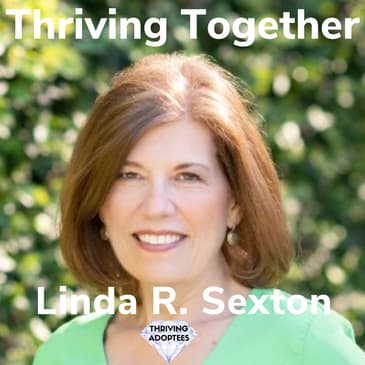
Adoptive mother Linda R. Sexton is an open adoption pioneer who seeks to educate on today’s practice of open adoption where the biological parents and adoptive families know each other and remain in contact after the adoption is finalized.
https://www.facebook.com/lindarsextonauthor#
https://www.instagram.com/lindarsextonauthor/
Guests and the host are not (unless mentioned) licensed pscyho-therapists and speak from their own opinion only. Seek qualified advice if you need help.
Want to learn more about thriving for you, your kids, your families or your colleagues? Pick a time to talk here
[00:00:02] Hello everybody, welcome to another episode of the Thriving Adoptees podcast. Today I'm delighted to be joined by Linda Sexton from Florida. Looking forward to our conversation today. Thank you Simon, thank you for having me. I'm just thrilled to be here today. And we've just been talking about adoption in Florida and conferences that are going on right, so hopefully in October Linda and I will be meeting at the Families Rising Conference. Fingers crossed right?
[00:00:31] Fingers crossed. Fingers crossed. And so this is a shout out to other listeners out there if you're in Florida or somewhere near Florida and you're interested in looking at a conference. This Families Rising is a conference for adopted parents and adoption professionals in Orlando. It's the first week in October. So, and I'd love to meet you there.
[00:00:59] Yeah, listeners, right? Real people, real people in real time. So to the podcast, Linda, what does thriving mean to you? Thriving. Well, first of all, Simon, I love the name of your podcast, Thriving Adoptees, because it is so positive.
[00:01:20] And it really speaks to the fact that you can get to that spot of adoptees thriving. And as I was thinking about this, it's so important that the adoptee, I'm an adoptive mom, and it's so important that the adoptee is the North Star of the adoption arrangement, if you will.
[00:01:47] And I think the best way for adoptees to thrive is if there's a great foundation where the adoptive parents are thriving in the adoption space, as well as the birth parents thriving in the adoption space.
[00:02:04] And I think that if you can get that formula where all three parts of the triad are thriving, then that child or the adopted person has a much better chance of thriving. Yes, and I totally agree with you, right? And for reference listeners, Linda adopted your two kids like three decades ago, right?
[00:02:33] They're in the late 20s, if I remember rightly. Yes, that's correct. My oldest, Finley, is 30 years old right now, and Sophie is 26. And we started our adoption process 33 years ago. And during that time, adoptions were predominantly closed and secretive, if you will. And we were one of the first to really be involved in open adoptions.
[00:03:01] And that was something that has served us so well throughout our lives. However, I will say that it was not easy. And I could have used a lot of training going into it that I didn't get and wasn't available at the time.
[00:03:21] So one of the reasons as an adoptive mom that I'm so passionate about this subject is because I don't want other adoptive parents going into the situation, really not being prepared to understand what it means to be an adoptive parent and how different that is than parenting somebody you gave birth to.
[00:03:45] Yeah. And I love the North Star idea, arranging ourselves around the kid and the child. And the truth, right? So for the adoptee to thrive, the parents have to be thriving.
[00:04:07] And if we can help the birth parents thrive as well, I'd go a step further that the adoption professionals, the professionals that are supporting the adopted parents, they need to be thriving too, right? So it's all a big kind of thriving fest, right? Or love fest, right?
[00:04:30] Right. So we have listeners to the show that are adoptees, we have listeners to the show that are adopted parents. Were there any birth parents listening to the show? I don't know. So maybe some adoption professionals. What I really like to drill down on, to focus on is what helps you thrive as an individual, as a human being,
[00:04:58] and clearly as a parent, so that we're talking about what helps human beings thrive. And therefore the message that we're talking about, the content that we're sharing is relevant to whoever's listening. Yes. So what does thriving mean to you from your own personal perspective?
[00:05:25] Yeah. I think from my own personal point of view, thriving is when you have the opportunity to work or to give back or to do something that you're passionate about. And I feel like actually the subject of adoption and open adoption specifically is something that I have been passionate about for many years.
[00:05:53] And now actually as a retiree, I have this wonderful opportunity to give back to that community and help people coming after me understand the importance of open adoption. I have, I think about what we did really well and what we could have done better.
[00:06:16] And just the opportunity to share that, you know, that 30 years of experience with people that are either working in the adoption space or part of the adoption constellation really actually helps me thrive. And the other thing that helps me thrive is watching my children thrive. Like any parent, when your kids thrive, you thrive.
[00:06:42] If your kids aren't thriving or if they're faltering or they're having a hard time, you as a parent feel that very much. So allowing your kids to thrive really helps me thrive as a person. So what does giving back give you?
[00:07:05] Well, giving back gives me a sense of purpose and it just gives me a lot of satisfaction to help others and to help others raise adoptees so that they can thrive. And I think that, you know, the most important thing is when I sat back and I wrote a book about my experience of open adoption and I learned so much when I did research.
[00:07:32] And one of the things that I learned is that at the very beginning of any adoption, it actually begins with loss for all three members of the triad. And it was very intuitive and obvious to me that the birth parents were going to lose the ability to raise their child and that there was going to be a lot of grief around that. And I did I did focus on that and I understood that very well.
[00:08:01] But what I didn't know and understand 33 years ago was that the child also has a huge loss when they don't have the ability to grow up with their biological family. And and at least at first, I didn't focus on a loss for the child. I thought, oh, I'm going to give this child a wonderful upbringing and a wonderful life. And I focused on the positive for the child, not recognizing that they had a loss.
[00:08:30] And then the other thing that I learned is, wait a minute, I have a loss to coming into this. Like many adoptive parents, we have experienced infertility and there's a loss associated with that. And that's something that if if it can be acknowledged that all three have a loss, that is really a foundation for healing.
[00:08:57] And what I found is that you can develop some really incredible relationships and healing through all of this. But you've got to come through the grief and you've got to recognize the grief for yourself as well as the others in the triad. Yeah. So what what gets what or what got you through the grief?
[00:09:17] I have to say that, honestly, I don't feel like I got through it until I really focused on it as I was writing my book and doing the research. And one of the wonderful things is it caused me to sit down and interview everybody that was part of my own adoption constellation.
[00:09:41] So in our case, I was able to interview not only my children, Finley and Sophie, and have conversations that perhaps we didn't have while they were growing up. But I also interviewed all four birth parents and I learned so much about them during that interview. But it strengthened my relationship with them as well.
[00:10:08] So I think that I didn't really recognize or think about my own grief until much later. And it was through my research and working on giving back through writing a book that helped me get through my own. Yeah. Yeah. So when we get near this topic of the stuff that we haven't realized, I always think of that of a quote I heard in a training years ago.
[00:10:37] And it was from a Swiss therapist guy called Carl Jung. He said, until we make the subconscious conscious, it will rule our life and we will call it fate. What is in our subconscious that we haven't brought out of the shadows and into the light to look at before. That drives us, right?
[00:11:07] That's what he's saying. The stuff that is secret, the stuff that we haven't seen yet. Yes. The stuff that is what's pulling the levers behind the behind the. Is it the ghost in the machine? You know, it's pulling the levers behind behind behind behind us. Behind. We can't see that. We can't see what's going on for us. Yeah.
[00:11:35] And, you know, one of the things what I'm so passionate about is talking to people about open adoption. Yeah. Because if open adoption is done well, there are many secrets, so many secrets that are out in the open that don't have to be secrets. Right. Yeah. So it really starts you off on a footing that and a foundation that is so it can be so healthy, if you will.
[00:12:03] Not easy, not automatic, but it can really be helpful. And I'm so passionate about open adoption because I remember going into it how scary the thought was to say, well, I'm going to make a commitment to keep the birth families in our lives throughout my children's growing up period. And you think to yourself, what am I getting myself into? Are the birth parents going to want too much of the time, too much effort?
[00:12:31] Is my child going to prefer birth mom over me? There's all of these things that go through your mind. But if you really commit to open adoption and transparency and openness and honesty and talking about things the way they are, that you don't have things locked back in your subconscious, if you will. They are out there from the very beginning.
[00:12:59] And that's why I think I know most adoptions today are open to some degree, some more than others. We happen to have a very open adoption where, like I mentioned today, we know all four birth parents. And it just gives me so much joy that both of my children can and do communicate with their birth mom and their birth dad kind of on their own without my intervention.
[00:13:27] And that's a wonderful place for them to be. But just the idea of openness and transparency is what I'm so passionate about. You talked about that initially feeling scary to you. Yes. So what was it? What have you learned about those fears and navigating the... What have you learned about yourself?
[00:13:58] Yes. Navigating those challenges. Yeah. You know, it's... The idea of a birth mom and a birth dad coming to your home and visiting the baby, the toddler, the child as they grow. You... I remember thinking, how are they going to feel? How are they going to deal with this? Are they going to want the child back?
[00:14:25] And what I found was visitation in and of itself, the event was a really happy place for all of us. And the child loved seeing the birth mom and the birth dad. And we enjoyed the visit with each other. And the thing that was so poignant to me is that I recognized how grateful we were to each other.
[00:14:56] So as birth mom and birth dad came into our home, they expressed gratitude towards me and my husband. And we expressed gratitude to them. And it wasn't about any kind of competition. It was the North Star. It was about the love for this child, the North Star, and how grateful we were for each other.
[00:15:24] And that doesn't say that it was easy, right? But I didn't quite expect that, that that's what would come out of the visits. But for me, that's what came out, this overwhelming gratitude and even affirmation that they were affirming. I think I made the right decision. I'm so happy to see my child here with you. And I got affirmation from them, something that I never expected to get.
[00:15:54] And this was so initially it felt scary. Yes. Yeah. So what would you say to adoptive parents there who are scared of this stuff? Yeah.
[00:16:14] What I would say to adoptive parents comes back to what is going to be best for this child. And you need to think about as that child grows, not just a baby, but you need to imagine that this child is going to grow into a toddler, a child, and eventually a teen and an adult.
[00:16:42] And as that child develops their identity, if they do not have knowledge of their biological family, it can be a huge void, particularly as a teen. And it will help them tremendously to have that void filled and those questions answered.
[00:17:06] And that gives them the best opportunity to really grow up whole by knowing their identity on both sides. And it's not perfect. And it's not easy. But boy, it gives them a leg up in life. So if you're going to be an adoptive parent, you naturally will want to do what's best for your child.
[00:17:31] And if you can have that kind of relationship, that's going to be best for your child. And the other thing that I will say is that I recognize that sometimes the birth parents are not available to you for a myriad of reasons. If that's the case, there's probably somebody in that biological family that is available, whether it's a birth grandmother, an aunt, an uncle, a sibling.
[00:18:00] And if you can develop a relationship with them, that can help your child tremendously. So it doesn't just have to be the birth parent if there's lots of reasons why that might not be very stable for you. But there is somebody. And so it's work. You need to reach out and try to find the right person in that biological family so that your child can stay connected to their family.
[00:18:27] So it sounds like it's about creativity. From one perspective, it's looking about creativity and persistence. And also, but more fundamentally, it seems to me to be putting the focus, putting the love, putting on, sorry, I'm struggling to put it into it.
[00:18:57] Putting what's best for the child above your own fears. Yes. Yes. What is best for the child? And the truth of the matter is, I think people need professional support to help them do that. And certainly in my time, there was no professional support for myself, for my husband, or for the birth parents.
[00:19:26] And we kind of learned about this as we went. And we were fortunate that we could talk to each other. And we had instincts, I think, that served the children very well. But these things can get really tricky. And I think it's in order to put the child first, you need to learn and you need to seek professional help yourself.
[00:19:52] And I did find that both of my children, by the time they got to be teenagers, they needed some professional help and therapy. And I was able to get them some therapists. But in that time, I found that the therapists were not adoption competent. And unfortunately, I didn't know enough to say, I've got to seek out a therapist that is adoption competent.
[00:20:20] When I said to the therapist, well, you know, this child is adopted, they would say, yeah, but that probably doesn't have anything to do with what we're dealing with here. And they were wrong about that. So it wasn't until my kids got into college that we got adoption competent therapists. So I think in order to do it, get a therapist and make sure they're adoption competent early on. But, you know, don't kid yourself. You're probably going to need professional help. Yeah.
[00:20:50] One of the truisms that we keep on coming back to, and I always drop it in when we get anything onto this subject, in case the listeners are new to the show and they haven't heard me say this before, that if you're adopting a child or you have adopted a child as a baby, that the child has no, that loss happened before the child had words.
[00:21:19] So the loss is pre-verbal, right? They can't put it into words. And for that reason, talk therapy is not the way to go with pre-verbal loss, with relinquishment loss. It just doesn't work. However, a lot of therapists don't see that.
[00:21:50] They come from a position where they've got a potential client. They want to help that potential client. And their passion to help somebody will often overlook, overall, their ability. They'll think that they can do something.
[00:22:08] But pre-verbal trauma and can't heal pre-verbal trauma with talk therapy because the adoptee doesn't have any words or memory of that loss. So we're barking up the wrong tree with traditional talk therapy.
[00:22:28] And now that I've come through it after 30 years, I really believe in that concept of the primal wound and the pre-verbal loss. Again, I didn't know about this at the time that I adopted my babies.
[00:22:44] But looking back, I can see so many things that could have potentially stemmed from the fact that they had trauma when they were separated from their birth mother at birth.
[00:23:00] And, you know, things like anger that comes out in ways that are not consistent with whatever event caused them to be angry or inability to connect and attach or difficulty attaching. I don't want to say inability, but difficulty in attaching those kinds of things. And, you know, fear of abandonment in ways that seem unreasonable.
[00:23:31] And again, looking back on my children, I see some of those signs, but didn't understand them at the time. Well, Finley was born in what? 1995, right? Yeah, 94. 94, right. Yep, and Sophie 98. Yeah. Well, the primal wound book had only been published in 1993, right? Yes, yes. And actually, I didn't even read that book until Finley was in college.
[00:23:59] And an adoption-confident therapist gave that book to Finley, who gave it to me. And I was like, wow, I didn't even know this. So... Well, I didn't read it until I was in my mid-40s. Yeah. Yeah. Lots of resources available today that were not available 30 years ago. Yeah. One of the challenges for me with the primal wound is it's very...
[00:24:30] It's about our psychology rather than our essence. Yeah. Who we are underneath our psychology. Yeah. Yeah. Perhaps a different conversation. So what did Finley make of it then? Well, Finley's reaction was, wow, now I understand myself so much better. Now I understand some of my feelings.
[00:24:58] And it was interesting that Finley shared that concept in that book of the primal wound with Sophie. And when Sophie, when Finley told Sophie about it, Sophie absolutely rejected it. Sophie said, that is crazy. There is no way that, you know, I've had a wonderful upbringing and I feel really good and I feel stable. And you can't tell me that I had trauma as a child, et cetera.
[00:25:28] Finley has actually now come to understand things a little bit better. But it was interesting that, I'm sorry, Sophie has come to understand it better. But Finley's reaction was, wow, I get it. I see myself. And Sophie rejected it immediately. But, you know, it's not an easy thing to hear the first time. No. I don't think there is one primal wound. I think it is a spectrum.
[00:25:57] Yes, I agree. I agree. And I think that both of my children have different reactions and to a different degree. I think they experienced the primal wound very differently. And one, I think it was more severe than the other. And I can see that now. And I can understand maybe some of the reasons what was going on psychologically with birth mom, et cetera.
[00:26:27] It's complicated. Every adoption situation is complicated no matter what. And so is the reaction to that trauma and separation of birth. What other resources have you found useful? Well, I think so. I will say that when I wrote my book, and I will say it's called The Branches We Cherish, an open adoption memoir.
[00:26:53] I wanted to give back all author profits to organizations that provide support and therapy to birth parents and adopted persons. And the organizations that I found, first of all, for birth parents, there's a couple of them. One is called On Your Feet Foundation. And they do a fabulous job of helping birth parents get on their feet. They have lots of communities.
[00:27:22] And they've got Zoom calls, et cetera, where birth parents can get together on Zoom calls on your feet. They're out of Evanston, Illinois, I believe. But so much of the work they do is virtual. Another organization is called Brave Love. And Brave Love does help, gives a platform, if you will, for birth parents to tell their story.
[00:27:48] And in fact, Sophie's birth father, Ricky, told his story and Brave Love published it. And that really helped him heal. And then there's the third organization called Boston Post Adoption Resources. And they have a dozen adoption competent therapists. And they work only in the adoption constellation.
[00:28:13] So it's a wonderful group of therapists that really know what they're doing when they deal with adoptees. So those are organizations that I target to give any of the book profits to. Yeah. Yeah. So you mentioned the word healing there. What does healing mean to you, Linda?
[00:28:34] In this context, I think healing means the ability to go through the stages of grief and come out on the other side with acceptance of where you are and an ability to thrive.
[00:28:56] I do not think it means that you're healed and it's done with and you forget about it. I don't think that kind of healing is there for the adoption constellation, if you will. I feel like it's the acceptance and understanding. And again, if there is forgiveness or anything like that that comes through.
[00:29:23] But your ability to accept, to love the people that are closest to you and to thrive in your own way. I think that's really what healing is in this context. Thanks. Sorry, I forgot to mention, you mentioned Brave Love. We've had the director of Brave Love on the podcast before. Okay, good. Janelle Bassam.
[00:29:50] So I'm going to link, I'll link to that episode in the show notes because we've got so many episodes of this, of Thriving Doctor's podcast, it can be tricky to navigate it. So I will put a link to the Brave Love, to the interview. The Brave Love, awesome. In the show notes.
[00:30:14] You talked about Ricky sharing his story through Brave Love and that having a healing effect on him. Why do you think that is? What do you think it did for Ricky? Have you got a clue for that? Yeah, that's a very good question. And by the way, Ricky, of the four birth parents, Ricky is the one that is thriving the most and is most healed, if you will.
[00:30:42] And I think that what helped Ricky so much was a couple of things. First of all, he had a family that was very, very supportive of him, particularly a very strong mother who was very engaged in the whole process and brought the whole family in. So he was surrounded with love from his own family, if you will.
[00:31:08] And then when he reached out to Brave Love, he wrote his story. He talked about his story. And I think that can be very cathartic because when something hurts so badly, it's, you know, the first thing you want to do is to bury it. And Ricky didn't bury it. He wrote about it and he shared it with people.
[00:31:35] And he did things like when he went off to college, he would if he would date anybody, he would say, I'm a birth father. And he would always acknowledge to himself and to others that were important to him, that this was something that was really important in his life.
[00:31:57] And I think that just the ability to talk, to write is very cathartic and can be very healing. Yeah. And he did that early on. Yeah. And I guess the next question that comes from that was writing your book, was that cathartic for you? Oh, writing my book was really cathartic for me.
[00:32:21] I mean, I actually didn't know how much I had to learn and to even grieve myself over what I was learning and what I didn't know. And, you know, then you go through, gosh, if I had known this, then I would have done things differently, et cetera, et cetera. And that caused me to grieve about things.
[00:32:44] So I do find that for me personally, writing about it and interviewing everybody and connecting, again, bringing us all together was just so healing and cathartic for me. So one of the best things that I could have done for myself and frankly, for my family, because it caused my children to think about things that perhaps we hadn't talked about before as well. Yeah.
[00:33:14] So it was about togetherness and about communication and about clarity and about openness. That's, but there's a bit of magic as well that you can't quite put into words though, I think, with this healing stuff. Yes, I think that's, I think that's right. I think that's right.
[00:33:38] It's, it's connecting, it's connecting in, in ways that you say, you feel like, I understand your hurt and your loss and I'm here for you. And we're all part of this together.
[00:34:03] And you honor, you honor the parts of your child that come from both the adoptive family and the biological family. And when you can honor all of that together, it's, it's healing.
[00:34:25] It's when you see your child do things or be interested in things that, you know, don't come from you at all. And then you recognize where they came from. Oh, I think that one came from your birth mom or your birth dad. And you see, and you make those connections. There's, there's kind of magic there that it's, and, and you honor it.
[00:34:50] It's like, that's really cool that you can be, you, you're part of me and you're part of them equally. It's, it's that whole nature versus nurture. And you can't say one is so much more important than the other. They're both, they're both there.
[00:35:12] And if, if, if one's missing, like if, if the nature part is missing and all you have is the nurture part, it's a big void. So when you, when you see it, when you see it coming together, it's just, it's just magic. Yeah, it is. Well, it seems it. Is there anything that you'd like to share that I've not asked you about?
[00:35:40] Well, I think, I think the most important thing, and maybe I've, I've said it in, in, in other words, but the spirit of openness and transparency is so important.
[00:35:58] If you're going to be part, if you're going to be an adoptive parent, and again, whether or not you know and can see and feel and touch and visit with birth mom and birth dad, it's wonderful if you can do that.
[00:36:14] But if that's not, but if that's not available to you, the connections, whether it's about heritage or other people in the family, just honoring all parts of who that child is, is, is just so very important and being open and transparent. And it just makes the world a difference. And if you're comfortable with it, your child will be comfortable with it.
[00:36:42] If you're uncomfortable with it, your child's going to be uncomfortable with it. So how you handle that transparency and openness will mean everything in the future. Thanks a lot, Linda. It's been great. Thank you. Thank you, listeners. We'll speak to you again very soon. Take care. Bye-bye.