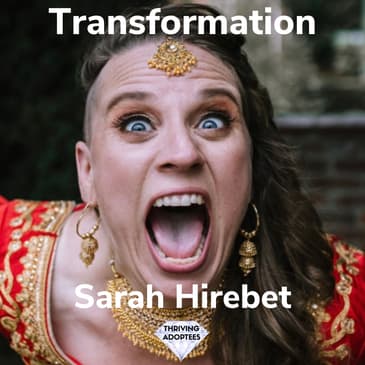
Some moments on healing journeys are HUGE - Transformational. They don't come any bigger than what Sarah experienced during labour. Listen in as she shares her lessons from this transformational moment and beyond.
Guests and the host are not (unless mentioned) licensed pscyho-therapists and speak from their own opinion only. Seek qualified advice if you need help.
Want to learn more about thriving for you, your kids, your families or your colleagues? Pick a time to talk here
[00:00:00] Hello everybody welcome to another episode of the Thriving Adoptees podcast. Today I'm delighted to be joined by Sarah. Now can I get this right? Sarah, hear a bit.
[00:00:14] You got it perfectly.
[00:00:15] Yeah, cool. Thank you for your patience on that. So Sarah, healing the trillion dollar question. What does healing mean?
[00:00:30] What does it mean? I thought about this quite a bit and I feel like there are two really big components that are part of my life probably on a daily basis.
[00:00:44] Kind of the first one is this idea of deconstruction and taking apart the narrative that I've been fed and that I've spent my whole life believing but that which this narrative has been built on a lie.
[00:01:05] Yeah. A giant untruth and what does it mean to me to take that apart and bring truth back into my life? So I'd like to spend some time talking about that.
[00:01:18] I think for me my second part is understanding my ability to self support as ultimately key for my healing which has been I think a very contentious subject with myself.
[00:01:38] And perhaps this is because at the core of the wound we're trying to heal as adopted people is having been relinquished and given up when we were very small and had no control.
[00:01:55] And in a space where it was the job of other people to support us.
[00:02:04] And we missed something.
[00:02:07] And now I think a lot of the manifestation of problems in my life of things that are maladaptive comes from this moment where I didn't get the support but I missed the window where it was supposed to come from other people.
[00:02:24] And I'm now a 45 year old woman who's responsible for providing it for myself.
[00:02:30] Yeah.
[00:02:32] Is that a similar kind of thing to self parenting?
[00:02:38] I mean, yes, yes. And I do a lot of it. I think my journey into becoming a parent is actually the is actually the key moment for the beginning of all of this.
[00:02:53] My deconstruction began on the day that I gave birth to my first son. And before then, I would have steadfastly told you that I would have bought into the narrative in every way that adoption is a good and wonderful thing that solves a problem for an out of luck mother and a poor infertile couple and this baby that has a big need right.
[00:03:20] And then I had this moment that is almost indescribable in its rawness where physically I was as vulnerable as humanly possible mentally spiritually in every way.
[00:03:44] And I was in hours of pain that's novel to me. I haven't had a baby before and it breaks down into this dark place in your soul right before you give birth where you have to make some decisions about engaging in that process.
[00:04:04] And something that I didn't know despite so much preparation was that was that there was a wound there for me that was blocking this normal natural maternal process.
[00:04:23] There was no medical intervention that was going to be able to help me, but not, you know, not a physical medical intervention. But for me I had been in labor for over 20 hours, and I had been pushing for three and a half, which is a really long time.
[00:04:47] And I was giving birth at a midwife center. I mean, I know midwives are something that you're much more familiar with over there in the UK but it's not necessarily as common here in the US.
[00:04:58] So it was not in a hospital I was with people who were very centered on women's care and they came and they said to me and my then husband.
[00:05:10] I got ketones in her urine she's weak her, her labor is slowing down. We need to think about a transfer to the hospital.
[00:05:20] And I disassociated so I didn't know and now I recognize what is my brain broke with fear and just pure terror to leave this space.
[00:05:32] I remember all this buzz and hustle around in my my ex husband said to the nurse, Why are you taking her there. Well she needs rest, and we'll give her an epidural and we'll have a rest and he said if that is what she needs that won't that this is not going to help her.
[00:05:50] Can she stay here and we got a hold of a doctor who apparently said, Hey, we could take another moment we can let her rest they gave me a quarter dose of new pain which is not not a pain relief drug but a drug that makes you real fuzzy I guess but
[00:06:06] and I'm lying there and my doula is patting my head and then the contractions have stopped and I've looked up at her and I said, Jam.
[00:06:17] I want you to know that I'm trying as hard as I can.
[00:06:24] I don't want to.
[00:06:28] She said, Why.
[00:06:32] And this thing just bubbled up inside of me and I said, If I give birth to this baby.
[00:06:42] I just find out that I love this baby in a way that I was not loved.
[00:06:52] Because I was.
[00:07:00] So happy when I don't know why I had been so insistent during my whole pregnancy that my mom my adopted mother be there as a support person and I think I said to myself oh she didn't get to do this.
[00:07:12] So maybe she'd like to join and have an experience with me and now I realize that maybe some part of me.
[00:07:19] The newest thing that hadn't surfaced before and my doula went and got my mom.
[00:07:27] And she held me and she said, Oh honey.
[00:07:31] The moment they put you into your arms, you were my baby.
[00:07:35] I loved.
[00:07:40] I needed to know that.
[00:07:43] And I have to say that like the world shifted like I became filled with energy and I stood up and my ex husband was like holding underneath my arms and squatting right there and I give birth to my baby because I've gone from no labor to
[00:08:00] this reassurance that my soul was calling out for.
[00:08:07] I've been able to do this thing and now I've got my son in my arms and I just awash with a sense of love and ah, and then the very next thought is.
[00:08:20] Oh, for Maureen my birth mother.
[00:08:25] Oh, how did she do this.
[00:08:31] What happened to her.
[00:08:33] I was so surprised to reply.
[00:08:43] And then I started to sit down and say well what are the answers to these questions.
[00:08:50] What does this mean, this thing that I thought was wonderful.
[00:08:56] I had the power to stop me from being able to give birth until I began to take it apart.
[00:09:09] Yeah.
[00:09:15] And it's been quite a long journey with respect to that.
[00:09:22] We have whale teas I mean obviously I love my mom very much.
[00:09:26] I have a relationship with my birth mother who found me when I was 24 and that.
[00:09:32] And I'm 45 now and that's been difficult for me to suck out.
[00:09:42] I know and I'm very lucky in this that from the time of finding her she expressed nothing but stress and fear and worry.
[00:09:51] She told me that you have been with me.
[00:09:54] I remember when I first spoke to her, I didn't understand it then because then I was 24 and I didn't have babies.
[00:10:00] I said are you okay?
[00:10:02] Her first words to me are you okay? Are you okay?
[00:10:05] Yeah, I'm okay. I'm great. I've got a great life.
[00:10:09] Right.
[00:10:11] And I'm happy because for me she hadn't really been present in a narrative sense in a way that I could remember in my mind.
[00:10:21] She was there though, in a body way.
[00:10:27] The body knew that we had been separated.
[00:10:33] And that it meant something and it wasn't until I dug into therapy with a adoption and trauma competent person who could give me education and resources to read about the way that these memories are stored and that they're meaningful.
[00:10:55] I started that deconstruction process and say, oh, this didn't matter to me.
[00:11:03] I was there when this happened.
[00:11:07] Some part is remembered.
[00:11:16] And I think that has made all the harder by society saying, all these babies are a blank slate. I mean my parents were told
[00:11:23] that I would, that I would fulfill their needs to have a baby and that they could raise me and that would work and that these replacement parents, the sur gets were enough.
[00:11:37] And I actually find it as you know, to speak of healing that it is a rather constant problem in the side of a thorn in the side of my healing to live in a society that it insist that insist that that's true.
[00:12:04] And that it doesn't have a nuance for or respect for that dyad, a respect for a thing that I came to know when I had my own baby that mother and infant are in relationship in the womb.
[00:12:21] They're in relationship throughout the process of labor there in relationship moments after when you just intuitively bring them to your breast.
[00:12:30] They're in relationship for months afterwards when the baby when only nursing and only mama and only that physical connection will do and we know this we know that babies that you know even if they don't have that nursing mama nearby that they need that touch
[00:12:45] and that it matters if that touch is not a remembered touch if the voice is different if the things are, are off.
[00:13:06] And I think that the one of the reasons it's such a hard conversation is that there's a lot of people out there trying to meet a really important need.
[00:13:18] I mean, I love being a mother it's been fundamental and transformative and beautiful in my life and I would have deep and abiding sorrow if I couldn't have parent.
[00:13:34] And sometimes I spend time talking to my current husband who is the biological father of a child between us and who stands as a parent to the two children that I had from my prior marriage.
[00:13:50] And I see how he parents them and I can run those parallels to how my, my parents parented me and I know that you don't have to have a biological connection to have a wonderful relationship have a true parent and child connection.
[00:14:09] But I also know that there's been a harm for me, and having been asked as a human to have a purely surrogate relationship to have lost in this sudden and dramatic way that initial first connection and that I have a hunger.
[00:14:40] For it to find something for it and before I knew any of these things before I began this deconstruction before I could understand, I was reaching out in my life within my relationships going.
[00:14:51] How do I get attached how do I feel connected how do I feel closer to people I'm dating to people I'm married to friends.
[00:15:00] And often in ways that were maladaptive.
[00:15:05] Well, I guess that's what gets back.
[00:15:07] Yes, go ahead.
[00:15:08] Yeah.
[00:15:10] You see, we're looking in the wrong, we're looking in the wrong filing cabinet, you know with the how question only.
[00:15:18] You know, all the stuff that you're talking about is is is being about instinct, instinct. Well, yeah, it's been about instinct is being about feelings it's been about connections.
[00:15:29] There's not been anything to do with the brain department, other than obviously the huge impacts of you knowing that somewhere in somewhere in your body that was you something in your body will stop in you and delivering you
[00:15:50] to the sun until until it didn't anymore. There was also a cataclysmic shift that you've described so eloquently and and so powerfully and so emotionally that the how question has is is is like, like, it's it's sure can cheat in it, or even more extreme than that.
[00:16:15] You know how can we make up for this thing how can we protect against the impact.
[00:16:24] I never asked in the first.
[00:16:26] I never asked, I never asked people how do you heal.
[00:16:31] Hmm.
[00:16:34] Yeah, for some reason I've never that you know I played around with the questions that I asked. It's not a logic thing.
[00:16:42] It's not healing isn't a logic thing.
[00:16:44] It's it's an insight thing.
[00:16:50] It's a shift we don't we don't make the shifts happen.
[00:16:54] We hang out and listen to podcasts and read books and go to therapy and happens, but we don't make it happen.
[00:17:03] You know, I don't know you wake up in the morning thinking I'm sure how I'm going to heal myself today doing right.
[00:17:11] But it starts you know that's where I get back to it starts with knowing that there is something to be healed.
[00:17:22] And a lot of people would really like us adopted people to be grateful and content in this space and to not point out the harm.
[00:17:38] Because if we're sitting here saying you have hurt me, you hurt me when you adopted me.
[00:17:47] You hurt me when you gave me up to be adopted.
[00:17:53] Well that's terribly confrontational and really difficult to say to birth families and to say to adoptive families, you will cause harm.
[00:18:05] And they would really rather say no we have done good.
[00:18:12] Well, we've we've bought into the you described.
[00:18:18] You said that the narrative had been fed to you and you believed it.
[00:18:23] And I think we've all done that.
[00:18:28] And I've adopted but also the other people are bought into the other people have been bought into a narrative as well.
[00:18:37] They've fallen they've fallen for it.
[00:18:40] And the so who's who's been who's been perpetuating the myth and the people that the people that benefited.
[00:18:58] Right.
[00:18:59] And in the end it means not it's not you or I right your infants, we didn't have agency at the time.
[00:19:07] And if I can sit and I can say you know within the power structure of how this works and look at my parents.
[00:19:14] And you know, I'm going to give them a lot of grace for being people who adopted in 1978.
[00:19:20] You know where did they go they were like, Oh, my mother had a brain tumor she could not have children and someone you know society said we have a path for you here is the way and society also told her and everyone accepted.
[00:19:34] This path is a good one because this there's a mother out there who needs your help, who who doesn't have the resources she needs and the best answer is to take her baby and give her to you with who have resources.
[00:19:55] Instead of, I don't know, give her resources.
[00:20:00] So they they operated in that space and I would say today and right now.
[00:20:05] You know, I can I'll deal with my own healing, you know I'm responsible for it. But if other people in the world would like not to perpetuate harm.
[00:20:16] Then my first statement to them is do not participate in that lie that there is this freely available baby that needs you out there if you're trying to adopt children.
[00:20:31] You are kidding yourself.
[00:20:34] If you think it's simple, or if it's good.
[00:20:37] And maybe my parents have some reasons we can be sympathetic because they didn't have access to information but right now you're certainly you're listening to this but out in the world with what we can research what we can look up what we can hear how adoptees are able to speak and could be heard.
[00:20:56] I hope people listen.
[00:20:59] And I know, because I've had a lot of conversations with people who aren't.
[00:21:02] And you know, part of my part of my healing is setting that aside and saying, I will put this out there but I won't own whether you decide to be ethical with that information.
[00:21:16] Right, that's not on me. I can't change the whole world but I can put my story out.
[00:21:26] So this the self support the self support it.
[00:21:30] Yeah.
[00:21:32] What does, what do you mean by self support?
[00:21:35] Because I said, I said, parenting and then we went.
[00:21:40] Yeah, you went to a different way, different directions.
[00:21:45] We did bring you background.
[00:21:46] I mean, I think that it begins with just knowing that that is even possible that if the wound if there are wounded parts that are caught back in a younger time.
[00:22:03] Right.
[00:22:04] So my understanding from the therapy and the and the reading I've done is that these parts can get stuck. So there's a little baby self someplace sitting there with its chubby little arms up going, pick me up hold me close fix it.
[00:22:21] And that part still out here right and it can show up. And so somebody can say something to me out in the world, maybe at work.
[00:22:30] And that part can rise up and say, pick me up take care of me hold me fix it.
[00:22:36] Except if I did that to you right now.
[00:22:40] You would be repelled you really go you can't demand that because when a little little one does it we go oh hey.
[00:22:50] And when an adult doesn't give you a hug I might not.
[00:22:54] I might give you a hug Sarah. I wouldn't pick you up.
[00:22:56] I'll give you a hug.
[00:22:58] Right and there's like a level right like my husband can come and give me a hug when I'm sad, but he can't be responsible for regulating my bodily systems that are triggered through trauma right.
[00:23:14] So that's what I mean by self help that self regulation that if we help babies regulate.
[00:23:22] Adults have to be able to do it on their own.
[00:23:26] And so learning, I mean I think I spent a lot of my life engaged in spaces and relationships where I was pushing outwards and hoping that someone else was going to co regulate with me or help me soothe those parts.
[00:23:44] And having somebody say hey you can learn to do it yourself was a revelation to me.
[00:23:52] So I take if that's a takeaway here and I bet there's a lot of adopted people.
[00:23:57] I mean I spent a lot of years going I can't like I need something from out there.
[00:24:02] Yeah.
[00:24:04] And being able to say that's the lie as well but that's another lie that's a that's another lie that's whether you're going to be able to do it on your own.
[00:24:13] You are you know a department store manufacturer, a church and you know like an adoption agency you know whatever you are they're all trying to you know like the line is anybody trying to persuade us that we need them you know like
[00:24:40] I know how you feel.
[00:24:43] I know how you feel.
[00:24:45] Yeah, I used to feel like you did.
[00:24:48] Come and spend some time with me come and spend some money with me and I'll make you right that I this was on this we got into a similar line of conversation under the interview that I had just before this but you know we it's healing is an inside job.
[00:25:10] There you go.
[00:25:12] That's it healing is an inside job and there are lots of people offering you external things and I think one he mentioned the church is a particular note in talking to other adoptees and then examining my own experience I think that adopted people are often highly susceptible to religious influence especially high control religions and religions that want to provide you with
[00:25:39] this will fix it all this will fill it give it all over.
[00:25:45] Well, you know God.
[00:25:48] And it's not just us though this is their culture so Catholic is your born man.
[00:25:56] You need to be good.
[00:25:57] You can become good by going to church and will.
[00:26:03] So we'll make you get into it will let you into heaven.
[00:26:07] I mean that's the essence of will let you in and will fulfill what you're wanting what you're yearning I mean I grew up in these churches singing songs about this perfect Jesus that was going to fill the hole which is an externalization right which is not a.
[00:26:27] I will fill the hole and I will learn to regulate what is hard and and the politicians do this as well we're not we're not just they do.
[00:26:41] We're not just you know we're not speaking on the church.
[00:26:46] I mean everybody's trying to say right it's super simple it's it's clear and it makes people feel better hey well here's a simple problem we can or simple solution to your problem.
[00:26:56] And and we want that we seek out these spaces to fill ourselves up until we learn that we need to fill it ourselves.
[00:27:09] And I think that I know means have achieved perfection here but I have worked very hard to be able to recognize through a number of signals you know is the voice that's talking is what's going on in my brain is it is it rigid.
[00:27:28] Is it insistent is it absolutist that's probably a child voice that's probably a triggered voice and I need to find the part in myself that has great wisdom and that part for me has been deeply informed by my motherhood and by how natural it was for me to care for my little ones and to say hey this is a part of me I have this innate power.
[00:27:55] And ability deep competence.
[00:28:00] I was able to grow a human birth to them nurture them care for them one of them's 14 he's off you know doing so much out on his own I am I am I'm doing this thing it's it's powerful and profound and I don't give the credit to God for that.
[00:28:19] I did those things and I own my power in that space.
[00:28:25] And that means that I can learn if I can if I can help them with all their big feelings I can help me with all my big feelings.
[00:28:38] So and I mean I'd be the source for everyone right but I think we've got to find someplace you know when I think of when I tap into my higher self and my higher wisdom it's that it's that part of me that feels that deep competence and calm.
[00:28:56] And you know you spoke of reparenting and and can be present can parent myself can parent that part of me that is unregulated and jibbering and scared right.
[00:29:10] Yeah.
[00:29:11] Have you done any IFS stuff internal family systems on your therapist.
[00:29:15] Yeah. Yeah that's part of that's that's part of the methodology we spend this time giving up the parts identifying them giving them a space to exist I think I think my early methodologies before doing that kind of work involved suppressing those parts and just saying well you're not allowed to throw fit you're not allowed to be here or you know what to be angry right I've got to put some very over developed
[00:29:45] self protective parts.
[00:29:48] That are aggressive.
[00:29:51] The pop out that I think developed in this maladaptive way to take care of my little relinquished self.
[00:29:59] Right.
[00:30:00] And sometimes I think about those parts as needing like another job you know like a border colleague needs some work to do.
[00:30:07] My protective parts need some place out there away from good society to do another job to feel OK like they're not needed here right.
[00:30:19] Because they don't help me in my relationship.
[00:30:23] And my really you know with my kids and I'll help me with my husband and I'll help me with my family and so a lot of this you know when I think about healing it's about hey where are all these parts and how do they get supported.
[00:30:34] How do they get what they need how do we see them and hear them without necessarily letting them dry.
[00:30:41] Another thing that's been really recent in my journey towards healing and you know again you're right how do we do I don't know it's not prescriptive here but something my my therapist said to me just really open
[00:31:00] Lee she said you know you talk a lot about this is your name the singer looking for but I've also noticed that when you talk about your birth mother my birth mother Maureen she said you other her.
[00:31:20] And what do you think about that and I mean I knew exactly what she was talking about that I.
[00:31:28] Often don't cleanly identify with her but I don't think of her as mom that I don't.
[00:31:38] Jump to what our similarities are even when it's obvious that we actually have a just to vocabulary that's really similar like biologically move our hands the same way right things came from her right.
[00:31:51] And so I spent some time really chewing on why I was doing this.
[00:31:55] And talked you had a lot of therapy sessions around it and and my therapist said well think about this.
[00:32:05] You know maybe it's not right maybe it is but she's here like you have you have access.
[00:32:13] And you know that's something I know you don't sign and right like that's like not everybody dots right.
[00:32:20] And she said maybe what is it what does it feel like to explore that relationship and maybe strip away what you're doing to push it away.
[00:32:30] So I actually sat down with her not that long ago and told her about some of this and I told her and I thought this would be a very possibly a really like horrific thing to hear from me right like this this part of my hesitation is how painful for me to go to her and say I keep you at a distance.
[00:32:53] And I'll tell you why I do it I figured it out.
[00:32:57] I do it because there's a primal trauma that there's a wound that you caused me.
[00:33:05] And I'm afraid that you can hurt me again.
[00:33:08] And I have to say she was astonishingly gracious in making a space to say to just not make it about her right and in this way she mothered me.
[00:33:29] In the way that I mother you know my two year old when he's like wants me at three o'clock in the morning and I do not want to get up and go sit on the couch.
[00:33:38] That is what I did last night she mothered me and went whatever it felt for her.
[00:33:43] She said I'll hear you and I'll listen to you and I'll let this be about you telling me that I hurt you.
[00:33:52] And we spent some time on that.
[00:33:58] And that's hard like intellectually which I put that intellectual part I know I all day long I will tell you I don't be happy to defend Maureen's decision to do that she was 20 years old.
[00:34:12] She was Catholic.
[00:34:16] She was raised in a community of people who told her she had terribly sinned and that she could redeem herself in one way by giving her baby away.
[00:34:27] She was told she would have no support.
[00:34:30] She went to her parents she begged them to help keep me.
[00:34:34] They told her she would be thrown out.
[00:34:36] She had no path.
[00:34:38] She told me that her mother wheeled her out of a hospital after her C-section and she was begging take me back in give me my baby.
[00:34:54] She wanted to undo the papers and her mom bundled her into the car drove her home.
[00:35:03] Wow.
[00:35:06] She was so happy.
[00:35:09] She was so happy.
[00:35:12] She was so happy.
[00:35:15] Everybody worked to push her in this space.
[00:35:20] And before she even got to any of that this family system that was that way.
[00:35:27] She had a child.
[00:35:30] She was raped by a neighbor.
[00:35:34] Her family had not helped her when she was a child.
[00:35:38] This is her story and I am co-opting it in a way but we have talked about this and she has been gracious about letting me explore in that space as well.
[00:35:44] She was so happy that she had no support.
[00:35:47] She was so happy that she had no support.
[00:35:50] Sex wasn't a thing that she could say no to at that time.
[00:35:54] That she disassociated from her trauma when someone propositioned her in any way.
[00:35:59] So she ends up pregnant because she is not fully present because of all these systems that she is in.
[00:36:06] And then once the system has her it says there is one answer.
[00:36:10] It is not that you get to mother and not that you get to keep your baby.
[00:36:17] So I want to just take you back about three minutes or so.
[00:36:24] Yeah.
[00:36:26] You didn't keep your Maureen, your birth mother at a distance.
[00:36:33] You didn't do it.
[00:36:35] No, no I did for a while.
[00:36:37] No, no you didn't.
[00:36:39] But in the end you are right.
[00:36:42] I thought it was hard.
[00:36:44] Simon it was.
[00:36:46] I spent a lot of time really thinking about what would it be like to really open this up and bring her in?
[00:36:58] It was the trauma that kept her at a distance.
[00:37:02] Oh wow.
[00:37:03] I guess that's a really good insight.
[00:37:06] It was a barrier to me right?
[00:37:08] Sorry?
[00:37:10] It was a barrier to me.
[00:37:12] This trauma was here forcing like I felt.
[00:37:19] And it's interesting that I just use the word felt because I think talking to her about it seems to have loosened this.
[00:37:27] Yeah.
[00:37:29] Talking to her about it seems to have been healing.
[00:37:33] Yeah.
[00:37:35] Because you're expressing the truth, aren't you?
[00:37:38] See I know that trauma was the barrier because that was the barrier between me and my birth mother.
[00:37:47] She was dead but there was still a barrier.
[00:37:50] And reading the letter from her that she'd written just after four or five days after she had placed me to use the PC term.
[00:37:59] To use the term?
[00:38:01] To use the term.
[00:38:03] And I think it's a good thing that I'm not going to be able to read it.
[00:38:08] So I remember reading the letter from her, four or five days after she'd placed me to use the PC term.
[00:38:19] To use the term?
[00:38:21] To use the term.
[00:38:24] Yeah, reading that letter from her 48 years after that,
[00:38:30] That removed the barrier between me and her.
[00:38:34] So I know that the trauma, I know that trauma was the barrier between me and her.
[00:38:40] And it wasn't you that kept Maureen at...
[00:38:47] at Alms Angth, it was the barrier that was...
[00:38:50] That's what it did then.
[00:38:52] You froze.
[00:38:54] I froze. Yeah, so did you.
[00:38:58] Well, there we go.
[00:38:59] Well, hopefully you're able to edit that out.
[00:39:01] You know the trauma was the barrier.
[00:39:03] I know the trauma was the barrier.
[00:39:05] Yeah, it wasn't anything that you did.
[00:39:07] It wasn't...
[00:39:09] It wasn't uppercase.
[00:39:11] It wasn't uppercase as if you're going to go to...
[00:39:13] If we're going to use...
[00:39:17] If we're going to use an IFS language.
[00:39:20] It wasn't uppercase as self.
[00:39:23] Right.
[00:39:25] It was the true self.
[00:39:27] Right.
[00:39:29] Yeah, it was the...
[00:39:31] It was the trauma in the way.
[00:39:33] Trauma in the way.
[00:39:35] That's... it gets in the way.
[00:39:37] That's what it did.
[00:39:39] And such a stunning thing for you.
[00:39:41] I mean, you had the barrier of death in your way.
[00:39:43] But because this letter existed.
[00:39:47] Gave you this opportunity
[00:39:51] to address some of this trauma.
[00:39:54] And I know you do a lot of advocacy work
[00:39:56] and have been organizing
[00:39:58] to help people learn more about that space.
[00:40:01] And I think one of the most important things
[00:40:04] that all of us can do as advocates
[00:40:07] is to say,
[00:40:09] truth should be available.
[00:40:13] I should be able to have my birth records.
[00:40:17] My birth record shouldn't be a lie.
[00:40:20] These letters, these...
[00:40:22] Any information about identity are files.
[00:40:26] Those are ours in a fundamental way.
[00:40:29] The names...
[00:40:31] My name was Danielle.
[00:40:37] My name wasn't Sarah.
[00:40:40] Danielle Susan Cocklin.
[00:40:43] He's the person that I was.
[00:40:46] And it was hidden from me.
[00:40:49] And as part of my healing journey,
[00:40:52] I've been doing a lot of exploration
[00:40:54] of being able to
[00:40:56] not just stop othering Maureen,
[00:40:59] my birth mother,
[00:41:01] but I've been othering Danielle.
[00:41:05] It's actually really painful for me to say that.
[00:41:10] Everybody else?
[00:41:12] I'm going to go back.
[00:41:14] I'm going to talk over you.
[00:41:16] Sorry, I'll talk over you there.
[00:41:18] You haven't been othering Danielle.
[00:41:21] Your trauma has been othering Danielle.
[00:41:24] Sorry, I'm not...
[00:41:27] I appreciate that.
[00:41:30] I appreciate that because
[00:41:34] she's been harmed by it
[00:41:37] and it's taken me a really long time to see her as me,
[00:41:41] to say I am Danielle,
[00:41:46] as well as all the other things that I am.
[00:41:50] And I guess maybe you're right,
[00:41:52] I didn't hurt myself.
[00:41:55] The system did and this trauma that I experienced did.
[00:41:58] But I... You know what?
[00:42:00] I can heal myself
[00:42:04] by coming back into connection
[00:42:08] with Danielle Esme.
[00:42:14] Yeah.
[00:42:16] I think that's what part...
[00:42:18] I haven't done any parts work therapy,
[00:42:20] but I've spoken to a lot of adoptees who do parts work therapy
[00:42:23] and who have done parts work therapy.
[00:42:26] And that's...
[00:42:29] It's what Jill Balti Taylor would call a team huddle,
[00:42:35] not an expulsion.
[00:42:39] So there's this woman that you're at,
[00:42:42] an atomist I interviewed a couple of months or so ago.
[00:42:46] And it's just about the team huddle.
[00:42:49] So if we...
[00:42:51] Yeah.
[00:42:53] If we are mixing our metaphors here.
[00:42:55] So the team includes all of our parts.
[00:43:03] It's about bringing all our parts in
[00:43:06] rather than trying to boot them out or silence them.
[00:43:10] And that's what we do.
[00:43:12] That's what I've done.
[00:43:14] I say we, I say that's what I've done with the Angus Earth
[00:43:17] and that's what you talked about doing with the Angus Earth.
[00:43:20] We're trying to silence our parts,
[00:43:26] rather than listen to it.
[00:43:31] Yes.
[00:43:33] And I think that part of making that space to hear them
[00:43:39] is also recognizing, hey, we can listen
[00:43:43] without necessarily letting that part be the one to decide what we do.
[00:43:49] No, that's why you have a team huddle because you do it as a team.
[00:43:52] That's why you have the team huddle
[00:43:54] so that what you do becomes purposeful
[00:43:58] and not driven by trauma.
[00:44:03] And having interviewed...
[00:44:08] Well, no, let me say it a slightly different way.
[00:44:12] No, I can't.
[00:44:14] Sorry, another little story's come to mind.
[00:44:17] So I know an adoptee advocate who I've interviewed for the show
[00:44:23] and she says, well, joy, British, can't remember a surname.
[00:44:28] It's a long time ago.
[00:44:30] Probably first 20 or so episodes.
[00:44:32] So I'm wearing 460 or something like that.
[00:44:36] She said if we go in,
[00:44:41] if we go in to advocate showing any sign of anger,
[00:44:51] then we're cancelled, I think is the word that she used these days.
[00:44:56] Ignored is what she said.
[00:44:58] We're shut out.
[00:44:59] This was before this.
[00:45:00] Yeah, shut out.
[00:45:01] We are shut out.
[00:45:02] So we need to be...
[00:45:06] We need to be...
[00:45:09] Yeah, we need to be...
[00:45:12] And this is such a difficult conversation, Simon.
[00:45:16] Are you aware of the Facebook group adoption facing realities?
[00:45:20] I've heard of that, yeah.
[00:45:22] Okay, it's very...
[00:45:23] Well, it's very interesting because...
[00:45:25] I'm a member of some of them, but you know, like I did...
[00:45:27] It's a group that's very...
[00:45:30] That's trying to focus on giving adoptees the room to speak,
[00:45:35] including the space to be angry.
[00:45:37] But it gets a little confused in there
[00:45:40] because as you're saying, if you're advocating
[00:45:44] and you're mixing in kind of the therapeutic venting space,
[00:45:48] it gets cancelled.
[00:45:50] You don't get heard, you don't have a platform.
[00:45:52] And it's funny, I tried to advocate for that in there
[00:45:57] in a way that I was attempting to be very gentle.
[00:45:59] And I got booted right out.
[00:46:01] I got cancelled by the adoption group.
[00:46:04] And then I'm sitting there feeling a lot of feels about it.
[00:46:08] Right?
[00:46:09] I'm like, my own people just threw me out.
[00:46:12] Right?
[00:46:15] So I think that it's interesting
[00:46:19] that that can even be a controversial space, right?
[00:46:22] Like this idea...
[00:46:23] This thing that you're saying, my point is the thing
[00:46:25] that you're saying that we get cancelled if we get angry
[00:46:29] and we're advocating, I think is hands down true.
[00:46:34] And so for me, I try to spend a lot of time being very conscious
[00:46:39] of what am I doing here?
[00:46:41] Am I here to persuade somebody?
[00:46:43] Or am I here because I'm trying to deal with something
[00:46:46] I've got going on internally
[00:46:48] and just mark those as different spaces?
[00:46:51] Right?
[00:46:52] Yeah.
[00:46:53] I love the intentionality there.
[00:46:55] I love the consideration that goes into that.
[00:47:01] And I hope that I haven't miss spoken
[00:47:07] with anything that I said in the last couple of minutes.
[00:47:11] Because I'm just saying that's what another advocate told me.
[00:47:15] And we need to be...
[00:47:17] Yeah, yeah.
[00:47:18] It's something to consider, right?
[00:47:20] Because also maybe some righteous indignation,
[00:47:25] you know, it's hard to know.
[00:47:27] I shared a story very recently on my Facebook page
[00:47:31] about the experience of going to change my name
[00:47:33] after I got married
[00:47:35] and having to fill out this form.
[00:47:38] And it asked me, you know, my parents' names
[00:47:43] and my name at birth.
[00:47:45] And the entire time that I'm filling this out,
[00:47:47] I'm feeling a lot of rage actually, right?
[00:47:51] That I'm lying.
[00:47:54] That they could have set up the system
[00:47:57] so that I could put in both pieces of information.
[00:47:59] They could have not falsified my birth certificate, right?
[00:48:02] Like these are all options.
[00:48:03] They were absolutely ways to do this that were better.
[00:48:07] And I spent...
[00:48:09] Then I spent a lot of care in writing this kind of out
[00:48:12] and trying to think about,
[00:48:13] well, how can I express the sense of my outrage
[00:48:18] in an accessible way?
[00:48:20] And that was a...
[00:48:26] Yeah.
[00:48:27] I mean it's a difficult thing.
[00:48:28] And then there's a burden that it places.
[00:48:31] And I mean, isn't this always the true?
[00:48:33] Like he was over at the bottom of the oppression heap,
[00:48:35] ends up having to do all the emotional labor.
[00:48:38] Whether it's a...
[00:48:40] Whether it's, you know, us as adoptees trying to push up,
[00:48:43] everyone say, hey, we're doing a bunch of work
[00:48:45] and you run into these groups where adoptive parents are like,
[00:48:47] you're wrong.
[00:48:49] Great. Thanks.
[00:48:51] Fuck you.
[00:48:53] Right.
[00:48:55] Yeah.
[00:48:57] Oh, something I meant to say earlier on, talking about...
[00:49:00] It's back to birth parents.
[00:49:02] Back to...
[00:49:04] So you talked about being conscious yourself.
[00:49:07] Like you said something really great about your birth mom
[00:49:12] when you said that how she had been
[00:49:15] when you had this conversation with her.
[00:49:18] And one of the things I've heard from a few people
[00:49:22] is that it's often the rawness
[00:49:29] is still...
[00:49:31] The rawness of the trauma is still there for our birth moms.
[00:49:36] And so they haven't...
[00:49:39] A lot of them might have...
[00:49:42] A lot of them may have not done the work,
[00:49:45] had their resources to do the work.
[00:49:47] And we've usually done some sort of work
[00:49:52] before we go for the reunion,
[00:49:55] going down their reunion route.
[00:49:57] And hopefully we are on our way.
[00:49:59] And sometimes they're behind us.
[00:50:02] And so it was great to hear
[00:50:06] of how she'd clearly done some stuff
[00:50:13] or seen some stuff differently,
[00:50:16] which made it...
[00:50:18] Yeah.
[00:50:19] Made for a better...
[00:50:21] It made for a better conversation, I think, for both of us.
[00:50:25] But I don't know what to say.
[00:50:27] Our relationship has been evolving for 21 years now.
[00:50:31] And we were not...
[00:50:33] Neither of us, I think, walked in to reunion
[00:50:36] with a lot of knowledge or education.
[00:50:39] And I guess we're both lucky in a way.
[00:50:44] Or we're both...
[00:50:45] Or kudos to both of us.
[00:50:47] Yeah.
[00:50:48] Because when...
[00:50:51] Kudos!
[00:50:52] Kudos for us.
[00:50:53] Because when it got tender, when it got hard,
[00:50:55] we had distancing, we had pulling back,
[00:50:57] but we have stayed in it.
[00:51:00] And the result of the conversation
[00:51:03] we most recently had was kind of an exchange
[00:51:05] of notes that we wrote each other,
[00:51:07] kind of reaffirming like,
[00:51:09] hey, we're here.
[00:51:11] Yeah.
[00:51:12] We'll stay in it.
[00:51:15] And we'll just keep...
[00:51:19] Keep working this through together,
[00:51:22] which...
[00:51:23] And that's it, yeah.
[00:51:24] In a lot of ways.
[00:51:25] That's it.
[00:51:26] That's it, right?
[00:51:28] Yeah.
[00:51:29] A lot of things come down to tenacity, persistence
[00:51:33] and patience, don't they?
[00:51:35] Well, tenacity is a trait
[00:51:42] that I am told I have in spades for both good or ill.
[00:51:46] Well, yeah.
[00:51:49] The last conversation had...
[00:51:51] I'm on my knowing of my birth mother
[00:51:53] that it's an inherited one.
[00:51:55] Oh, right.
[00:52:00] I just think...
[00:52:02] How much good does knowing that, you know,
[00:52:05] that tenacity, persistence, patience...
[00:52:12] It's very good.
[00:52:13] It's sticking with it, you know?
[00:52:14] It's sticking with it.
[00:52:16] It is.
[00:52:17] So, all right, how do we circle this
[00:52:20] all up here?
[00:52:21] What have we achieved today?
[00:52:23] Well...
[00:52:27] sticking with it, really.
[00:52:29] You know, it could be the motto for reunion.
[00:52:33] It could be the motto for life.
[00:52:36] It could be the motto for healing.
[00:52:39] No, it's just sticking with it.
[00:52:42] Healing is showing up, sticking to it.
[00:52:46] I mean, and maybe that's it,
[00:52:48] if that's a takeaway, because we have our dark moments, right?
[00:52:51] It's not easy.
[00:52:54] Yeah, and sometimes...
[00:52:56] Sometimes we have to halt the journey, right?
[00:53:00] Take a bit of a breather, you know?
[00:53:03] Take a rest, yeah.
[00:53:07] Yeah.
[00:53:08] I sometimes think about the podcast that, you know, like...
[00:53:13] You know, would I have more subscribers if I did less episodes?
[00:53:18] Because people just can't keep up with it, you know?
[00:53:25] But at this point, I'm sticking with it.
[00:53:29] Sticking with it.
[00:53:30] Sticking with it.
[00:53:31] I think it's good.
[00:53:32] Well, I appreciate the opportunity to stick with the larger discussion with you.
[00:53:37] Yeah.
[00:53:38] I appreciate you too.
[00:53:39] And I'm going to give you that cue, Dott's back again.
[00:53:42] And all of...
[00:53:43] And both of you, long throw.
[00:53:46] Yeah.
[00:53:47] Yeah.
[00:53:48] Lots of lovely listeners will speak to you soon. Take care.