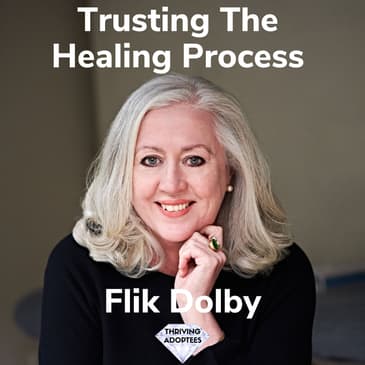
Flik believes she chose to be adopted. What???? Perhaps one of the most challenging things I've heard in over 500 episodes. Listen in and find out why she believes this. Ooodles of insight into grace, acceptance, peace, the mind body connection and more. We go deep. Where the great stuff is buried.
Find out more about Flik:
https://www.therebalancecentre.com/
Here are links to the books I mentioned
https://www.amazon.com/s?k=chris+niebauer&crid=3JXO4KTRK9CES
https://www.amazon.com/Power-vs-Force-David-Hawkins-ebook/dp/B00EJBABS2/ref=monarch_sidesheet_title
Guests and the host are not (unless mentioned) licensed pscyho-therapists and speak from their own opinion only. Seek qualified advice if you need help.
Want to learn more about thriving for you, your kids, your families or your colleagues? Pick a time to talk here
[00:00:02] Hello everybody, welcome to another episode of Thriving Adoptees podcast. Today I'm delighted by a tribute run by Flik, Flik Dolby. Two Brits in a row, Flik. A Brit guy today and a new today. Yes! Finally, we love you Americans, but we just try, need some more Brits. Need
[00:00:21] some more Brits. So here we are. Looking forward to our conversation today. We had a great, great chat last week. So healing, does it resonate with you? To what extent does the word healing resonate with you, Flik? It really does, yes. I think I've always been
[00:00:44] aware of healing and the power of healing. I think from the very early on, very young age, because coming into this world, being adopted, I was very much aware that there was something different about me and I had to make peace, if you like, with being different
[00:01:08] to my peers, different to my friends and healing. I was very curious as a child, I thought, naively, that when you became an adult, you were totally healed, that you had everything sorted. So I was sort of on a mission, right? I'm going to crack this, I'm
[00:01:26] going to sort out why I'm adopted, what my story was and by the time I'm an adult, that's it. My problem's really over. Yeah. That was a little naive. But yeah. You got on it early, you got on the healing journey, you got on healing bus early, right?
[00:01:45] I did. I did, yeah. I think because I mentioned being curious, being nosy and curious was what set me on my healing journey. And I've done a lot of things over the years. And all, nothing's been wasted. Everything has some resonance. And all the things I've
[00:02:10] done have got me to where I am today. And I don't believe that I'm healed, I think it's an ongoing process. And it's a bit like they say in some therapy, you know, there's the onion layers, you feel one layer off and something else comes out
[00:02:25] and say, oh, I'm on a good bit at the moment. But then, well, something happens in life and it's a trigger for something else deeper down that I have to look at. So yeah, it's an ongoing process.
[00:02:39] So you talked about difference and making peace with the difference. Is that what healing means to you then? Being at peace with the difference? Or is there a diamond? I think being at peace and acceptance are, I think for me, to get to the
[00:03:02] point where I accept that I chose, because I think I did choose to be adopted, is quite, yeah, I feel at peace with that. And also knowledge, like knowledge is power. And I think when I then found out who my mother was,
[00:03:22] who my father was, where I came from, that gave me a sense of peace. So that I think that was part of the judicial puzzle in my healing process because there wasn't anything else that I didn't know.
[00:03:37] Yeah. I mean, you said I chose to be adopted and you link that to acceptance. To me, acceptance, that's a little bit low. That seems lower. Somebody says I chose to be adopted. And then say, I accept being adopted. Except it
[00:03:59] doesn't seem to be quite on the same level. It would, I would like grateful or and you know, we know that's a loaded term, right? I can't think of anything. Can't think of a different word. I just I'm getting a slight
[00:04:15] imbalance between acceptance and saying I chose to be adopted. Well, I definitely think I chose to be adopted. And that came first. So I, I realized I chose this path, this life. I came in
[00:04:32] before I came in, you know, there's a to Z of what you want. So I went as I'm curious and nose and let's get on with it. I'll go for the adoption one. But within that, that growing up, there were some complications.
[00:04:44] There were some things that I didn't really understand. And I struggled with. And I think in learning about my adoption and in learning who I was and insecurities, things that I had, you know, being quite sensitive, that was part of parcel of being adopted. So I think
[00:05:05] that's where the acceptance comes in so that I can, I could look better at my frailties, if you like, and think, well, I accept, I accept who I am. Because you get bombarded with people with having judgments. Even even my adopted parents, there was judgment, not
[00:05:26] from my father, but definitely my mother. And then friends, families, teachers, everyone's got an opinion on, on me and my story. So I think to sort of sort all that through, grace is a good word. I think I've come to a place of grace.
[00:05:47] Yeah, yeah, great grace, grace fits better with our chosen to be adopted than acceptance somehow. And I'm sorry, I'm getting a bit hung up on the words. So I apologize. Right? You don't like that word? It's been, yeah, just a slight imbalance really.
[00:06:06] I'm going to blame being in publishing for 22 years, despite not being very good at English. So now you talked about choosing to do you remember the moment when you had that thought for the first time? Which I chose to be adopted though. Do you remember that?
[00:06:34] Remember having that thought for the first time? No, it's a bit like I never remember the day I knew I was adopted, you know, when I was told that I think I was very young.
[00:06:49] Very I was, I was very young, a baby that I yeah, I think I also have such a strong connection with my birth mother. And I knew that it was like this or I always knew I would
[00:07:10] meet her. So I think I don't know where that came from, that sort of knowing that that was my part and I also knew very early on that I probably wasn't meant to be with her for long
[00:07:27] in this lifetime. So I don't know where that came from, but it was a really strong feeling. And strangely enough, when I met her, I was about, I was about 20 1920. And she didn't live much longer. And she lived up in the north, I'm
[00:07:47] in the south. And I was living abroad at the time. So I think I only met her about three times before she came out became ill and then died. And it was like, gosh, thank God, I did it. And that knowing that I've got to do it.
[00:08:05] Yeah. Something tells me that you might be into kind of reincarnation and coming back multiple times. And this time I choose it. Maybe you know, yeah. I kind of do think I believe in past lives. Yeah, I don't know.
[00:08:31] No, it was just something the way you said when you said I chose them, I chose to be adopted. Something was running in the background for me. She's going to say this time round. You know, this time. And it, it's a strange line of questioning for
[00:08:49] me to go down because I'm not, I'm not really into that. So I can't ask you any many, many meaningful questions about it. So let's go back. I'm wearing your subconscious maybe you are. Well, maybe I am. Yeah. Or maybe one of what maybe I was in
[00:09:05] a previous life. Yeah. Yeah, maybe I was in. So you you talked about the fact that none of what you've done a lot of different things and none of them are wasted. Can you tell us a little bit more about that?
[00:09:21] Yeah, I've done talking therapy. I've done healing by energy work stuff. Yeah, yeah. There was a guy many years ago who he lived locally to me and he was a dowser, you know, with the pendulum. So these are the people that have the two pieces
[00:09:48] of metal in their hands and they find or a pendulum, you know, other do with the pendulum. Yeah. He picked up a lot of stuff. And at the time I'm, I'm so into it, but I'm really cynical. But yeah, done that. What else have I done? Lots
[00:10:11] of body work. But it's and then I did something called the Landmark Forum. Which is that last time. Yeah, that was very powerful for me because the reason I did that was I went Tony Robbins, you know, the peak performance coach. He came over
[00:10:33] to England to do seminars in the early 90s and I worked for him. And all his trainers did Landmark Forum and they were a lot of them qualified hit the therapist. So I thought, well, if they do that and they're successful, that's what I'm
[00:10:49] going to do. But doing the Landmark Forum was incredible because you go there for three days and you have a therapist at the front when I did it, there were about 500 people in the room. And they said, you've got to make peace with your parents.
[00:11:06] So I'm thinking, well, my parents, which parents? Is it my adopted parents? Or is it my birth parents? So I put my hand up and I said, well, I'm a little bit confused. Which parents you're talking about? And she turned around because they've got
[00:11:24] notes on everybody. And she said your birth parents, you've got to make peace with your birth parents. Can we get hold of them? And I was like, well, my father, I knew lived in Australia. And my mother, she was up but she was very ill
[00:11:41] at that point. But I somehow managed to get hold of my birth father's telephone number and rang in very early one morning in Australia and made peace with him. Which I didn't know I was going to do that when I went on the Landmark Forum, but
[00:11:57] that was it was amazing. It was a really great seminar. I thought it's a bit hard. I thought it's a bit hard to um, there's a certain language that they use which can be a little bit annoying. But they when I did it, which was many
[00:12:18] years ago, they said it's sort of your you're making inquiry about your life. You're just looking at your life over a three day period. And then at the end of the three days, you sort of like in a blank canvas and say, well, how do I want
[00:12:32] to be in what do I want to do moving forward? So is that hardcore? It's like when people say, oh, you've been brainwashed by going on a seminar. I kind of that doesn't really bother me because I think well, if someone's helping
[00:12:45] me go into my brain and cleaning out and put it back together and I feel better than okay, call it brainwashing. Yeah. I like mind blowing the word mind blowing, you know, because, you know, I think my mind could be could do with
[00:13:04] a bit of blowing. You know, if you could get a mind blow like a leaf blower, because especially all the left brain not good enough stuff. Yeah, that's a classic adoptee trait, isn't it? Yeah. And and I know a lot of non adoptees
[00:13:25] have got it too. That I could do with that blowing away. You know, I could do with a brain my brain being washed. Yeah, it's a good thing. Yeah. My when my wife repers I went on a big retreat thing 17 years ago, and
[00:13:47] then I went back for another four days to be kind of trained in it to an extent couple of years after that sort of three, four years after that. And she she refers to those people as chicken worshipers. That's
[00:14:04] that's, I guess, that's how people who are a little bit different from the know, right? Talking about being a piece of that. That's how they I guess that's how they view view stuff. Yeah. That's a bit different. Yeah. Yeah. Yeah,
[00:14:27] just thinking of other things like roughing technique. We had roughing and Felden Christ and Crystal, we have done the whole nine yards. Yeah. So we you mentioned this before we started recording today and last last week about this
[00:14:47] work that you do and mind mind body connection. So can you tell us what that healing journey has been like for you? You talked about learning kinesiology and and having some big insights. Yeah. Well, the power of kinesiology is
[00:15:13] that it's you're asking your body for answers. You can ask it questions in your body, you'll give me the answers. And it's it's done on a subconscious level. So if we can, if I can put my ego to one side and ask the body,
[00:15:33] the body will guide me down and tell me whether some are in balances and they can be structural, they can be nutritional, they can be emotional, they can be electrical in balances. And we're, we are kind of quite complicated beings. And the power of kinesiology is
[00:15:54] massive. It's it's helped me on my balancing my hormones, certain types of life, you know, that they can go right. But a huge impact has been on you mentioned earlier, not feeling good enough. And where does that come from? And you can
[00:16:19] track back and ask back, which happened to me in my training, when did you first feel that you weren't good enough? And I think I went back part of my memory specifically, but it was almost in utero that that feeling was implanted. And
[00:16:36] it's, are you ready to release it? You asked the body, yes, no, it can do such a myriad of amazing things from helping people from getting over operations injuries, I mentioned to you before, it is, I don't know, I don't know
[00:16:56] why it's not so widely used. Because you know, when you get that gut feeling, it's like that, but it's just on a much more powerful level. And things that we naturally do, like, you know, some might hold your head, that's actually a
[00:17:11] really good thing to do when you're stressed or upset. We actually use a lot of the tools, but we don't realize we're using them. And you mentioned Americans, the Americans are much more into kinesiology applied kinesiology which is the derivative that I've been trained in. And
[00:17:31] sadly, maybe we're a bit too cynical in this country, but it's an uphill struggle to kind of get it more accepted and use that. It's phenomenal. I worked with a lady the other day, she had a she said she had an injury. But when she
[00:17:50] came to me, I'm ascertained that actually the injury was in her hip. And she'd be going to see a physio for the last couple of months, he hadn't even done any physical work on her to get told to do some exercises. And then a
[00:18:06] couple of sessions, it completely sorted it out. So yeah, it is, I can't sing it's praises enough really. So it would be, you know, if people that I shared with you before, and I've talked about some podcasts, that I'm doing
[00:18:24] some somatic experience and work at the moment. And I did a session this morning, which was very powerful. The somatic and the kinesiology, they're kind of in the same, they're in the same realm, right? Yeah. Yeah. Because the somatic is sort of movement of
[00:18:44] the body, isn't it? So now in energy to be released, which is very similar to kinesiology, we work on meridian lines, the lymphatic system. And it's releasing blocked energy. And if we think of ourselves as, you know, all our experiences of
[00:19:04] x number of years, emotional things that have happened injuries, something somebody said, school, whatever. We kind of keep filling up our tank with lots of blocked energy and somatic work and kinesiology and hippotherapy massage to a certain extent, help release and move the
[00:19:27] blocked energy. So I don't know whether you felt how you felt after your session this morning, but did you feel a bit tired or? And now I was okay. I don't lighter, something like that. Maybe lighter, lighter, you know, just less on the shoulders.
[00:19:54] Yeah. So you felt like you released something? I felt like I'm releasing something. Right now I'm feeling a little bit of frustration because inside around on this topic, yeah, because I think there's as you were talking about the body coding stuff, you know, we always go anywhere
[00:20:19] near there. I go, you know, the body keeps the score the best of uncull, whatnot. And there's so much kind of, there's so much trauma education. And it helps us understand it. To a certain extent understand the source of the trauma.
[00:20:36] But it doesn't help us healing, you know. And so what we're trying to do here on 5 minute adoptees is healing education. So find out what's helped you and then like all the other conversations been having and, you know, put them
[00:20:52] into a framework and one of the things that I think the Western world has missed is they think of they can overestimate the psychological part of healing. And they underestimate the other parts and people don't even talk about different parts, right? Until a fellow adoptee
[00:21:21] Teresa Kerry, she talked about it, she just rappelled an awful lot types of healing. She said, well, obviously psychological, emotional, physical, which is somatic stuff, relational, social and essential. And then she just ruffled them off. And I just thought, hold on a minute. Like
[00:21:38] we live in a world like Nancy Barrier talked about it being holistic, psychological and everything right? As describing the wound. But the second book is, as far as I can remember, kind of pure play psychological stuff. And everybody talks about this somatic stuff. But there's a
[00:22:07] mismatch between understanding trauma and healing it. And like, I'm like, why is nobody we're all looking in the wrong place? We're all focusing on the wrong stuff. I think, I think it's a really good point. I think with the therapeutic, intellectual, psychological healing modalities,
[00:22:34] it can be written down and it can be, you know, one plus one, you know, it's formulaic. But to do physical healing work is so individual. And it's my healing is going to be different to your healing. And what might work for me one day
[00:22:51] might not work for me the next week, we as I said before, we're we're complicated beings. And I don't think you can put it in a book and sell it. It's like an art form, you know, it's just very, very different. And I think it's hard to
[00:23:09] quantify it. And that's where people what they want. Oh, if I do this, this and this, you're going to be healed. No, you might get some reliefs. And then it and also it's about us taking responsibility for our own thoughts and feelings. And
[00:23:26] that again, you know, I might have a week where I don't feel like doing anything, particularly good for me on my healing journey. But again, trying to tell somebody you need to take responsibility and find what works for you. And it might
[00:23:43] not be one thing might be a myriad of things. That's, it's quite challenging. Yeah, it can't be written down. It can't be. Well, it's, you know, the trauma is preverbal for us. So, so like the healing preverbal and reading some very interesting stuff now that
[00:24:13] have promised neuroscientists, I've plugged them a little bit. And I forgot to say that's good. And it'll come back to me and I'll put it in the show notes. What what it preverbal and preverbal and subconscious are kind of the same thing. Yeah.
[00:24:45] Preverbal. Did you did you hear that? You need to hear that what's going on in the background? No, two really big Chinook helicopters just flew over about 300 foot above them. Yeah, preverbal and subconscious are the same thing. So preverbal nonverbal preverbal is the same as nonverbal
[00:25:15] nonverbal, nonconscious. It means you know, you can't you're not aware of it. We can't put it into but on some level we are. And that's in kinesiology, you can you can test the body back and go back to the very, very
[00:25:34] beginning. Spot on. Yeah, I used the wrong word. I don't know what the right word is. I don't know if the right is a feeling and it's an energy. And you know, the trauma you can ask the body is that still affecting you? Where's
[00:25:50] it affecting you? Which part of the body is it affecting you? Which is phenomenal insight of how much healing one can do by just challenging the body through muscle testing. And that just really excites me because I think we're all
[00:26:08] meant to, I feel, heal ourselves. We have the we have the technology. We have the capability to heal ourselves. But it's what I mentioned, my ego can get in the way because I think, oh, I should be doing that, I should be
[00:26:25] doing that. And also, I think with the work I do in 12 step recovery, that's when you hand things over to something a higher power, whatever your God is to you. Asking for help is okay. And that's a phenomenal healing tool, I think.
[00:26:48] Yeah. So I remember the book is called No Self No Problem by Chris Nebauer. And I'm also going to plug another book which I plugged all the time in, which is one I recommended to you this David Hawkins book David versus Force, which is
[00:27:03] all about well, the first half is about kinesiology. So he develops, he's developed in the 60 70s, a scale of human consciousness. But it was developed using muscle testing. And muscle testing is, is it, would you call that one form of
[00:27:22] kinesiology? I don't know, is it pretty major part of it? You're challenging the body with various muscle testing. Yeah. Yeah. So do any particular healing moments come to mind? I think we've just got we've gone out macro, we're going to zoom back into micro.
[00:27:45] And in my life, any healing moments? Anything particular comes to mind? I think getting the first letter from my, my birth mother was a huge moment of sort of validation, I think, you know, I was, it was a really good experience. It was a lovely
[00:28:19] experience. And I was living in Spain at the time and it was the first letter I got when I arrived there. And just her accepting me and getting in contact with me, just made me feel okay. I thought, Oh, it's like a once been lifted off me.
[00:28:37] So I think that was really powerful. Yeah. And not everybody has a great reunion, which is sad. But for me, it was very, very good. You use the word, did you say validating? Because when I said the word validation, I normally think of a belief. But
[00:29:10] validating us as a being, right, feeling valid, that seems to take Yeah, to take validation to a whole new level, right? Yeah, it's because you know, your for me as an adoptee, I was two people. You know, I was, I got christened twice. I was, I
[00:29:36] was christened Bernadette by my birth mother. And then I was adopted as Felicity Flick, you know, it's like, there were two people. And it was almost like, when I heard from my birth mother, she recognized and was validating the person I was
[00:29:56] born. And it's, it was very powerful. It's like, I've done a lot of inner child work. And we don't, I don't think I've got one in the child, I've got several of them. So there's the pre adopted one. And then there's the newly adopted
[00:30:17] one. And then there's the toddler and then there's a teen and there's the rebel team. There's, there's quite a few but she gave me validation for being born, I think, being born her child. And I kind of that was really, really powerful, very important. Like I can't.
[00:30:40] Yeah, I was, I was somebody to her. Now I was only with it for six weeks, but I was that person. I was that baby. To her. And that was significant. And because when you're adopted, it's like, what adopted? This is who you are now. And I
[00:31:00] wasn't encouraged to look and find out where I came from. Was really put off it but didn't work. So you take on an identity that is part of your adopted family. So you're sort of making things up as you go along.
[00:31:18] So you're, are you comparing, contrasting different and valid? These are these two opposites for you? Yeah, she definitely gave me. I definitely felt I was a different baby than the one I became when I was adopted. So
[00:31:43] she kind of validated that there was this other baby that was born that wasn't the one that was then brought up in my adopted family. I was gonna say she, she validated your pre adoption personality. Yeah. Also when I met her, I absolutely knew her. It's like the
[00:32:06] feeling she had for me was so familiar. And the love she had for me, I knew I knew the feeling. And that was extraordinary to think because I didn't even know I knew it until I felt it. So there's a lot of kind of intuition stuff we talking
[00:32:27] about is that does this feel like intuition? Well, like the work I do, I think everything stored in our bodies. That love she had for me was in my psyche somewhere and when I met her, it was like the switch went on and I
[00:32:42] went oh my gosh, that's familiar. I remember that one. So maybe I was quite in tune, I'd say. Yeah. And did she look like you? No, not really. I looked more like my natural father. He had very, I used to have very curly hair. He had curly
[00:33:03] hair. My, my adopted mind, no, my birth mother. She used to perm her hair and but fun. I don't think I looked much like her, but I did go to Ireland where she was from. I went to her funeral when she died, but a couple
[00:33:22] of years later, I went to Ireland and I was with my siblings. And we went to visit some just went to visit somebody locally. And the guy answered the door and my brother was about to introduce me and he said,
[00:33:40] oh, I know who you are. You're there's no mistake in your Rose, Rose's daughter. And I went, how do you know that? I said the chin, the eyes and I went, wow. Yeah. Yeah. And that's the weird thing. It was a fascinating thing about adoptees. It's like the
[00:34:00] mannerisms you take on from your nurturing and your upbringing versus the inherited. And my cousins used to say to me, oh my God, the way you use your hands is just like your mom and I'd go, I'm just using my
[00:34:17] hands. No, no, no. And it's nurture versus nature. It's an incredible thing. Sort of we're almost ambidextrous. As curiosity being the biggest driver of all this because you've yeah, definitely. I think I think I'm growing up when you know, children can be nice or
[00:34:45] not so nice and people ask questions. I think I used to get annoyed thinking, well, why don't I know where I'm from and who I am? Why do it's my right to know? But that didn't get received with much enthusiasm for my
[00:35:02] adopted mother. But yeah, I was thinking, surely as children on this planet, we've got a right to know where we come from. Just to me, it was like no brainer. It was sort of, I need to know and I want to know. Yeah. So yeah, curiosity.
[00:35:25] Because there's still 40 of the 50 states which are closed in the US. And like, we've been open since 75, I think. Yeah. My mum that scared my mum when that. Well, I understand it. Yeah. Yeah. But nowadays it's different, isn't it? They're much more open with communication and where people
[00:35:57] come from. But yeah. Yeah. I used to say to my mother, I said, I feel like I'm sitting on a fence and I'm in the middle. And I look to the left of my past and I think, well, that's a
[00:36:11] woman that went through all that she went through and gave the child out. So she's got all her thoughts and feelings. And I'm thinking, I want to know about her. And then I'm sitting here and then I'm looking to you
[00:36:22] and my present and my future. And you've got all your thoughts and feelings about why you had to adopt a child. And I'm thinking, well, okay, what about me? I need to know both sides. And that I was told, well, you know, you might
[00:36:41] upset somebody. She may not have told her husband. You could really upset a family. But it still didn't work. It's like, okay, I'm still, I still want to know. Yeah. There's something big that something just panies just dropped for me in terms of us worrying about upsetting people.
[00:37:07] People pleasing. Yeah, well, there's people pleasing. There's not upsetting them as well. Like so, in trying to insert ourselves into a biological family, well, no, that's trying to insert ourselves into our biological family's life. Let's put it that way rather than certain to family because that sounds
[00:37:31] not quite right. That and you know, I thought about this. I have thought about this a lot since getting out of the hospital. I know I don't have two half brothers. And I've been told not by my biological father not to call his number again.
[00:37:59] But I could, like, but do I want to cause the do I want to cause the upside? Do I want to cause the upside? Am I do I really want to know them? You know, but it kind of you know, if
[00:38:22] you come if you compare that sort of upset with relinquishment trauma upset, it's just choking cheese. And it's like, yeah, yeah, because you had you have a choice now if you want to get in touch with your half brothers or
[00:38:46] not. I'm guessing do they not? Do they know about you? No, I'm sure. I'm sure that I'm sure their mother doesn't know about. Yeah, that doesn't know about me. You know, this was 1966. Yeah, same. He signed the little piece of
[00:39:02] paper away and the next thing he knew was me ringing him last October. So is he on your original birth certificate? He was, yeah, but it was quite a common name. But connecting with a cousin, I found out I found this, I find the
[00:39:17] name of the city that he lived and I put his name in the city into Google and up to up to up to a pop to his telephone Yeah, you were saying, you know, the original the trauma of being adopted is one thing, isn't it? But then
[00:39:38] and I was worrying about it was in a little bit family upset. So yeah. Yeah, and it's bound to, isn't it? Because it's like my circumstances, my birth parents then got married about a year after I was born and went on to have three children. So I've
[00:40:00] got three siblings, full siblings, full siblings. Yeah, and they didn't know about me until each of them were about six, age 16. And then my mother told them and they were they were keen to meet me. But you know, that is
[00:40:22] I kind of touch with them, but you go in you are different. You're sort of you were taken away different. And then you can in my case, I could go back in, but I'm not part of really. It's it is complicated.
[00:40:39] Yeah. So is there anything that you feel has kind of gotten in the way of your on your healing journey? No, I think the only thing I think possibly is how society hasn't really up until I discovered you and so much work that's
[00:41:09] been done over the last probably I don't know, 10, 15 years about adoption. It's been such a close shot thing. I told you last week, sort of my brother, I grew up with this adopted and had a school friend, friend outside school and a college friend.
[00:41:29] He only they're the only adopted people I knew and nobody really talked about it. I think society's lack of compassion, I think, has probably he did some of my healing because there's a lot of ignorance around adoption from my point as well as everybody else.
[00:41:54] And I think thankfully now there is much more dialogue and conversation and, you know, the open book about adoption, which needs to happen. I've done a bit of work in prisons and it's, you know, full of adopted people. And there's a lot of trauma about being adopted.
[00:42:22] And it's about time we one can get more help than I went on my journey on my own, didn't even know there was much help out there. It's very different these days. Yeah, thank goodness. That has to happen, doesn't it?
[00:42:43] Is there anything you'd like to share that I've not asked you about, Fred? I don't think so. And he I'm just going to lean into your intuition here. Don't always do this, but any ideas come to mind about what to call this conversation? When I release the interesting.
[00:43:18] I feel that for me, trusting my instincts, trusting our body. Something to do with trust, I think. Yeah, trust in the process, the process of our healing. Cool. Thank you very much and thank you to listeners. We'll speak to you again. Thank you so much, Simon.