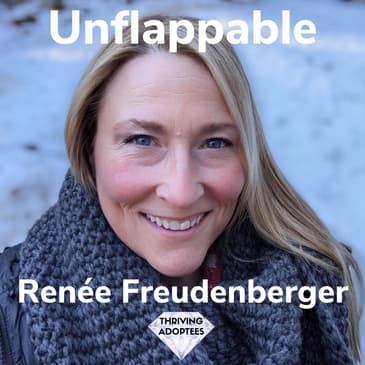
Raising kids challenges all parents. The more trauma, the bigger the challenges. Listen in as adoptive mother Renée shares her learnings on commitment, sticking with it and being unflappable as we raise our kids to thrives
Here's an extra thought from Renée...
"Of all the things that I said that children need to thrive, I wish I had added fun! Children need the opportunity to explore who they are in ways that disarm their fight or flight. We always exposed our foster children, and later our daughter, to lots of different activities (sports, dance, art, theater, camps), where she could learn something new and have fun. There, she could also make mistakes and realize it was okay to make those mistakes and that she could figure out her own solutions. We call that the dignity of risk, and it certainly helps build resilience!"
https://www.linkedin.com/in/renee-freudenberger-6481b018/
https://www.facebook.com/woodfords
Guests and the host are not (unless mentioned) licensed pscyho-therapists and speak from their own opinion only. Seek qualified advice if you need help.
Want to learn more about thriving for you, your kids, your families or your colleagues? Pick a time to talk here
[00:00:02] Hello everybody, welcome to another episode of the Thriving Adoptees podcast. Today I'm delighted to be joined by Renée Freudenberger. That is a cool name, Renée. Thank you, it's a wedding present. Oh, of course. I interviewed a young adoptee called Wilson Munsterman a few months ago and I thought that was really a really cool name. So Munsterman and Freudenberger, yeah, they both sound a bit German, don't they?
[00:00:30] Yes, yes, my husband's family is German. Yeah, yeah. So listeners, Renée is a, she's a mum through adoption and you were a foster parent before that, right? That's correct, yes. I was a therapeutic foster parent for 12 years and I stopped that work after I adopted my daughter. My husband and I really wanted to focus on her and her healing and her childhood experience and minimize additional loss for her.
[00:01:00] And so we, we stopped fostering. Yeah, yeah. My mum and dad fostered in the, in the, in the sixties before, yeah, before they got approved for, for adoption. But when they got approved for adoption, they stopped fostering so that they would be free to, to take a baby one, when one became available.
[00:01:19] And that was me. And listeners, she's, she's also, she's also a professionalist area. She's training, training development director at Woodford's family services. Correct. I'm the director of training and professional development. Professional development. Yeah. Yes. I've missed the professional there. But close enough. Well, that's okay. Thank you. No worries.
[00:01:42] So a, a big, a big heart and a big, a lot of experience in this, in, in this space. I'm also thinking about that 20, you know, 12 years of therapeutic foster parenting. Yes. That's been an incredible learning experience for you.
[00:02:00] It was for sure. You know, when we started, not all children were considered to be therapeutic. Even though in retrospect, I certainly identify that they are, if you're in foster care, by very definition, you are in need of therapeutic services. And we just, my husband and I both learned and grew so much through that experience. Yeah. So where, where, where was the growth? What, what was the,
[00:02:30] what was the areas that really stand out for you from the, from that time? Well, I think when I, I always knew I was going to be a foster parent. When I graduated from high school, I knew.
[00:02:42] Uh, and I think there's this, this assumption, this natural, I call it the puppies and sunshine phase of fostering where you're just starting out and you really believe that love can solve problems for children that they just need to be in a healthy and safe and loving environment. And I do believe that that's true.
[00:03:34] And I do believe that that is true. And if you make the shift between, I'm doing all the right things to, am I doing what's right for this child so that they feel safe and can grow, then you're missing the mark. Yeah. Yeah. And it took me, I think I'm still learning that, but it took me many years to really make that leap from I'm, you know, it being about what I'm doing to it being about what, that I'm doing what this child needs. Yeah.
[00:04:04] Yeah. Yeah. So, um, you, you mentioned the, you mentioned the thrive with there, right? So, um, what, what does thriving mean to you from a personal perspective? And then perhaps we'll look at it from a, uh, from a child or a teen's adoptee's perspective. So what does thriving mean to, to you?
[00:04:25] I think it's different for everyone, but I think thriving to me means that I am living a life that is of my own design that brings me joy and peace and challenge opportunity to grow and strong relationships. Yeah. So it's quite a lot there.
[00:04:52] I like the, I like the, uh, the, the, the breath. It gives me, uh, lots to, to play with. How, how do you see the relationship between parents thriving and their kids thriving? Well, children are sponges and they take in their surroundings and they are looking to their parents or their parental figure.
[00:05:20] For guidance as in terms of how to move through the world, how the world works, how to handle challenges. And so when parents are able to do those things, when parents are able to set boundaries for themselves, set goals for themselves,
[00:05:38] handle challenges that come their way in a way that is positive and, um, empathetic and resourceful, then they learn the same. Yeah. So in a word, is it modeling? Is that? It really is. It really is modeling. Yeah. It's walking the walk, right? We can tell our kids what we, what we hope that they will do and what are, you know, some of the best answers to their problems.
[00:06:07] But until we demonstrate that, that these things are successful by doing it, not just talking about it, it's just talk. Yeah. Before we hit record, you were talking, we were talking about self-reliance. And you talked about thriving being, living a life of my own design, you said. Yes.
[00:06:30] So those two things seem to kind of go together, the self-reliance piece and creating a life of our own design. Yeah. What does that mean to you, Renee? Understanding the resources that you have and that you bring to everything that you do.
[00:06:55] You know, I think for many children that have been in my home, when you ask them what they want to be when they grow up, they can't even envision a future yet. And so that doesn't come from just pick a target and walk towards that target. That comes from building the resources that you need to achieve any goal that you might have.
[00:07:20] And that's self-reliance, you know, learning how to be self-reliant, learning how to determine your own future and, you know, take control of that. Yeah. Yeah. And how does the modeling piece play into that?
[00:07:42] Well, for me, I think I talked a lot as a parent about challenges that came up for me, you know, shared examples that maybe my child did not witness occurring in my workplace or with my personal relationships.
[00:08:01] But also, you know, with family dynamics and her own friendships, just sort of modeling how I handle my relationships, how I handle my work, how I handle my work ethic and how I manage my household. All of those things, you know, seeing me make decisions as an independent person, sharing my own challenges and how, you know, I was happy with how this turned out because I worked really hard.
[00:08:30] And also, I worked really hard at this and it didn't turn out the way that I hoped, but I'm okay and I'm going to pivot and do something different.
[00:08:37] And so just, you know, managing life's normal ups and downs with frankness about this is the reality and building resilience around dealing with those disappointments and joy around celebrating the successes.
[00:09:01] Yeah. In work, do you find a reluctance to foster and adoptive parents? To what extent are they reluctant to share those stories?
[00:09:21] To me, it sounds like you're sharing stories of your own stuff so that your daughter knows that adults have tricky stuff too. Yeah. And I did a lot of working with kids before I came into doing the podcast five and a half years ago. And I found that vulnerability about sharing tricky stuff that I went through being bullied when I was a kid.
[00:09:50] I found that that was like rocket fuel for empathy. And it's kind of like, I got the impression that not a lot of people, not a lot of adults dared to go there. Right. But I stumbled upon that and I really found that that was, as I say, a real boost for empathy.
[00:10:16] And whenever I got anywhere near that space in a classroom with 30 kids and, you know, teacher was there as well, right? So because of safeguarding. But I could feel the hum of the kids kind of disappear as they became all ears. Yeah. And I'm wondering, you clearly did the same. I was doing it as a one-off as a professional going into schools. Yeah.
[00:10:45] You did it on an ongoing basis with your daughter. And I'm wondering, to what extent is that common practice and to what extent is there are people reluctant to do that? I think it varies. Honestly, I, we work with some amazing foster families here at Woodford's. And I, my experience has been in talking with them that some are very forthcoming.
[00:11:11] A lot of, as I'm sure you've stumbled across in your many years of experience with this, a lot of people are drawn to this work for a very specific reason. And oftentimes it has to do with a challenging family system of their own growing up. And so there can be a vulnerability and a fear that sharing that might somehow disqualify them as supporting a child from a traumatic background. I feel as though the opposite is true.
[00:11:40] I think if anything, it, it builds your empathy muscle to a degree that a child can only benefit from if you're willing to share some of that, not to dump your trauma on them, but really to help them to understand, like, look at me, I'm an adult and I, I'm okay. I experienced these things. I have my own childhood trauma. And yet I have built my resilience and I've built a life that I'm happy with, that brings me joy. And I brought you into it.
[00:12:10] And I'm so blessed for that. And, and I continue to grow and to change. So I think when, when parents, whether they're foster parents or adoptive parents or just parents, parents are willing to share some of those experiences, children, children benefit from that because they understand everybody faces challenges.
[00:13:02] Not just me. And so I think that's deep in our, in our training. Our job is to train social workers and foster parents and all kinds of paraprofessionals in how to do their work in a, in a successful way and to provide the supports needed to the, to our clients across the agency. And one of the things that we say to every trainer, when they come through the door is your anecdotal material makes this real for the learner.
[00:13:30] And so share your experiences so that it's more credible. So telling someone you're going to be okay is great. Showing someone you're going to be okay. That's the magic. Yeah. Yeah. As you were talking about it, I thought you were going to say magic dust or gold dust, right? I was going to say secret sauce. Secret sauce. Okay. All of these things apply, right? All. Yes. Pick your favorite. The magic fairy dust. Sure.
[00:14:01] Yeah. And I just, as you were listening, I was reflecting on some conversations that I had yesterday and other conversations that I have. And the, the, the more we kind of share in those conversations, the more that we share the tough stuff, the deeper the conversation goes. Yeah.
[00:14:25] And, and I, I think I find that the, the professional and the personal experience in this space adds for a depth of conversation to this podcast, right? Agreed. That, that, you know, the, sometimes it's, it's trickier to go when the professional, the professional experience is, is all, is all that there is. Mm-hmm. Yeah.
[00:14:49] And so how do you see that, the, the, the relationship between depth and, and empathy? Between depth and empathy? Depth and empathy. And, and, and, and we talk, I'm talking, obviously I'm talking about this kind of vulnerability and being, being, being able to, not trauma dump, but to share, share, share your tough stuff. Yeah. With, with your kid. Yeah.
[00:15:17] I mean, I think just being able to, I can think of countless conversations that I've had with my daughter where she has shared something that has come up for her. Mm-hmm. And I don't want to make it about me. I want, I want to keep the focus on her. So I might say something like, well, would you like to hear about a, a similar experience that I had? The answer is usually yes.
[00:15:43] Or I'll just chime in and just start sharing with her something that happened. But also it can just be as simple as saying, you know, I had something similar happen to me when I was younger and, and that was, it was so hard. So I can only imagine like how hard this is for you, you know, or, or I understand that this is really challenging. How can I support you? Sometimes it's, do you want advice or do you want me to just listen?
[00:16:08] Um, but you're able to pull from your own experiences and have empathy for something that maybe someone else might say, well, that's just drama. You know, that's just, I raised a girl. So there's a lot of drama that comes with that. And, you know, resisting the urge to be dismissive is a lot easier when you have empathy.
[00:16:31] When you understand what a person has gone through and how very real that feels, even if you know tomorrow, it's just going to be a distant memory for them in the moment. It's huge and it's scary and it's upsetting. And having been through something similar, you can, you can empathize and support in whatever way is going to be helpful to that child. And it's a considered approach you're talking about here.
[00:17:00] Um, I mean, considered, but I'm presumably it's wisdom in the moment. It's, it's, I I'm, I'm thinking of some, something I saw as a conference a few years ago. It wasn't an adoption conference. It was a marketing conference, but the people were using vulnerability as a strategy and it was almost like color by numbers vulnerability. And it, it felt really forced.
[00:17:24] Um, uh, uh, and not, not considered that these were, these were presentations, right? So these were one way communication, right? The audience is either crying or laughing or, you know, clapping, whatever they're doing, but it's, it's a, it's a one way conversation.
[00:17:41] Whereas what, what you're talking about is, is a more considered approach where your wisdom takes you where it goes in, in the moment in a, in a real, a real rather than a, than a, a forced way. Yeah.
[00:17:57] I think it's so important to be genuine, whatever your responses to kids when they're struggling, because kids are smart and they, they see through our falseness, you know, better than probably anyone. And kids with trauma are hypervigilant to being played, you know, they've, they've been played by adults.
[00:18:25] That's maybe a terrible way to say it, but you know, they've, they've been abused and, and miss, mistreated. And they're watching for signs that someone is not genuine in their affection, in their safety. And so when you're, when you're just phoning it in, in any way, it's, it's not, it's not going to fly. No.
[00:18:52] How do you see the relationship between trauma and, and thriving? And if I can start by asking you with about your own stuff and whatever you, uh, and then we'll move on. To the kids stuff. Um, but obviously whatever you want to share. Um, yeah. How, how do you see that? Well, uh, I have certainly experienced my share of childhood trauma.
[00:19:21] Um, and you know, even just being a child of divorce in and of itself is a qualifying factor, I think, but there were other things involved and I was lost for a long time. You know, when I entered into my, uh, early adulthood, I was on my own at a very early age, had my own apartment at 18, had a full-time job, was paying all my own bills. Um, but I felt really unlovable. I felt really lost.
[00:19:49] I could not, if you asked me what I wanted to do with my life at that time, I certainly could not tell you. And fortunately, one of the beautiful things that came out of my childhood was that my parents, my mother in particular was, um, she was very smart and she was very resourceful and resilient. And she held us to a very high standard, even when things were difficult.
[00:20:13] And I think even in my lost moments as a young adult, that, that was running through me, that resilience, that ability to make a better choice, set some goals for myself. And so I think, and also I, I didn't, I didn't come to that in a vacuum. You know, I didn't come to sort of my healing in a vacuum. I had therapy.
[00:20:41] I have wonderful sisters who are like my best friends. And so I had built this community around me of people who loved me and were invested in their relationships with me and who I, who I wanted to be proud of me.
[00:20:59] Um, and so, you know, I think my trauma taught me resilience because I also was developing the tools that I needed for resilience along the way. And knew that I wanted something better for myself, for my family, for my child. And, uh, and so that's, that's the correlation that I make. Yeah. Yeah. I am who I am because of the things that I experienced when I was younger.
[00:21:29] I, there are some things I wish hadn't happened, but also I know I am me because of them. And so wouldn't necessarily change them. I mean, you mentioned healing and resiliency. So what, what, what do they mean for you and what do they mean in, in terms of yourself and the way that you raise and relate with your daughter? That's a great question.
[00:21:58] I, I think for me, when I became a foster parent, by the time I became a foster parent, I was married. I had a good, a decent job. I was feeling like, okay, I'm building a life. Uh, and I feel ready to share that with someone and, and help them. And, uh, my husband was game for it because I had told him we were going to do this.
[00:22:23] And I did have that sort of puppies and sunshine view of foster parenting that I talked about. And about six months into it, I realized I need therapy. This is bringing up so much stuff for me. These, my first foster placement, who I'm very close with to this day, had significant trauma.
[00:22:45] And hearing about some of the things like, you know, the food insecurity and the abuse was really triggering for me. And I realized if I'm going to be, if I'm going to be able to help anyone, I need to really help myself. And if I'm being honest, looking back, I think even my marriage, I had very low expectations for it, given my own personal experiences.
[00:23:13] Um, and so I, I just did a lot of work on that, you know, with a, with a therapist, but also in conversations with my partner, uh, and my sisters. And, uh, and, and that sort of helped me to build my internal resources.
[00:23:31] And when you can identify what you have inside for resources and outside of you in your environment for resources, that's really powerful in building resilience. Yeah. Do you remember the moment when you realized that you needed help? That I needed help, yeah. Yeah.
[00:23:56] My, my foster daughter, um, had, I basically had told her that I loved her and she had refused that. Like, you know, as many foster children would, um, you know, feeling we were like six months in.
[00:24:24] And in my mind, I was trying to make her feel safe. And as I said earlier, I didn't really know that that was about, not about me, but about her. So I had said, you know, I, I, I love you and I'm so glad that you're here. And there was some rejection that came with that, like an eye roll and a walking away. And I was devastated, like crying in the bathroom, devastated about that.
[00:24:50] And when I stopped crying, I realized this wasn't about me. It was, I mean, it wasn't about her. It was about me and what was going on internally for me. Like I felt a rejection that I had felt as a child.
[00:25:07] And then I realized as I started to think about it, all the other things that were coming up as a result of, um, as a result of her trauma being really vicarious trauma for me. To what extent do kids with trauma make it about, make it about us when it's about them?
[00:25:37] Every chance they get, you know, I mean, are you asking like for them, from them? I'm not, I'm not sure. I'm actually, uh, I'm actually thinking about something that happened in the conversation with me and somebody recently. Yeah.
[00:25:57] Uh, when there was, uh, when that other person made it about me, but it was, and it hurt. Uh, and it took me probably four days to realize it was about them. Mm-hmm. It was their, it was their SH1T. It was their, it was their trauma.
[00:26:25] Not, not mine, but that person made it about me. Right. Well, that's more comfortable, isn't it? Like it's more comfortable for that person. And I think I said every chance they get, because if you don't, if you're not able to successfully, and in the beginning, it's just not there yet.
[00:26:50] But if you're not able to successfully create a space for a child to sit with their trauma and understand it's not my fault. Before they get to that, many of them think it is exactly their fault. And so it's much easier when there's a challenging behavior, let's say, to blame you in some way, blame the people around them, make it about the people around them.
[00:27:19] And that's a, that's a challenge because there's no growth for the child in that moment. There is just yet another adult disappointing them. Uh, and so that's where really creating a space where they feel safe, where they have that felt safety, as TBRI says, um, where they can start to say, okay, this is about what's happening for me.
[00:27:44] I feel scared because of this thing that has happened to me in the past being brought up and I can deal with it. Otherwise they can just push it on to the way you're behaving as you address their challenging behavior or, or their trauma of the week. Yeah. Um, some things occurring for me here in the kind of the, the, the two sides of the, of the coin, right?
[00:28:10] So there's the, I'm thinking about my own, uh, trauma surfacing at 40, right? It hadn't, it hadn't surfaced before then in words that came out of my mouth, as far as I was concerned. Right. So I was, I was blind to it. I was blind to my, right. I was blind to it.
[00:28:38] And that's what happens with pre-verbal trauma. Yes. Yeah. We, we, we don't have words for it. Um, it's like it. So we don't have words for it. Um, it's like an iceberg. We can't see it. Right. Um, and I, I put it outside. I put it outside as in, she didn't love me. Right. Right.
[00:29:08] The other side of that coin is to, to, to take it, make it internal. I'm, I'm unlovable. So there's two sides to the, to one coin. I'm unlovable or she didn't love me. Right. Um, I'm not quite sure what the question is. And it's both, right? Yeah.
[00:29:38] It's both. And it's neither because maybe she really did love you. Well, and that was the choice, but isn't it interesting that that's not either of the answers that you came up with? No. Um, I guess that's the next coin. Yeah. Yeah. So that's the coin we hope to get to. I am. Well, yeah.
[00:30:03] Um, so what, what happened was these words, I, you know, I, I shared these words with a, a, a therapist type lady. She was actually a horse whisperer, right? She was a, she was a horse whisperer and coach autistic coach. You know, she did communication skills and she still does communication skills with horses,
[00:30:27] um, with autistic kids and, and other random people like me. Right. Um, so I said, she didn't love me enough to keep me. And the, and Sarah said, uh, I'm a, I'm a mum, Simon. I don't think it would have been like that. So the fresh thought of, she didn't love me enough to keep me was challenged by Sarah in,
[00:30:57] in, in, for want of a better word. And, and I saw the truth in what she said. And I, I got at a fairly deep intellectual level that it, that, that she didn't reject me. But then 10 years later, when I found out the truth and I got my adoption file and, um, I, I felt her love for me.
[00:31:25] So at one point there was a, and I can only see, I can only, that only makes sense looking back. Like, so I would say at the time her love for me landed the, in the first conversation, but it didn't actually really land until 10 years later finding the truth and getting there. Yeah. I'm so glad that you did.
[00:31:54] I'm so glad that you were able to see your file and learn that. Yeah. See it in writing. That's not, everybody gets that. Amazing. Yeah. It was big. It was huge. It was huge. Um, I don't know. What, what have you learned about lovability and kids with trauma feeling unloved and their projection? What?
[00:32:23] I mean, I wish I had a really great way to articulate it. It's so challenging because for most of them, there's not an ending like the one that you just described. Seeing a file can sometimes make it worse because there's decisions and abuses and neglect that
[00:32:44] led to this child's, where they are now that their adoption or their foster care. And, and it's hard for them not to internalize that. And for my own daughter, you know, I always, I was very careful in the words that I chose
[00:33:08] to describe her mother because I didn't want it to be an us and a them situation where she was an enemy or bad. Because when the person that made you, where your DNA exists is bad, then what does that make you? So I was very careful to say your mother loved you, but was just not in a position to care for you safely and needed help in making that decision.
[00:33:38] And that's how, that's how you ended up with us, which was such a blessing to us. Years later, as she got older and, you know, one of the maybe pros and cons of our social media driven world today is the ability to find people very easily and connect with those people, which for many foster children, they are driven to do that.
[00:34:03] Um, and then they, then they connect with, with their biology and those folks who have failed them in some way. And unless there's been profound healing, it can be a really, either way, it can be a very emotionally difficult situation. And that was my daughter's experience is that it was not what she hoped it would be. She tried to connect with her biological family.
[00:34:33] And felt very unsafe and very, you know, unfortunately her mother said some pretty cruel things to her that deepened her concern about her level of lovability. And that somehow it was her specifically that was the problem. However, the more time that she spent trying to build some sort of relationship,
[00:35:01] the more she saw their unhealthy behavior and started to realize these are the choices that this person makes without me in the room. They're the same choices. This has nothing to do with me. And I think it took her a really long time. And probably she's, she's, I would say she's still working on it. Starting to understand I am lovable.
[00:35:27] Her choices are a result of her own trauma and her own experiences and her own ability to make healthy choices for herself. And they're not a reflection of, of my value as a person. Yeah. And so she had to come around to the same thing as you did, but in a different, more roundabout way
[00:35:50] that involved maybe a little bit more suffering and triggering because she had to be exposed to something that was dangerous for her initially and then still felt dangerous. Yeah.
[00:36:07] A story's coming to mind about a mentor of mine who realized that, you know, he had a, his first proper girlfriend, he thought it was, I think he was early twenties. He thought that they were going to get married and have kids and that was it.
[00:36:36] And then she dumped him. And he had a profound realization that putting his peace and happiness in somebody else's hands was, yeah, a recipe for disaster. Yeah.
[00:37:00] And that caused him to look inwards at, I don't know, 20, 21, something. And it's 180 degree shift because we're conditioned to, to, to look for, for love outside, aren't we? Right.
[00:37:29] Yeah, absolutely. And, you know, children from trauma backgrounds can engage in some pretty dangerous, challenging and risky behavior in the, in the seeking of external validation.
[00:37:49] And so it's great that at 21 years of age, he had that insight and could make a shift to finding his own value internally. The more conversations that I have, the more clear to me that it, the whole thing comes down to insight. Yeah. Mm-hmm. It really does. I agree.
[00:38:16] There has to be a safe place for that to grow. There has to be time and space for that. And that's, I think, where parents come in is creating that safe space for those insights to develop. To, um, to what extent do we talked at the start of the conversation about sharing our own stuff? Yeah.
[00:38:46] Presumably that's with a view that our insights catalyze some insights amongst the kids, right? Mm-hmm. Yeah. Yeah. Yeah, that the, that hopefully they'll start to see that, like, and internalize that piece instead of just all the negative things that are swimming around in their heads that they've been told
[00:39:10] or that they just feel innately because they've experienced trauma at an age before they, they, they can remember it. But that has impacted them in such a way that it's shaped their self view. Have you talked to your daughter about the vulnerability? About vulnerability? No, about unlovability.
[00:39:40] Yeah, we've had definitely conversations about that because, uh, we, her biological mother told her that she didn't love her, didn't want her. Um, and this was in her adult years. And that was really a blow for her. She had experienced some pretty significant trauma as a teen, unrelated to her early childhood experiences, but very triggering. She was a victim of a, of a violent assault.
[00:40:10] And it really set her back. She developed complex PTSD. And in the face of all of that and the work that she was doing just to survive, uh, she reconnected with her biological mother and it was not a supportive situation for her. And I think she really spiraled. And I think she really spiraled. I mean, she was already struggling, but then she really spiraled hearing those words from, from her mother.
[00:40:40] And, you know, for me, I was, I was, first of all, just worried about my daughter living through all of that. It was a really, really scary time for her father and I. And very gently trying to prove to her and to, in a way that she would see that she was lovable, that this was not about her.
[00:41:09] And, uh, and to help her to call upon the resilience that we knew that she had built over the years, which seemed inaccessible to her for a period of time. And so we did have a lot of conversation about that. And sometimes it was just one or two words because that's what she was capable of, you know? Um, yeah.
[00:41:32] And then slowly she, you know, with her own hard work came to, came to see that she had worth, you know? And that this was not about her being unlovable, but about some people around her being unsafe and not healthy themselves. Yeah. I feel the need to drop in some hope here.
[00:42:02] You know? Yeah. So, you know, after I found that, after I found that, got the file and, um, and I read this letter that helped me see my birth mother's love for me, feel my birth mother's love for me. She, um, I found out that she died and, and I was okay.
[00:42:27] And then a few years later, I called my, I, chance circumstances led me to get information for, about my biological father. And I called him completely out of the blue. So the last thing he knows, right? He signed out, he signed away his rights on a little crappy piece of paper. Um, 1966. And then this guy rings up out of the blue.
[00:42:55] Me rings up 56 years later. And he didn't want to know. Mm. And I was okay. Mm. Right. So, uh, what seems, what, you know, people, when people say to me that, oh, I say, well, I found out that she died and, and people go, oh, I'm so, so sorry. I said, well, it's okay.
[00:43:25] I, I didn't, I, I didn't grieve. I didn't, I didn't feel, I didn't grieve that. That didn't cause me grief in the grieving. That, that wasn't a huge loss for me. Right. That didn't impact me poorly. And nearly did the, the, um, the rebuttal or rejection, whatever you want to call it from my biological father.
[00:43:54] So, we, doing our work, um, can mean that what would be, seem to be, um, bad, bad stuff, bad, bad outcomes. Don't, don't necessarily make us feel bad. That's right. That's right.
[00:44:22] And that's when you have done that work and you've built your own resilience and you've built your own self-esteem and your own self-worth, then it's easier to handle whatever disappointments might come your way. And, and the, the biggest thing here is that feelings are inside job, right? Yeah. Yeah, absolutely.
[00:44:49] For my daughter, uh, a couple of years ago, she became a mom and it was unexpected blessing. And what has been the most joyful thing for my husband and I is watching her be this extraordinary mother.
[00:45:08] And when you talk about, you know, just to bring our conversation full circle, the empathy and how that leads to, um, how your experiences can lead to greater empathy. I think her experiences have made her an extraordinary mother because she is, she's unflappable in a way that I only wish that I had been.
[00:45:31] And she is able to be playful with her daughter and, um, and, and align with her when she's, you know, she's two now. So she's, she's feeling all the feelings and helping us all to feel them too.
[00:45:50] And my daughter is just so empathetic to that and so calm, not that she, you know, never gets frustrated, but just that she, I think she's really dialed into the emotions of her daughter and can just come alongside her in a way that I think all the work that she's done over the years has, has gifted her this, this ability.
[00:46:16] And isn't that what we want is for our kids to have a better life than we had to have a better experience. She's fiercely protective, uh, but not in a way that's limiting. Like she exposes my granddaughter, who by the way is adorable, uh, to everything, you know, to, you know, she is not shy about taking her out into the world, but she is holding that hand closely.
[00:46:40] And, um, and, um, and protecting her, but also building her confidence and like just watching it all happen. It is, it's, it's so rewarding and so joyful for my husband and I to see her thriving and to see her, uh, impacting this little person in such a way.
[00:47:03] And I don't think she could have ever imagined that for herself, you know, a couple of years ago, we weren't sure we could imagine that for her, but here she is. Yes, she is. Resilient. Yeah. And thriving. And thriving. She's thriving. And, you know, I would say she's, she's 27.
[00:47:21] So there was some patience involved and, you know, I, I think the timeline for adopted children, particularly those with challenges and trauma can be longer than the average bear.
[00:47:37] And that as parents, we just have to stay the course and continue to, I'll never stop parenting her, but I have to parent her in, in many different ways now than I did even three years ago. So that patience and understanding that it's, that it might take some time, but it's worth it. It's worth the journey. Yeah. Yeah. Wow. It feels like a good place to bring it in. Yeah. Yeah. Great.
[00:48:07] Thank you. I'm so grateful for the opportunity to speak with you about this today. And I'm really glad that you do this podcast for, for all those adoptees and adopters out there. Yeah. Thank you, Renee. Thank you, listeners. We'll speak to you again very soon. Take care. Bye-bye. Okay. Take care.