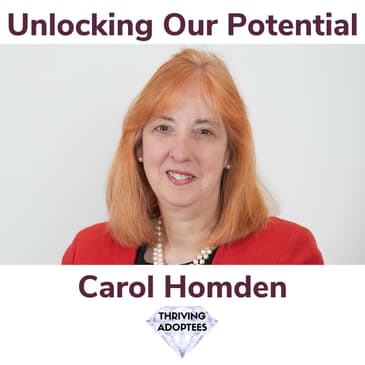
"The past is a place of reference, not a place of residence." A great quote from Roy T. Bennett. As adoptees we talk a lot about the past, our stories and more. This episode is all about the future. Creating our own future. Listen in as Carol shares insights and learnings on potentiality - unlocking our potential. But it's not all about us, it's about helping others unlock their potential too.
Here's the link to listen to the interview I mention. It's with Anthony Lynch and it's called Different, Not Wrong:
https://thriving-adoptees.simplecast.com/episodes/different-not-wrong-with-anthony-lynch
Connect with Carol here:
https://www.linkedin.com/in/dr-carol-homden-cbe-39413918/?originalSubdomain=uk
https://www.facebook.com/Coramsince1739
https://www.instagram.com/coram.uk/
Guests and the host are not (unless mentioned) licensed pscyho-therapists and speak from their own opinion only. Seek qualified advice if you need help.
Want to learn more about thriving for you, your kids, your families or your colleagues? Pick a time to talk here
[00:00:02] Hello everybody, welcome to another episode of Thriving Adoptees podcast and this is the first, first interview of the year. So Happy New Year listeners. Happy New Year. Carol, today I'm delighted to be joined by Carol, Carol Homden. Thank you for making time for us today.
[00:00:17] My pleasure and Happy New Year.
[00:00:18] Happy New Year. So yeah, listeners, Carol and I have planned to do this on two previous occasions, but we've got sidelined by talking about other stuff, other adoption related stuff. So here we are third time lucky.
[00:00:34] So what comes to your mind Carol when you hear this, the name of the podcast Thriving Adoptees, what comes to your mind?
[00:00:45] What comes to my mind is actually a marvellous thought, which is that it's so important to celebrate adoptees and their adoptive families in achieving a thriving for life.
[00:01:02] Yeah.
[00:01:03] And I think that's really important to recognise and also what is involved in that, paying a tribute as it were, to that lifelong journey.
[00:01:15] Which is adoption.
[00:01:17] Yeah.
[00:01:18] So thank you, Simon, for making these podcasts and for making that possible and for all of us to travel together in understanding that journey.
[00:01:29] Yeah.
[00:01:30] What does thriving mean to you?
[00:01:34] What an interesting question.
[00:01:36] I think thriving means being comfortable with oneself, one's story and one's potentiality for the future.
[00:01:47] It doesn't mean that everything is perfect, but it does mean that one has reflected, accepted, considered and knows that we are, what would be the term perhaps, able to navigate our future with confidence.
[00:02:12] Yeah.
[00:02:14] I love all that.
[00:02:16] I love all that.
[00:02:17] I love all that.
[00:02:17] The area that seems to be least covered on the 500 odd episodes that we've had in the bag show, so to speak, and the one that really hits me between the eyes is the most interesting bit too, is the potentiality.
[00:02:37] So, and this forward looking, and so, you know, you mentioned story, which looks to me, you know, for me is we look at your story is looking in the past potentiality.
[00:02:49] And, and so, you know, potentiality, we're clearly we're talking about the future.
[00:02:53] So what's potentiality and how does that stack for us as, for the listeners and the adoptees?
[00:03:04] What does potentiality mean?
[00:03:07] Well, again, that's a complex question, and I am not a psychologist, but I'm going to answer it from, from two different directions.
[00:03:15] I'm going to say that if we read a story, and we can see the beginning and middle and the end of that story, and we can see the way in which the narrative unfolds and the chapters are written and the writer has crafted that narrative, and we can see ourselves in relation to that story.
[00:03:33] It identifies and helps us to identify that we are not the victims of our past.
[00:03:41] The story can unfold and can be written in different ways, and that we have agency within that, that we have choices that can be made, that understanding the start of the story as a beginning and understanding our context and our origins is really important to our present.
[00:04:03] But it also really identifies that we can unlock ourselves different futures.
[00:04:11] So that's quite theoretical.
[00:04:13] But here in Quorum, we do quite a lot of work with children about reading, and the enormous importance of storytelling and reading, and helping us to understand that we are able to develop and craft and write our own story.
[00:04:30] That, for me, that for me is what potentiality means.
[00:04:33] It means that agency.
[00:04:35] So it doesn't mean having all the skills in the world or learning to speak French or whatever.
[00:04:42] All of those things may happen.
[00:04:44] They are part of different pathways.
[00:04:45] But the potentiality is actually the core self-belief, which is about the fact that we can be agents in that.
[00:04:54] And, you know, I have the privilege to be chief executive of the world's first and longest continuing children's charity, the very origin of children's social care, which is itself a story that has unfolded.
[00:05:10] And one where support to children who have needed the support of others, of other families in order to support them.
[00:05:21] This is absolutely core to the work that we do.
[00:05:27] And one of our oldest beneficiaries of the moment, he had been relinquished into the care of what was then called the Foundling Hospital as a baby.
[00:05:42] He had experienced that schooling for the 15 or so years of the time.
[00:05:50] He had entered the army.
[00:05:52] He had fought in the Battle of the River Kwai.
[00:05:55] He had lost his ear.
[00:05:56] He had been a prisoner of war and he lost his wife to the influenza epidemic.
[00:06:03] And I said to him, what have you learned, David?
[00:06:06] And he said, I have learned that you need to accept and adapt.
[00:06:12] And that has meant so much to me through time that if we can come to terms with the things that we traveled from and have traveled through,
[00:06:22] and we then learn the skills to adapt and develop.
[00:06:27] And that is the potentiality that you talk about.
[00:06:32] So you're linking kind of that future focus.
[00:06:36] It's adapting and writing our own, writing our own future, an empowerment and future facing approach.
[00:06:48] Yes.
[00:06:49] Yes.
[00:06:50] And I think, you know, recognizing the fact that it is children who are adopted and children are, are children, development, children develop.
[00:07:01] They are, what's the word?
[00:07:04] They're dynamic.
[00:07:05] They actually evolve and develop.
[00:07:08] And we can and do continue to do that.
[00:07:11] And we can reconsider our story and re-acclimatize ourselves within our context.
[00:07:22] And I think that I think having a podcast of this nature that allows the different perspectives of thriving adoptees to convey those,
[00:07:32] it amounts to so much more than the sum of the parts.
[00:07:35] Each individual story is itself powerful, but the aggregation of all of those experiences is also a really important story.
[00:07:43] Yeah.
[00:07:46] What's coming to my mind as well, it is because I've done some therapy, but not a lot.
[00:07:53] And, but I've been coached a lot.
[00:07:57] And the idea that this, this, this, the central thing for me is that a lot of therapy looks back, whereas coaching is all about looking forward and, and, and to what we want to achieve rather.
[00:08:16] So it's all about, it's about the, the, the chance for change in how we feel, think and feel now as an enabler for greater, greater achievement in, in, in, in the future or the achievement of, of goals.
[00:08:43] Yes.
[00:08:45] I mean, a therapeutic journey, which is obviously supported by a very significant amount of scientific understanding and care and skill is, is, and may be a very important ingredient in, in this.
[00:09:01] Um, equally, one may find one's path, you know, and a child may find their path and a sense of belonging, perhaps in a community, uh, of, of, uh, shared experiences or in an, in a community of shared goals.
[00:09:18] So for example, uh, sport can play an incredibly important thing, playing a violin in an orchestra so that one feels not alone.
[00:09:29] So something very important or with the freedom and permission to explore one's old past and have the courage and skills and support to do that, but also something very important about the sense of belonging.
[00:09:45] So often adopted children, um, will, you know, maybe the only adopted child in their school, certainly in the UK, because very few children are actually adopted these days.
[00:09:56] So it's really important, uh, that they know that they're not the only one.
[00:10:02] They're not the only one today or yesterday or tomorrow.
[00:10:06] Yeah.
[00:10:07] Yeah.
[00:10:07] Uh, and, and actually that validation of those experiences, uh, and that sense of, um, uncertainty or anxiety or whatever, um, can be sometimes greatly, uh, and, uh, facilitated and strengthened.
[00:10:27] Yeah.
[00:10:27] Uh, just by that.
[00:10:28] We've, we've run workshops, for example, for, with older young people who are adopted working with younger young people.
[00:10:35] Uh, and that is so interesting because, uh, there will be, for example, conversations that take place about the experience of school or about, um, how my parents don't understand me.
[00:10:50] And the older adoptees, for example, say, yeah, well, I used to think that, but actually the music is a bit loud, isn't it?
[00:10:57] And, you know, it's so interesting how that peer support, uh, to, to the experience can, can be very strengthening, um, of resilience.
[00:11:07] But equally, there are other circumstances, as you say, uh, where, uh, different types of therapeutic support, uh, whether that's, as it were, psychological and talking therapies, or actually whether it's more sensory work, um, addressing some of the issues that may have occurred is really vital.
[00:11:28] And it is very important that people, um, have access to that, uh, in a timely way.
[00:11:35] Yes.
[00:11:35] But I think the podcast series itself is, is helping with that sense of, of a belonging and of, and of a traveling and of, and of not being alone.
[00:11:45] Yes.
[00:11:46] Yeah.
[00:11:47] All those things.
[00:11:48] And, and the, the thing that strikes me is, uh, is, is, is the, is the journey and the passing back.
[00:11:58] So the, the, the idea, what, what's consistent with what we're trying to do on the show and what you just talked about with your mentoring program is to, uh, is to have communication between people at different stages of the journey.
[00:12:14] So that we, you know, we, we, we, we, we're, we're, we're catalyzing the healing.
[00:12:20] We're catalyzing, we're accelerating the growth.
[00:12:23] We're catalyzing progress by sharing what's helped, uh, helped us.
[00:12:29] And that's one of the things I, you know, people ask me questions about all sorts of different things.
[00:12:33] I will often say to them is find out somebody who's ahead of you on the journey that you want to take and, and, and help and ask them what helped them get there.
[00:12:44] And then that might unlock some stuff within, within you.
[00:12:48] What is the message you would have given to your past self is an interesting, uh, way of thinking about that.
[00:12:56] But with the nuance that there are two dynamics here, there is age and there is also stage.
[00:13:04] So one, maybe at a different stage in the journey, irrespective of age.
[00:13:09] Um, so, you know, um, and it's interesting that, uh, quite a number of, uh, older adoptees.
[00:13:18] So perhaps adoptees in their fifties or sixties will say to me is that, um, I've undertaken this journey now and I'm glad I didn't do that when I was 21.
[00:13:28] Because I'm now at the stage of my life, my age, where the elements of the story that I am uncovering, uh, can be placed in a broader context of the family life that I have gone on to have.
[00:13:44] For example, and equally, uh, younger children will benefit greatly from, uh, just young people a little bit older than them.
[00:13:54] Uh, able to just say, I know, I, I know, I recognize what you're saying.
[00:14:00] And it doesn't always have to feel like this.
[00:14:04] You know, you can travel, travel a journey.
[00:14:06] Yeah.
[00:14:07] So there's no magic bullet is there to, uh, any of us in our, in our navigation of life, but there is, you know, the support and encouragement that we can receive, uh, from, from those around us who have empathy and synergy and compassion.
[00:14:27] Yeah.
[00:14:28] Have you got a favorite metaphor around, uh, potentiality?
[00:14:34] Oh, I don't think I do.
[00:14:41] I think there is a saying, but it's that, that comes into my mind from the poet, uh, Rilke.
[00:14:49] But which actually might sound like it's not about potentiality, but, um, it is, it's translated also from his orational journey, but it is.
[00:15:01] It is, who talks of victory, question mark, to see it through is everything.
[00:15:11] And that travels with me in many contexts, actually, that, uh, life is about the seeing through.
[00:15:23] Yeah.
[00:15:25] And, uh, and, uh, and, and, and another, this is really not quite addressing your question and you'll have to forgive me because I can't draw down a metaphor directly.
[00:15:35] Um, uh, but there's also, uh, the famous speech by Churchill who said that, um, along the lines of, uh, defeat is not final.
[00:15:52] Victory is not absolute.
[00:15:54] It is the courage to carry on that matters.
[00:15:56] Yes.
[00:15:57] I have just that sense, actually, that that is where the potentiality lies in that courage, in that daily journey, uh, of, of opening up those new opportunities.
[00:16:10] And the other thing that comes to my mind, it's not really quite a metaphor.
[00:16:15] Um, but, uh, Malala, Malala Youssef, uh, said that in a world that is silent, even one small voice is powerful.
[00:16:25] Yeah.
[00:16:26] Yeah.
[00:16:26] So it's actually, again, it's not quite resonant.
[00:16:30] I don't quite have one about potentiality.
[00:16:33] So you'll have to forgive me.
[00:16:35] But those, those do live with me.
[00:16:37] That sense of, um, yeah, the courage, the courage of continuing to explore and travel and reinvent oneself and move to the future.
[00:16:50] Yeah.
[00:16:51] So the, the phrase that pops off to me on the back of that is lifelong learning.
[00:17:00] Yes.
[00:17:01] Certainly.
[00:17:01] Never, never done.
[00:17:03] Never, never finished.
[00:17:05] It's, it's a lifelong.
[00:17:06] So you've got life, lifelong, lifelong journey and lifelong learning.
[00:17:12] Yeah.
[00:17:13] Lifelong learning on a lifelong journey.
[00:17:15] Yeah.
[00:17:15] And the other thing I would say that is lifetime opportunity, because there is a lifetime of moments at which one can open new doors and take new avenues.
[00:17:31] Yeah.
[00:17:32] If cross cutting all of that, one has the courage to carry on.
[00:17:36] Yeah.
[00:17:38] Yeah.
[00:17:38] You, you talked about opening, opening the doors just then.
[00:17:42] Uh, and I think the, the reason I asked the question, a reason I asked for a metaphor around potentiality is because I think you used the word unlock.
[00:17:51] Yes.
[00:17:52] Um, and where I was, where I was going was, well, what, what do you see as the, uh, the keys that unlock our potentiality?
[00:18:05] Well, that is such an interesting question.
[00:18:08] And at Corum, we work a lot in the context of the building of resilience.
[00:18:14] And there is no doubt that a sense of security is, is really important, uh, educational opportunity so that one can develop skills and see different avenues that you could, uh, potentially take in life.
[00:18:33] Um, and I think the other thing I would say based on our experience here is the, I'm not going to quite use the word forgiveness, but the, the building of pride, a sense of self, the pride in who I am.
[00:18:58] Um, yeah, um, and of course going with that involves, um, that sense of, uh, doesn't mean to say that that's all about me.
[00:19:16] You know, that it isn't just about self-obsession, but actually about so many of the young people that we work with in Corum, uh, for example, young people in the care system who may have had a very rough time, multiple moves and a lack of security, lacking in continuity or access to education, perhaps periods of homelessness or, or worse.
[00:19:41] They will get involved in activities in, in, in, uh, working with others.
[00:19:46] And they so often say to me, I can now feel proud of who I am because I have served others.
[00:19:55] Yeah.
[00:19:57] Yeah.
[00:19:59] Did we talk about Lem Cissé last time we spoke?
[00:20:01] Well, yes.
[00:20:03] I mean, obviously Lem is a very important and charismatic and powerful, uh, important man.
[00:20:10] And figure.
[00:20:11] Um, very wise.
[00:20:12] And of course, the fact that he, he has found poetry as his avenue of expression and gives us so many, uh, powerful metaphors and the way in which he then shares those moments and rays of light and potentiality through his work.
[00:20:29] And his generosity in sharing his journey, which had very troubled times, uh, within it, but sharing the way in which he's navigated that journey.
[00:20:41] And, uh, I feel sure, but I absolutely hope that Lem would feel rightly proud of who he is.
[00:20:49] Yeah.
[00:20:50] He's doing so much work, uh, uh, uh, in the service of others.
[00:20:55] So that is a very interesting, uh, case study that you raised there.
[00:21:00] And, you know, I would commend people to read his book, uh, and indeed his, um, well, it's not Twitter anymore, but his, uh, his social media.
[00:21:10] Yeah.
[00:21:11] Where his little rays of light on different days, seeing the world from different perspectives, you know, gives one that, um, yeah, that encouragement.
[00:21:20] Yeah.
[00:21:23] Yeah.
[00:21:23] Yeah.
[00:21:23] I've, I've, uh, listened to his book on, um, on audio, uh, and loved it, but I've, funnily, because he's known for his poetry, but I, I've never dived into his poetry, only his life story.
[00:21:35] So this, this guy was, uh, he, he was, he, he was adopted, wasn't he?
[00:21:41] And then that, they, then, then that ended and he went into care and he, yeah.
[00:21:47] Uh, and he, he, he, he, he had a, he had a really tough time, but, um.
[00:21:51] Yes.
[00:21:52] He, he, he was adopted.
[00:21:54] He, his adoption then broke down and at a very difficult age and stage too.
[00:22:00] So he then had a very turbulent adolescence with a lot of very complex and difficult experiences in residential care.
[00:22:10] And then, uh, I suppose it must've been in his twenties, but certainly as he got older,
[00:22:16] he then accessed his records and explored his story and found actually his, you know, his, literally his name.
[00:22:25] Yeah.
[00:22:25] His name had been changed, um, and then was able to rediscover his roots and to learn the, the much more around the circumstances and realities, uh, of his mother's situation.
[00:22:41] Yeah.
[00:22:41] Yeah.
[00:22:41] Which brought him then, uh, a much greater sense of, uh, well, what would be the words?
[00:22:47] Kind of settlement of, of issues, I, I suppose, but it's not for me to speak for him.
[00:22:55] But his book is very compelling on that.
[00:22:58] Yeah.
[00:22:58] That, that word settled sounds like a really good word for thriving.
[00:23:09] Yes.
[00:23:10] A word settled and, um, and grounded.
[00:23:16] The, the, the, going back to the potentiality, the word that popped into my head.
[00:23:23] So you talked about, um, resilience, security, forgiveness, pride, um, and, uh, education.
[00:23:33] The word that popped into my head was openness.
[00:23:36] Yes.
[00:23:37] Rather than being set in our ways.
[00:23:40] And, you know, people talk about mindset.
[00:23:42] And I think about, when I think about set, I think about concrete setting and being intransigent and, and, and hopefully not becoming a grumpy old man.
[00:23:54] Because grumpy old men are by their nature, right?
[00:23:57] Set in their ways, their nature.
[00:23:58] And, and, and I don't want to be a grumpy old man.
[00:24:02] Um, my wife probably said that in some respects I am becoming more set in my ways, but the opposite of, uh, the opposite of set, um, would seem to me to be open.
[00:24:17] And instead of mindset, I'd be thinking about kind of mind fluid.
[00:24:24] Yes.
[00:24:24] Um, it takes a level of confidence and a level of inherent settlement to be able to be open in that way, I think.
[00:24:36] So, um, I have a little, uh, well, I'm not quite sure what the term would be, but a little way in which I sometimes would describe the work that Coram is involved in.
[00:24:49] And it would go like this.
[00:24:52] It's, I stopped crying because no one picked me up.
[00:24:58] I don't try because I might fail.
[00:25:02] I hurt myself so no one can hurt me more.
[00:25:07] So, as it were, the risk of trying and the risk of rejection, it may be a very significant barrier that needs to be unlocked.
[00:25:22] Hence the importance of this sense of place in the world and, uh, of being able to come to terms with.
[00:25:31] And, and openness is very important in that.
[00:25:35] I'll just come back to, to that, uh, in order that you can then have the confidence, courage, and so on to be open.
[00:25:43] Because it is that that opens the potentiality.
[00:25:46] That's why the word unlock, uh, for me is, is so important.
[00:25:51] But it's not like there is a single key or a magic bullet.
[00:25:56] It is a process that involves, um, a number of those different ingredients.
[00:26:01] And the reason I was flagging openness, which is, I thought, where you might be going is, of course, in the story of care and in the story of adoption, we have moved so significantly, uh, from an era of anonymity.
[00:26:19] Or perhaps it wasn't, in many circumstances, certainly in Coram's history, it wasn't so much, uh, an anonymity as a not knowing.
[00:26:29] So, and still, you know, there are circumstances around the world where adoptions take place where actually the identity of the child is not known.
[00:26:38] But the, certainly in general, we have moved from a sense of anonymity and, and, uh, and, and not sharing that information.
[00:26:48] And it therefore being a mystery and, uh, and, and, and, and an absence, uh, which, which is probably the most difficult to come to terms with to a modern approach, which is to say, uh, adoption is always based on openness of all the available information.
[00:27:07] You know, subject, you know, subject of course, to the welfare of the child and the age and stage of that child, because there can be some very profound and complex matters that have led to adoption, which obviously, uh, need care in, in their sharing.
[00:27:26] But nonetheless, the principle, uh, is one of that openness.
[00:27:31] And I'd be interested in, in your perspectives on that, Simon, but it seems to me that that is the biggest shift, really, the major shift, um, along with social attitudes that had, um, really kind of packaged that, that sense of lack of transparency and information with layers of perceptions of shame.
[00:27:54] Yeah.
[00:27:55] And stigma and stigma and sin, uh, to, uh, a modern sense, which is more, um, in some ways is, is, is, is a more compassionate, um, system and a more recognition of the fact that, um, having no information may well be a harmful absence in itself, a trauma in itself.
[00:28:22] Yeah.
[00:28:23] Yeah.
[00:28:23] Yeah.
[00:28:23] And the, the, the questioning, the, the, the incessant questioning that many adoptees have, have, uh, took, share with me that they have had from a very early age.
[00:28:35] And that wasn't my, that wasn't my experience.
[00:28:39] I wasn't question, I wasn't questioning a lot, but I know a lot of people, a lot of adoptees do.
[00:28:45] I felt that, yes.
[00:28:47] I mean, that, that is tied up with this complex question around, um, a sense of relinquishment, a sense of a, an unknown story, a sense of pressures or forces that must have made that happen.
[00:29:06] Yeah.
[00:29:08] Yeah.
[00:29:08] Which I think is also, um, uh, a different experience, certainly in the UK than the modern experience where, uh, adoption was very much a service is very much a service for children.
[00:29:23] For whom protection is a principal driver.
[00:29:26] so there are differences
[00:29:29] but as well
[00:29:31] underneath very
[00:29:33] profound
[00:29:36] shared
[00:29:37] experiences in that sense
[00:29:39] of searching
[00:29:41] and loss
[00:29:42] but in the many hundreds of years
[00:29:45] of this organisation supporting
[00:29:47] children in these explorations
[00:29:49] it is a minority
[00:29:50] who have
[00:29:54] wanted or
[00:29:55] come to that point
[00:29:58] of wanting to
[00:29:59] fully explore
[00:30:01] all of those issues
[00:30:03] So
[00:30:04] what about the
[00:30:09] potentiality
[00:30:10] and this notion
[00:30:12] of exploration
[00:30:13] and openness
[00:30:16] and curiosity
[00:30:17] and agency
[00:30:19] how do all these things
[00:30:21] create
[00:30:24] help us create a better
[00:30:26] future
[00:30:26] for ourselves
[00:30:28] and our
[00:30:28] fellow
[00:30:29] travellers
[00:30:32] Do you mean for ourselves
[00:30:33] or for others?
[00:30:35] Well
[00:30:38] either
[00:30:39] pick the one that you
[00:30:42] feel
[00:30:44] drawn to
[00:30:45] that you
[00:30:46] take
[00:30:47] to
[00:30:48] Well I don't
[00:30:49] know that I
[00:30:50] have fully
[00:30:50] the expertise
[00:30:51] to answer that
[00:30:52] from a
[00:30:53] kind of fully
[00:30:55] psychological
[00:30:56] basis
[00:30:57] but what I
[00:30:58] would
[00:30:59] what I think
[00:31:00] I would say
[00:31:01] is that
[00:31:03] we
[00:31:04] we need to
[00:31:06] live
[00:31:07] our values
[00:31:08] so
[00:31:10] if we
[00:31:10] share
[00:31:11] our
[00:31:12] experiences
[00:31:13] with others
[00:31:14] we are
[00:31:15] demonstrating
[00:31:17] that
[00:31:18] openness
[00:31:19] and that
[00:31:22] journey
[00:31:23] of exploration
[00:31:25] in its
[00:31:26] positive
[00:31:27] sense
[00:31:28] so in
[00:31:29] that sense
[00:31:29] it is the
[00:31:30] extension
[00:31:31] of
[00:31:32] of a gift
[00:31:33] and of
[00:31:34] guidance
[00:31:36] and back
[00:31:37] to that
[00:31:37] point
[00:31:37] about
[00:31:39] permission
[00:31:40] almost like
[00:31:40] a permission
[00:31:41] to
[00:31:44] to
[00:31:44] to extend
[00:31:45] for the other
[00:31:46] person to
[00:31:47] extend their
[00:31:48] hand
[00:31:48] and quite
[00:31:50] a lot of
[00:31:50] work that
[00:31:51] we we do
[00:31:52] in charity
[00:31:53] is around
[00:31:53] helping people
[00:31:54] to find tools
[00:31:55] to do
[00:31:56] that
[00:31:56] together
[00:31:57] so we
[00:31:59] have been
[00:31:59] developing
[00:32:00] something
[00:32:00] called
[00:32:03] objects
[00:32:03] in our
[00:32:04] stories
[00:32:05] which is
[00:32:07] designed to
[00:32:08] help
[00:32:09] it could
[00:32:10] be social
[00:32:11] workers
[00:32:11] it could
[00:32:11] be foster
[00:32:12] carers
[00:32:13] it could
[00:32:13] be
[00:32:14] our
[00:32:15] friends
[00:32:15] which is
[00:32:17] that
[00:32:17] finding
[00:32:18] those points
[00:32:19] of connection
[00:32:20] and
[00:32:20] exemplifying
[00:32:22] the story
[00:32:22] through the
[00:32:24] choice
[00:32:24] of an
[00:32:25] object
[00:32:25] that we
[00:32:26] share
[00:32:26] because then
[00:32:27] you have
[00:32:28] as it
[00:32:28] were a
[00:32:28] repository
[00:32:29] for the
[00:32:30] shared
[00:32:30] connection
[00:32:31] and the
[00:32:32] shared
[00:32:33] journey
[00:32:33] which is
[00:32:34] a trust
[00:32:36] and a
[00:32:38] point
[00:32:38] yeah as
[00:32:38] I say
[00:32:39] a point
[00:32:39] of connection
[00:32:40] that you
[00:32:40] can make
[00:32:41] so that
[00:32:42] can be
[00:32:43] enormously
[00:32:43] helpful
[00:32:44] partly
[00:32:44] because
[00:32:45] even a
[00:32:46] young
[00:32:47] child
[00:32:48] will be
[00:32:49] able to
[00:32:49] perhaps
[00:32:50] say
[00:32:50] why the
[00:32:51] teddy
[00:32:51] you know
[00:32:52] they might
[00:32:52] choose
[00:32:53] the teddy
[00:32:54] and so
[00:32:55] you can
[00:32:55] immediately
[00:32:56] then
[00:32:56] explore
[00:32:57] the
[00:32:58] issues
[00:32:59] around
[00:32:59] why
[00:32:59] teddy
[00:33:00] matters
[00:33:00] and the
[00:33:01] fact
[00:33:01] that
[00:33:01] I
[00:33:02] had a
[00:33:02] teddy
[00:33:02] too
[00:33:03] and
[00:33:03] my
[00:33:04] grandma
[00:33:04] gave me
[00:33:05] my
[00:33:05] teddy
[00:33:05] and
[00:33:06] where
[00:33:07] did
[00:33:07] your
[00:33:07] teddy
[00:33:07] come
[00:33:07] from
[00:33:08] do you
[00:33:08] see
[00:33:08] what I
[00:33:08] mean
[00:33:08] I'm
[00:33:08] not
[00:33:09] meaning
[00:33:09] for that
[00:33:10] to
[00:33:10] sound
[00:33:10] trivial
[00:33:11] and
[00:33:11] I
[00:33:11] have
[00:33:11] chosen
[00:33:12] an
[00:33:12] experience
[00:33:13] for a
[00:33:13] young
[00:33:14] child
[00:33:14] but
[00:33:15] equally
[00:33:15] it
[00:33:16] might
[00:33:16] be
[00:33:20] something
[00:33:21] which
[00:33:22] is
[00:33:22] a
[00:33:23] more
[00:33:23] reflective
[00:33:24] piece
[00:33:24] or
[00:33:25] imagery
[00:33:26] and so
[00:33:27] on
[00:33:27] and
[00:33:28] having
[00:33:29] those
[00:33:30] points
[00:33:30] of
[00:33:30] connection
[00:33:31] as I
[00:33:31] say
[00:33:31] that
[00:33:32] gift
[00:33:33] that
[00:33:34] extended
[00:33:34] bridge
[00:33:35] I
[00:33:35] think
[00:33:35] is
[00:33:36] personally
[00:33:37] extremely
[00:33:37] crucial
[00:33:38] in
[00:33:39] what
[00:33:39] you're
[00:33:39] describing
[00:33:41] I
[00:33:42] love
[00:33:43] that
[00:33:44] and I
[00:33:44] think
[00:33:44] it
[00:33:46] plays
[00:33:46] back
[00:33:47] to
[00:33:47] what
[00:33:47] you
[00:33:47] talked
[00:33:47] about
[00:33:48] the
[00:33:48] mentoring
[00:33:49] process
[00:33:50] and
[00:33:50] mentoring
[00:33:51] systems
[00:33:51] you have
[00:33:52] older
[00:33:54] kids
[00:33:55] helping
[00:33:55] younger
[00:33:56] kids
[00:33:56] and
[00:33:57] does
[00:33:58] the
[00:34:01] empowerment
[00:34:02] that comes
[00:34:02] from this
[00:34:03] and also
[00:34:04] the idea
[00:34:04] that
[00:34:05] if we
[00:34:06] are
[00:34:07] we're
[00:34:08] often prepared
[00:34:09] to do
[00:34:09] more
[00:34:09] for others
[00:34:10] than we
[00:34:10] are
[00:34:10] for ourselves
[00:34:12] and
[00:34:14] obviously
[00:34:15] we're
[00:34:15] just
[00:34:15] now
[00:34:16] here we
[00:34:17] are
[00:34:17] on the
[00:34:18] 8th
[00:34:18] of
[00:34:18] January
[00:34:18] whatever
[00:34:18] it
[00:34:19] is
[00:34:19] was it
[00:34:20] 8th
[00:34:21] 9th
[00:34:23] we're
[00:34:24] thinking
[00:34:24] about
[00:34:25] Christmas
[00:34:26] and the
[00:34:26] idea
[00:34:27] that
[00:34:27] giving
[00:34:29] gives
[00:34:30] such
[00:34:30] pleasure
[00:34:34] so
[00:34:34] we
[00:34:35] get
[00:34:35] back
[00:34:36] in
[00:34:36] spades
[00:34:37] when
[00:34:38] we
[00:34:38] pick
[00:34:38] out
[00:34:38] a
[00:34:39] present
[00:34:39] when
[00:34:39] we
[00:34:40] help
[00:34:40] somebody
[00:34:40] else
[00:34:41] we
[00:34:42] get
[00:34:43] a lot
[00:34:44] of
[00:34:44] we
[00:34:45] get
[00:34:45] a good
[00:34:46] feels
[00:34:47] I believe
[00:34:47] is the
[00:34:48] current
[00:34:48] world
[00:34:49] we can't
[00:34:50] say feelings
[00:34:50] anymore
[00:34:51] there's too
[00:34:51] many syllables
[00:34:52] we have
[00:34:52] to say
[00:34:52] feels
[00:34:53] right
[00:34:53] but
[00:34:54] you know
[00:34:55] and there's
[00:34:56] often that
[00:34:57] point
[00:34:57] where we
[00:34:59] are
[00:35:01] we
[00:35:02] become
[00:35:04] keen
[00:35:05] we
[00:35:05] become
[00:35:07] we
[00:35:08] want
[00:35:08] to
[00:35:08] share
[00:35:08] our
[00:35:09] stories
[00:35:09] in
[00:35:10] case
[00:35:10] it
[00:35:10] helps
[00:35:12] others
[00:35:13] and
[00:35:14] how
[00:35:14] important
[00:35:15] that
[00:35:15] is
[00:35:15] in
[00:35:15] the
[00:35:16] world
[00:35:16] of
[00:35:16] adoption
[00:35:17] and
[00:35:17] how
[00:35:18] so many
[00:35:18] of your
[00:35:19] great
[00:35:19] colleagues
[00:35:20] last
[00:35:20] year
[00:35:22] at
[00:35:23] the
[00:35:24] conference
[00:35:24] in
[00:35:25] adoption
[00:35:25] conference
[00:35:25] in
[00:35:26] Liverpool
[00:35:26] and
[00:35:27] you know
[00:35:28] I was
[00:35:28] the
[00:35:28] panellist
[00:35:29] and
[00:35:29] I
[00:35:38] to
[00:35:38] share
[00:35:38] their
[00:35:39] learnings
[00:35:39] and how
[00:35:40] that
[00:35:41] they're
[00:35:42] throwing
[00:35:43] themselves
[00:35:43] into
[00:35:44] that
[00:35:44] opportunity
[00:35:45] and
[00:35:46] getting
[00:35:47] bucket
[00:35:47] loads
[00:35:48] of
[00:35:51] benefit
[00:35:52] back
[00:35:52] for
[00:35:53] them
[00:35:53] for
[00:35:54] themselves
[00:35:55] and
[00:35:55] I
[00:35:56] think
[00:35:56] it
[00:35:57] often
[00:35:58] happens
[00:35:59] somewhere
[00:36:00] along
[00:36:00] our own
[00:36:01] learning
[00:36:01] journey
[00:36:02] that
[00:36:02] we
[00:36:03] feel
[00:36:03] that
[00:36:03] we
[00:36:04] want
[00:36:04] to
[00:36:05] give
[00:36:06] back
[00:36:07] yes
[00:36:09] and
[00:36:09] you
[00:36:10] know
[00:36:10] adoption
[00:36:10] is not
[00:36:11] unique
[00:36:11] in
[00:36:11] that
[00:36:12] I
[00:36:12] mean
[00:36:13] I
[00:36:14] have
[00:36:15] a
[00:36:15] son
[00:36:15] with
[00:36:16] very
[00:36:16] complex
[00:36:16] needs
[00:36:17] who
[00:36:17] is
[00:36:18] autistic
[00:36:18] and
[00:36:18] has
[00:36:19] learning
[00:36:19] difficulties
[00:36:20] and
[00:36:21] it's
[00:36:22] been
[00:36:23] of great
[00:36:23] strength
[00:36:24] in
[00:36:25] very
[00:36:25] difficult
[00:36:26] times
[00:36:27] to
[00:36:27] actually
[00:36:28] in the
[00:36:28] same
[00:36:29] way
[00:36:29] to
[00:36:29] be
[00:36:30] able
[00:36:30] to
[00:36:30] connect
[00:36:30] with
[00:36:31] other
[00:36:32] parents
[00:36:33] perhaps
[00:36:34] with
[00:36:34] children
[00:36:35] who are
[00:36:36] older
[00:36:36] so
[00:36:37] how
[00:36:38] do
[00:36:38] you
[00:36:38] see
[00:36:39] what
[00:36:39] the
[00:36:39] journey
[00:36:40] might
[00:36:40] look
[00:36:41] like
[00:36:41] when
[00:36:43] you're
[00:36:44] facing
[00:36:44] so
[00:36:45] many
[00:36:45] things
[00:36:47] and
[00:36:48] so
[00:36:48] much
[00:36:49] stress
[00:36:49] and
[00:36:50] grief
[00:36:51] and
[00:36:52] so
[00:36:53] that
[00:36:53] is
[00:36:54] I
[00:36:56] think
[00:36:56] it
[00:36:56] applies
[00:36:56] to
[00:36:57] us
[00:36:58] as
[00:36:58] members
[00:36:58] of
[00:36:58] other
[00:36:59] types
[00:36:59] of
[00:36:59] communities
[00:37:00] as
[00:37:00] well
[00:37:00] I
[00:37:01] think
[00:37:01] these
[00:37:01] are
[00:37:01] the
[00:37:02] kind
[00:37:02] of
[00:37:02] human
[00:37:04] truths
[00:37:05] things
[00:37:05] but
[00:37:06] there
[00:37:07] is
[00:37:07] something
[00:37:08] I
[00:37:08] think
[00:37:09] very
[00:37:11] particular
[00:37:12] about
[00:37:13] the
[00:37:14] sense
[00:37:14] of
[00:37:15] identity
[00:37:16] of
[00:37:17] living
[00:37:19] in
[00:37:20] between
[00:37:20] lines
[00:37:21] so
[00:37:22] this
[00:37:22] is
[00:37:23] where
[00:37:23] we
[00:37:24] have
[00:37:24] had
[00:37:24] the
[00:37:25] privilege
[00:37:25] of
[00:37:25] working
[00:37:25] with a
[00:37:26] group
[00:37:26] of
[00:37:26] young
[00:37:27] adoptees
[00:37:28] young
[00:37:28] who
[00:37:29] are
[00:37:29] in
[00:37:29] their
[00:37:30] twenties
[00:37:30] so
[00:37:31] they
[00:37:32] have
[00:37:33] come
[00:37:33] through
[00:37:34] their
[00:37:35] schooling
[00:37:35] system
[00:37:36] and
[00:37:36] some
[00:37:37] of
[00:37:37] them
[00:37:37] will
[00:37:37] have
[00:37:38] access
[00:37:39] records
[00:37:40] or
[00:37:41] access
[00:37:42] therapy
[00:37:43] but
[00:37:43] this
[00:37:43] group
[00:37:44] of
[00:37:44] young
[00:37:44] people
[00:37:45] who
[00:37:45] are
[00:37:45] living
[00:37:45] in
[00:37:46] blended
[00:37:46] families
[00:37:47] sometimes
[00:37:48] with
[00:37:49] birth
[00:37:51] children
[00:37:52] as
[00:37:53] well
[00:37:53] as
[00:37:54] other
[00:37:54] adoptive
[00:37:55] siblings
[00:37:56] who
[00:37:57] are
[00:37:57] coming
[00:37:57] from
[00:37:58] different
[00:37:58] nationalities
[00:37:59] different
[00:37:59] ethnic
[00:38:00] backgrounds
[00:38:01] they
[00:38:02] have
[00:38:02] been
[00:38:03] exploring
[00:38:03] with
[00:38:04] us
[00:38:04] these
[00:38:06] issues
[00:38:06] of
[00:38:07] navigation
[00:38:07] of
[00:38:09] blended
[00:38:10] identities
[00:38:11] in
[00:38:12] between
[00:38:12] lines
[00:38:13] and
[00:38:13] I
[00:38:14] think
[00:38:14] adoption
[00:38:14] and
[00:38:16] thriving
[00:38:17] adoptees
[00:38:18] have so
[00:38:18] much to
[00:38:19] teach us
[00:38:20] and to
[00:38:21] share
[00:38:22] which is
[00:38:23] so vital
[00:38:23] to
[00:38:24] the
[00:38:25] modern
[00:38:25] world
[00:38:25] which is
[00:38:26] so fluid
[00:38:27] in the
[00:38:28] sense
[00:38:28] of
[00:38:29] communities
[00:38:30] and
[00:38:31] identity
[00:38:32] and
[00:38:32] diversity
[00:38:33] and
[00:38:34] I've
[00:38:34] just
[00:38:34] been
[00:38:35] immensely
[00:38:35] impressed
[00:38:36] by
[00:38:36] the
[00:38:37] ways
[00:38:37] in
[00:38:37] which
[00:38:37] those
[00:38:38] young
[00:38:38] people
[00:38:39] have
[00:38:39] travelled
[00:38:40] that
[00:38:40] journey
[00:38:40] and
[00:38:41] used
[00:38:42] that
[00:38:42] journey
[00:38:43] not only
[00:38:43] for
[00:38:44] themselves
[00:38:44] in
[00:38:44] terms
[00:38:45] of
[00:38:45] their
[00:38:45] own
[00:38:46] discovery
[00:38:47] and
[00:38:48] potentially
[00:38:48] recovery
[00:38:49] and
[00:38:50] place
[00:38:51] in the
[00:38:51] world
[00:38:51] but
[00:38:52] actually
[00:38:52] seen
[00:38:53] that
[00:38:53] as
[00:38:53] something
[00:38:54] they
[00:38:54] can
[00:38:54] take
[00:38:55] forward
[00:38:56] to
[00:38:56] help
[00:38:57] others
[00:38:57] so
[00:39:00] this
[00:39:01] is
[00:39:01] regular
[00:39:03] listeners
[00:39:03] you might
[00:39:03] have
[00:39:03] listened
[00:39:04] to
[00:39:04] a
[00:39:04] podcast
[00:39:04] with
[00:39:05] a
[00:39:06] young
[00:39:06] adoptee
[00:39:08] called
[00:39:08] Anthony
[00:39:09] his surname
[00:39:10] has just
[00:39:10] gone out
[00:39:11] of my
[00:39:11] head
[00:39:12] so
[00:39:13] I'll
[00:39:13] put a
[00:39:14] link
[00:39:14] in the
[00:39:14] show
[00:39:14] notes
[00:39:15] this
[00:39:16] Anthony
[00:39:16] has been
[00:39:17] on the
[00:39:17] podcast
[00:39:17] before
[00:39:18] and
[00:39:18] he's
[00:39:18] one
[00:39:19] of
[00:39:19] the
[00:39:19] adoptees
[00:39:20] that
[00:39:20] you're
[00:39:20] talking
[00:39:20] about
[00:39:21] with
[00:39:21] this
[00:39:21] particular
[00:39:23] cohort
[00:39:23] so
[00:39:24] quick
[00:39:26] idea
[00:39:28] request
[00:39:29] if there's
[00:39:30] any more
[00:39:30] of those
[00:39:31] younger
[00:39:32] adoptees
[00:39:32] that want
[00:39:33] to come
[00:39:34] on the
[00:39:35] podcast
[00:39:35] they'd be
[00:39:35] very welcome
[00:39:36] to have
[00:39:36] a conversation
[00:39:37] with me
[00:39:37] to sign up
[00:39:38] it's okay
[00:39:39] find out
[00:39:40] if they
[00:39:41] want to
[00:39:41] do that
[00:39:42] because
[00:39:42] we do
[00:39:43] need
[00:39:44] different
[00:39:45] more
[00:39:46] younger
[00:39:47] adoptees
[00:39:48] I will
[00:39:49] let them
[00:39:50] know
[00:39:50] Simon
[00:39:51] in particular
[00:39:52] several
[00:39:52] of them
[00:39:53] have had
[00:39:53] inter-country
[00:39:54] experiences
[00:39:55] which I
[00:39:56] think is
[00:39:57] also
[00:39:58] a key
[00:39:59] ingredient
[00:40:00] within the
[00:40:01] story of
[00:40:02] adoption
[00:40:02] and
[00:40:03] very
[00:40:04] resonant
[00:40:05] to
[00:40:05] a
[00:40:05] globalised
[00:40:06] world
[00:40:07] where
[00:40:07] the
[00:40:08] navigation
[00:40:09] of
[00:40:09] cultural
[00:40:10] and linguistic
[00:40:11] backgrounds
[00:40:13] has become
[00:40:14] much more
[00:40:14] amplified
[00:40:15] than it
[00:40:16] used to
[00:40:17] be
[00:40:17] to go
[00:40:18] you
[00:40:19] mentioned
[00:40:20] when you
[00:40:21] were talking
[00:40:21] about
[00:40:22] some of
[00:40:22] your
[00:40:25] own
[00:40:26] private life
[00:40:26] you mentioned
[00:40:27] the word
[00:40:28] grief
[00:40:30] and
[00:40:32] that's
[00:40:33] a word
[00:40:34] that's
[00:40:34] often
[00:40:35] associated
[00:40:36] a lot
[00:40:36] of
[00:40:37] adoptees
[00:40:37] talk
[00:40:38] about
[00:40:38] grief
[00:40:38] I did
[00:40:39] a grief
[00:40:40] programme
[00:40:41] as a
[00:40:43] client
[00:40:43] last year
[00:40:44] to see
[00:40:45] if there
[00:40:46] was any
[00:40:47] grief
[00:40:48] that I
[00:40:48] wasn't
[00:40:48] aware
[00:40:49] of
[00:40:49] if there
[00:40:51] was
[00:40:51] unconscious
[00:40:52] grief
[00:40:52] to see
[00:40:53] if it
[00:40:53] surfaced
[00:40:54] if I could
[00:40:54] surface
[00:40:55] some stuff
[00:40:56] as part
[00:40:57] of my
[00:40:57] own
[00:40:58] ongoing
[00:40:58] journey
[00:40:59] and
[00:41:00] it didn't
[00:41:01] bring a
[00:41:02] lot
[00:41:03] for me
[00:41:04] actually
[00:41:04] the
[00:41:04] somatic
[00:41:05] stuff
[00:41:05] that I
[00:41:05] continue
[00:41:06] to do
[00:41:06] that's
[00:41:07] been
[00:41:07] far
[00:41:08] more
[00:41:09] beneficial
[00:41:10] but
[00:41:10] I was
[00:41:11] wondering
[00:41:11] if you
[00:41:12] are up
[00:41:13] for it
[00:41:14] could you
[00:41:14] share a
[00:41:15] little bit
[00:41:15] more about
[00:41:16] the grief
[00:41:16] stuff
[00:41:17] and you
[00:41:17] and if
[00:41:18] you'd
[00:41:18] rather
[00:41:18] not
[00:41:18] then
[00:41:19] clearly
[00:41:19] we're
[00:41:20] done
[00:41:20] well
[00:41:21] it's
[00:41:22] a great
[00:41:22] privilege
[00:41:22] to speak
[00:41:23] to you
[00:41:23] and I
[00:41:23] am
[00:41:23] not
[00:41:24] an
[00:41:24] adopter
[00:41:24] although
[00:41:25] I
[00:41:26] have
[00:41:26] worked
[00:41:26] in the
[00:41:27] field
[00:41:27] of
[00:41:28] adoption
[00:41:28] with
[00:41:29] and for
[00:41:29] the
[00:41:29] quorum
[00:41:30] charity
[00:41:30] in their
[00:41:31] service
[00:41:31] for many
[00:41:32] years
[00:41:32] but there
[00:41:34] is such
[00:41:34] a great
[00:41:34] resonance
[00:41:35] to the
[00:41:36] experience
[00:41:36] that I
[00:41:37] have had
[00:41:38] as a
[00:41:39] parent
[00:41:39] of a
[00:41:40] child
[00:41:40] with
[00:41:41] complex
[00:41:41] needs
[00:41:43] and of
[00:41:43] course
[00:41:44] within
[00:41:44] the UK
[00:41:45] context
[00:41:47] many
[00:41:48] children
[00:41:48] within the
[00:41:49] care system
[00:41:50] and who
[00:41:50] go on
[00:41:51] to be
[00:41:51] adopted
[00:41:51] may well
[00:41:52] also
[00:41:53] have
[00:41:53] additional
[00:41:54] needs
[00:41:55] in
[00:41:56] a
[00:41:56] disability
[00:41:57] or a
[00:41:57] special
[00:41:58] education
[00:41:58] or needs
[00:41:58] sense
[00:41:59] so
[00:42:00] there's
[00:42:00] a journey
[00:42:01] there
[00:42:01] around
[00:42:01] you know
[00:42:03] I could
[00:42:04] express it
[00:42:05] like this
[00:42:05] which is
[00:42:06] imagine the
[00:42:07] day that
[00:42:07] you're told
[00:42:08] that your
[00:42:10] child
[00:42:10] has a
[00:42:11] condition
[00:42:13] which
[00:42:13] cannot
[00:42:14] be cured
[00:42:16] and where
[00:42:17] they will
[00:42:18] experience
[00:42:20] marginalization
[00:42:22] and challenges
[00:42:25] and so
[00:42:25] will you
[00:42:27] so
[00:42:29] with
[00:42:30] autism
[00:42:31] and my
[00:42:31] experience
[00:42:31] of autism
[00:42:34] working with
[00:42:35] many families
[00:42:36] who have
[00:42:37] autistic
[00:42:37] children
[00:42:38] there's
[00:42:39] first of
[00:42:39] all
[00:42:39] the
[00:42:40] we knew
[00:42:41] something
[00:42:41] wasn't
[00:42:42] right
[00:42:42] and we
[00:42:44] just didn't
[00:42:45] know what
[00:42:45] it was
[00:42:46] and we
[00:42:46] were
[00:42:46] struggling
[00:42:47] and exploring
[00:42:47] how we
[00:42:49] come to
[00:42:49] terms
[00:42:49] with this
[00:42:50] and then
[00:42:51] the diagnosis
[00:42:52] is achieved
[00:42:54] and there's
[00:42:55] a kind
[00:42:55] of relief
[00:42:57] it wasn't
[00:42:58] me
[00:42:58] it wasn't
[00:43:00] I was
[00:43:01] doing it
[00:43:01] wrong
[00:43:02] you know
[00:43:02] it wasn't
[00:43:04] the wrong
[00:43:05] parenting
[00:43:06] or whatever
[00:43:07] you're right
[00:43:08] there is
[00:43:09] something
[00:43:09] and this
[00:43:09] is it
[00:43:10] so
[00:43:10] initially
[00:43:11] there would
[00:43:11] be perhaps
[00:43:12] a moment
[00:43:12] of relief
[00:43:13] and then
[00:43:14] there would
[00:43:15] be a grief
[00:43:15] which was
[00:43:19] actually around
[00:43:19] all that
[00:43:20] was not
[00:43:21] and all
[00:43:23] that that
[00:43:24] would not
[00:43:24] be
[00:43:25] and then
[00:43:28] actually
[00:43:28] something
[00:43:29] about
[00:43:29] realizing
[00:43:30] that
[00:43:31] and
[00:43:33] potentially
[00:43:33] a loss
[00:43:34] of social
[00:43:35] support
[00:43:35] network
[00:43:36] of others
[00:43:38] not coping
[00:43:39] with that
[00:43:40] even
[00:43:40] family
[00:43:41] wow
[00:43:43] then the
[00:43:44] rediscovery
[00:43:44] of
[00:43:46] a sense
[00:43:48] of belonging
[00:43:48] in a
[00:43:49] community
[00:43:49] of fellows
[00:43:51] who
[00:43:52] understand
[00:43:52] and that
[00:43:54] there is
[00:43:54] a journey
[00:43:55] and that
[00:43:56] there is
[00:43:57] that potential
[00:43:58] and possibility
[00:43:59] to make
[00:44:01] our way
[00:44:01] in the
[00:44:02] world
[00:44:02] and for
[00:44:03] our
[00:44:04] autistic
[00:44:04] son
[00:44:05] to realize
[00:44:06] his best
[00:44:07] potentiality
[00:44:08] so
[00:44:09] I don't
[00:44:11] know
[00:44:11] if that
[00:44:12] rings true
[00:44:13] entirely
[00:44:14] and there
[00:44:15] are obviously
[00:44:15] differences
[00:44:16] differences
[00:44:18] but for me
[00:44:19] that has
[00:44:19] always felt
[00:44:20] like a
[00:44:21] real bridge
[00:44:23] it's a
[00:44:23] human
[00:44:24] it's a
[00:44:24] very human
[00:44:25] story
[00:44:26] and there
[00:44:26] are
[00:44:26] the
[00:44:27] that
[00:44:28] you know
[00:44:29] is the
[00:44:30] is it
[00:44:32] the hero's
[00:44:33] journey
[00:44:34] there is
[00:44:35] that one
[00:44:37] so
[00:44:37] for many
[00:44:39] of us
[00:44:39] adoptees
[00:44:40] the diagnosis
[00:44:41] is coming
[00:44:42] out of the
[00:44:43] fog
[00:44:43] the diagnosis
[00:44:44] is the
[00:44:45] primal wound
[00:44:46] and then
[00:44:49] the sense
[00:44:50] that we're
[00:44:51] so for me
[00:44:51] personally
[00:44:52] right
[00:44:52] it was
[00:44:53] the sense
[00:44:54] I'm stuck
[00:44:55] with it
[00:44:55] right
[00:44:56] so that's
[00:44:56] the grief
[00:44:57] of what's
[00:44:58] lost
[00:44:59] and then
[00:45:01] there's
[00:45:01] the
[00:45:03] seeing
[00:45:05] through
[00:45:06] that
[00:45:06] in my
[00:45:08] case
[00:45:09] belief
[00:45:10] created
[00:45:12] obstacle
[00:45:13] that
[00:45:13] was
[00:45:14] mindset
[00:45:16] you know
[00:45:16] in terms
[00:45:17] of
[00:45:17] so
[00:45:20] there's
[00:45:21] the mindset
[00:45:21] and then
[00:45:23] there's
[00:45:23] the moment
[00:45:25] of
[00:45:25] mind
[00:45:26] fluidity
[00:45:27] when
[00:45:28] you
[00:45:28] realise
[00:45:29] that
[00:45:29] I am
[00:45:32] not
[00:45:32] stuck
[00:45:32] with
[00:45:34] this
[00:45:35] and then
[00:45:36] there's
[00:45:36] the community
[00:45:36] thing
[00:45:37] so I
[00:45:37] think
[00:45:37] the
[00:45:38] parallels
[00:45:39] are
[00:45:40] human
[00:45:41] ones
[00:45:42] and to
[00:45:43] do
[00:45:43] with
[00:45:43] challenges
[00:45:45] and
[00:45:46] things
[00:45:47] that we
[00:45:47] haven't
[00:45:48] envisaged
[00:45:49] before
[00:45:49] yeah
[00:45:50] and
[00:45:51] for me
[00:45:52] to see
[00:45:53] it through
[00:45:53] is everything
[00:45:55] to see
[00:45:56] it through
[00:45:56] is everything
[00:45:57] yeah
[00:45:58] yeah
[00:45:59] so
[00:46:02] we all
[00:46:02] have so
[00:46:03] much more
[00:46:03] to learn
[00:46:05] from each
[00:46:06] other
[00:46:06] and from
[00:46:07] the podcast
[00:46:08] so you
[00:46:09] know I
[00:46:09] commend you
[00:46:10] Simon for
[00:46:11] doing it
[00:46:11] and all
[00:46:11] those who
[00:46:12] contribute
[00:46:12] and I
[00:46:14] hope that
[00:46:14] the reflections
[00:46:15] are useful
[00:46:16] to all
[00:46:17] who may
[00:46:17] listen
[00:46:19] I'm sure
[00:46:19] there will
[00:46:20] be
[00:46:20] thank you
[00:46:20] thank you
[00:46:21] very much
[00:46:21] Carol
[00:46:21] and thank
[00:46:22] you
[00:46:22] listeners
[00:46:23] for listening
[00:46:24] to the
[00:46:24] first of
[00:46:25] this year's
[00:46:25] we'll have
[00:46:26] no more
[00:46:27] coming
[00:46:27] your way
[00:46:28] no doubt
[00:46:30] see you again
[00:46:31] soon
[00:46:31] thanks a lot
[00:46:33] thank you
[00:46:33] thank you
[00:46:33] for listening
[00:46:33] Thank you.