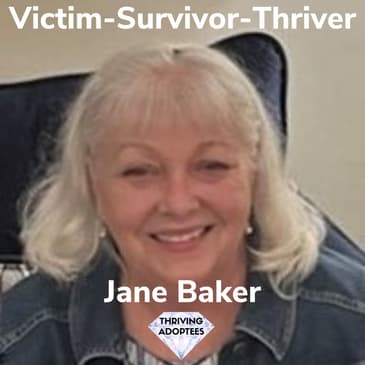
When we can see that our past and our trauma don't define us, we leave victimhood behind. Listen in as clinical social worker Jane shares learnings on what helps us move on...looking at what's going on in our heads, hearts and bodies.
Jane Baker, LICSW is a clinical social worker with concentration in trauma, attachment, and family systems. With her beginnings in the field of foster care and adoption over 25 years ago, she is experienced with the unique needs of adoptive families and children with early childhood trauma. This experience now includes recovery for other life changing situations such as Veterans issues, PTSD, divorce recovery, and grief/loss. She includes EMDR, and biofeedback in addition to traditional therapeutic approaches.
Connect with Jane here: https://www.adoption-associates.com/
Guests and the host are not (unless mentioned) licensed pscyho-therapists and speak from their own opinion only. Seek qualified advice if you need help.
Want to learn more about thriving for you, your kids, your families or your colleagues? Pick a time to talk here
[00:00:02] Hello everybody, welcome to another episode of Thriving Adoptees podcast. Today I'm delighted to be joined by Jane Baker in Decatur, Alabama. I spoke to Jane a couple of weeks ago and you were surprised to hear that she's got a huge heart for adoption. Only people with huge hearts for adoptions come on to this show. So the fundamental question, right, Jane, the one that I ask,
[00:00:32] everybody to kick this off, Thriving, what does that, what does Thriving mean to you, Jane? Oh, well from a clinical standpoint, we often move from victim to survivor to thriving and so Thriving is to me is when you've been able to make peace with the things, the losses in your life and or the traumas in your life and you recognize and value that you live to tell of them.
[00:01:01] And then you've figured out how to take those events and situations that that's happened to you and you've figured out how to make it work for you and for the betterment of other people. So it's not holding you back anymore.
[00:01:22] To me, that's kind of my ultimate definition of thriving and we can do that in lots of different ways. It doesn't always have to be just because we've had some big trauma, you know, in our life. But most of us have a few things in our life that we kind of wish hadn't happened. Yeah. Yeah. Have you heard that quote? Trauma is trauma is a fact of life, but it's not a life sentence.
[00:01:51] Have you heard that? Trauma is a fact of life. It doesn't have to define you. And I think when I work with people who've got a trauma history, that's a lot of it is untangling it.
[00:02:06] And if you've had a reasonably OK life and then some kind of trauma happens, it's kind of untangling who you are now from, you know, and getting to a place where you don't let that define your future. Yeah. You know, and of course, I work a lot, too, with kids who've been adopted out of orphanages and foster care and all of those kinds of things.
[00:02:35] So they had that just childhood developmental trauma. So they don't have a baseline to go back to. So I think the challenge in learning how to accept what's happened and grieve the losses and value that you survived and live to tell of it and then figuring out how to make that work for you and make you a stronger, either a stronger person or maybe more compassionate, more understanding of other people.
[00:03:06] That's a big journey. And it's a big process to get there. So I love the continuation, right? Victim, survivor, thriver. But there's presumably there's been for some of us, there's been a pre kind of victim state as well. There's an event's happened.
[00:03:36] What I think I mean by this is adopted at five weeks old or placed at five weeks old, should we say. I don't, I didn't have a much of a pre relinquishment, pre placement personality. Nevertheless, there was, there was a me there before.
[00:04:05] There was a me there before that, before that placement. Not one that I can remember clearly. Well, right. Cognitively, you can't pull it up. I'm a big believer. And I spent a lot of time studying things that Basil van der Kolk has written and others who've done a lot of study on, on childhood trauma and childhood losses. And our bodies remember everything.
[00:04:33] There's a part of your brain that remembers everything, but it typically remembers it in terms of perception, not in terms of facts or active memory cognitively that you can pull up and it's your own memory, which that doesn't really start till you're about five, six, seven, somewhere along in there. And we start having our own just cognitive memories, but there's body memories.
[00:04:59] And again, I think even in adoption, you know, babies that are placed at birth, you spent basically 40 weeks, 36 to 40 weeks in the body of someone else. You knew their moods and heartbeats and rhythms and all that stuff. And then suddenly they're gone. It's not, it's not in my world. It's not, it can be a traumatic thing.
[00:05:28] It doesn't have to be, but it is a loss. And it's certainly later as you kind of mature and you realize you learn that you're adopted and then you learn what that means. Oh, that means there's another family somewhere. That's when a lot of times that sort of cognitive work of making peace with your story kind of begins.
[00:05:52] And the way I think about it, you know, for some people that is, it is very traumatic for our kids in foster care. They had a lot of ups and downs and back and forth and hurt and disappointment. And, you know, the list of adjectives goes on before they get in their forever home. And some of it they remember, but some of it their body remembers. Yeah. So.
[00:06:19] How, because they're all, they're all wrapped up in one parcel, right? Does the, does the, the body stuff and the cognitive stuff. It's all wrapped up in one person, but it's two different tracks almost to me. Like. Yeah. Well, or not. I mean, it's part of your job as a therapist to separate those two tracks. Well, it is.
[00:06:47] And I think that's one of the things as, as therapists, we could get a lot better about. Um, and, and that is taking the time with our clients, whether it's a child or an adult and doing a really thorough history, a developmental history. When were you born? Where were you, where were you living? Who, you know, who were you born to? Who raised you?
[00:07:10] Um, if you weren't with your mom, who was the primary person and it just really getting a, as, as complete a history as we can, because then you kind of want to put that in, in a timeline. And I'm always surprised at the number of people that come into, into my practice and they've really not connected the dots.
[00:07:34] They have this memory and this memory and this well, and it's all, it's, it's a little bit like when I first started out in this business many years ago, there was this prevailing belief that if a person, if a child couldn't remember what happened to them, it's no big deal. And what we now know is, yeah, it is a big deal. Um, because just cause you can't remember it doesn't mean your body doesn't remember it. Yeah. Things that happen.
[00:08:04] And I say your body, it's like your survival wiring remembers it. So sometimes we have kids with over responses to unfairness or over responses to perceived abandonment. You know, you're going to leave me. No, I'm not. I'm just going to the car, you know, and, and they're just having this huge meltdown and there's, there's no logical reason for that, but that survival wiring kicks in.
[00:08:29] And, and typically if we do a really good history, you can kind of find a way to, you get an idea where that's coming from. And I'll give you a quick example. Um, I was working with a family many years ago and they had adopted this little girl from one of the Eastern European orphanages. And she'd done pretty well until she was about four. So they came to me and I, I typically don't do a lot with kids by themselves at that age.
[00:08:58] A lot of it is working with kids in the family and, you know, rebuilding that sort of attachment, those attachment pieces. But what she was doing and the reason they came to see is she's a little bitty for, um, she was getting up in the middle of the night going downstairs to the pantry and getting two liter and three liter bottles of, of drink and dragging it up the stairs and hiding it under her bed.
[00:09:27] And to save their life, they could not figure out how to stop her. If they locked the pantry door, she would have this big giant meltdown. So now everybody's up two or three o'clock in the morning. And so we're trying to figure, you know, figure this out. And I mean, she's four, right? She's not gonna be able to say, well, this is how come I do it. So what we got to doing was, I said, well, I've missed something. We've missed something. I want you to go back and tell me what it was like in the orphanage. Mom, dad, tell me what you remember.
[00:09:56] Tell me what it would describe it to me. Let's see what we could put together. Well, it turns out it was a rural orphanage. So it was pretty poor. Not a lot of people to take care of all these babies. It was two babies to a bed and they would go down the line and they would prop the bottles. They'd give them bottles, but prop it up. You know, nobody was rocking and holding. And they go down the line. And once they got all the bottles delivered, they'd come up the line and take all the bottles and then go down the line and change all the diapers.
[00:10:27] And I got to thinking, I said, well, what made you choose her? Versus the bedmate. Because sometimes, you know, you go pick up, you get one and they'll send you on with two. And I said, I just remember that the other one in the bed looked really sickly. She was underweight. She was pretty lethargic.
[00:10:50] And our baby that we got was pretty normal weight. She was, you know, had more energy and this, that and the other. And I said, you know what I think it might've been? She figured out early because she also had a habit of eating really fast, which a lot of them do. But I think she figured out if she drank her bottle really fast, she could take it from the one in the bed with her and finish hers off.
[00:11:20] I think she figured that out. And it was nobody there to stop her, you know. So now she's getting ready to go to what preschool? Well, what does preschool look like to a little kid? Orphanage? Lots of kids, not a lot of caregivers. Because none of that stealing those drinks happened until she started preschool.
[00:11:45] And so she's thinking, she's going right back to that orphanage thinking of, I got food now, but I don't know that I'll get it tomorrow. I don't, I don't know. So I'm just going to, I'm going to make sure I'm taken care of. And so once we started talking about that with her and, you know, mom and dad would rock her and put her to bed at night and they'd leave like some peanut butter and crackers on the nightstand.
[00:12:09] So she woke up at night, she could have that and they had, you know, a sippy cup for her. That's taking those bottles of drink went away. She's four. This whole behavior showed up because something about going to preschool triggered a body memory about being left in an orphanage.
[00:12:33] And all of that fear and uncertainty showed up and she decided to take care of herself. You know, what she'd been doing in the orphanage, she took care of herself. Yeah. So I just always thought that was such a interesting thing. It was only because we went back and we kept looking at the history. What was going on? What she experienced was that, that we could. And admittedly, at the time, it was a little bit of guesswork.
[00:13:04] And but because it's like, I think this is what it is. Well, let's find out. So let's make sure she's got food and something to drink beside the bed when she goes to bed at night. And let's see what happens. Well, sure enough. Yeah. That's what it was. QED. One of the things that came to me as you were talking was this, this idea of the blank slate. Yeah.
[00:13:35] That, you know, if you don't, if, if they can't remember it, then it doesn't matter. There's no impact. And this is a bit of a conundrum, right? So we know it's not a blank slate. We know it's not a blank slate. We know that there's trauma on the slate. So what's the slate? Well.
[00:14:05] Does that sound like a. Oh, no. I understand the question. And I think it's a good one. Um, for me, the slate is brain development. Because in utero, the survival wiring part of our brain develops quite early because again, it is it that part of our brain. There's part of our brain that never sleeps. It never shuts off. It is always gathering information. And it has one job.
[00:14:34] And that is to store that information in terms of perception. Safe, pleasant, enjoyable, fearful, terrifying, overwhelming. It stores that information that way. And it's real tied to the part of our brain where survival wiring occurs. Deep in that limbic system. And so it is it is.
[00:15:05] Hard, hardwired sort of. It's it's one job is to prepare you to stay alive. So it remembers things that are frightening and scary, even if you can't. Because it has one job, but that's to keep you alive. Well, maybe more than one job, but its primary job is to keep you alive. Um, so what we know about babies in utero is that they experience what mom experiences.
[00:15:35] If mom is afraid, they're going to feel afraid. If mom is, um, in a domestic violence situation, they're going to be dysregulated as well. Um, you know, so there's, there's a lot of things that in, in the brain development of us as humans that we share, uh, with our mothers.
[00:16:00] And, um, and so when we pop out and arrive on the planet fully, that stuff doesn't go away. It's already in there.
[00:16:10] And then kind of what happens after that, either kind of regulates that a little bit and, or, or not, or just continues, depending on the situation that, um, a baby is born into can continues to, uh, reinforce, um, all of that sort of self-protective. Yeah. Behaviors and impressions.
[00:16:35] We do a lot of things, even in our adult lives, for those of us, there, there's a difference in trauma and there's, there is trauma where you just feel like you're, you're overwhelmed and you might just die. Um, there's also loss and there's also neglect that I think in profound neglect leaves a longstanding mark on, on a child.
[00:16:58] And, um, and, um, and that, so there's, there's a lot of things that can contribute to this writing on the slate of I'm good enough. I'm not good enough. The world is a safe place. The world is a scary place. I'm okay. I have people who take care of me. I'm not okay. I'm all by myself. Yeah. Um, there's a lot of situations that really start to write, uh, on those, on that tablet.
[00:17:29] And a lot of our inner belief system has its beginnings and origins there. Yeah. And then our experiences in life tend to really enforce those things. Does that make sense? Does that answer your question sort of? Yeah, it does. It does. Um, one of the, you, you talked to about five minutes ago about a, a, a big, big deal, a big deal or a bigger deal. Right.
[00:17:59] Um, the, the pre, the, the pre-cognitive stuff is a, it's a big deal.
[00:18:05] Um, one of the things that strikes me is that, uh, our brains, like without that cognitive memory, should we say, if that's the right word, our, our brain or our current brain doesn't know whether it's making a mountain out of a molehill or a molehill out of a mountain.
[00:18:34] We don't know. We don't know because we can't remember how big the original hill was.
[00:18:44] And there's a sense to me that you, you talked about, um, you talked about the, the, the, the body's memory and you talked about the, the cognitive piece and, and the, the, the meaning of the fact that, uh, there are two families. Right. Right.
[00:19:08] What struck me is there's, there's, there's the, there's the meaning about the meaning after that, where, um, where the cognitive stuff really starts to snowball and self reinforce. The belief gets bigger, the snowball grows.
[00:19:30] I guess what I'm talking about here is our creative ability. Yeah. And we don't know whether we're dealing with a mountain, a mountain or a molehill. I'm talking, when I say we, I mean me, right. I don't know whether I'm dealing with a mountain, a mountain or a molehill. I don't know what you can pick out of that. That was quite a long.
[00:19:59] I think, I think one of the sad pieces or the, um, the unfortunate pieces about, um, especially having some kind of childhood trauma. And it certainly happens again, if you're kind of functioning pretty well as an adult and then something terribly overwhelming, you get, you know, you're a victim of some kind of crime or violent crime or something.
[00:20:20] And, um, I had a lady that worked with one time that she, um, um, for some reason she had crossed the railroad track in her car and she didn't see the train coming. And it was one of those train things where there was no arms to come down to stop you. And, uh, the back end of her car just got grazed. I mean, she was, she was still, you know, cause it turned the car around.
[00:20:47] So she was still hurt, but that trauma so defined her life after that in terms of, she would go five, six miles out of her way to get to work instead of going, you know, she would just, it was a problem. Um, so I, I think one of the things about, uh, any kind of trauma, whether it's childhood stuff or it's later is, is that it does tend to, um, make your life smaller.
[00:21:16] And, and you're right. I mean, there's a piece where it's like, you can't trust your instincts, your first instinct with something. Um, because there's a part of you that goes, I, I think I'm over responding, but I'm not sure. And your friends are going, yeah, you're over responding. What do you, what are you doing?
[00:21:37] You know, you go, but, but, but it feels, it's like, there's this piece where you no longer can trust your first instinct, which is tied to that survival wiring, or I'm going to take care of you. Because, because it happens so quickly, if we had time to sit and think in a real crisis situation, we'd end up dead every time.
[00:21:59] You know, it automatically prepares you to survive, um, in about four different presentations or strategies. Um, and, and I've had a lot of kids and a lot of adults say, you know, well, there was a little tiny part of me that showed up about halfway through there going, I think I'm okay and I need to stop now, but it couldn't stop. And I was just arguing or just fighting or I was just running like a crazy person out of Walmart into the parking lot.
[00:22:29] I had no idea where I was going. I was just running. Okay. Well, let's, let's, let's talk about that for a second. Um, and so there's that piece that I think is really one of, one of the tragedies in, in, in trauma is that at least for a while, uh, you lose your ability to trust your first instinct and you're absolutely right. You can't tell, is this a big deal or a small deal? Is this something where I really need something happened?
[00:22:58] You know, somebody dropped something in Walmart. It sounded like a gunshot. So I just took off running. Okay. But it wasn't. And you were okay. And nobody was dead. You know? So. Do you think you over responded by taking off and running out of the store, screaming and into the parking lot? Yeah, I think it did. All right. Let's talk about how that happens. Yeah.
[00:23:25] And I, again, I think that's that piece where we just have to, and I think that's the beauty of going to therapy and, and working through your stuff. There's so many ways now as therapists that we can deal, not just with the cognitive losses and trauma and hurt, but we can deal with the body. You know, EMDR, tapping. I do a lot of neurofeedback and biofeedback and things that we can do to address both.
[00:23:55] So to help you sort of reprogram that instinct in a better way. Yeah. If we go back to the victim. So there's the, there's the pre-event personality. There's, there's a pre-event personality. Then there's the event. Then we're going looking at victim, survivor, thriver. What is it?
[00:24:26] What is it? That's the, the progression. What, what, what's the progression? What, what is it that helps people progress from victim to survivor and survivor to thriver? Well, ideally it, it needs, it has to happen. It should probably happen in therapy.
[00:24:49] Although I know some people that have worked their way through things because they've had a really awesome support system and various other things. But because that, especially when, when you're, well, it can happen either way, but especially when you're a kid, that sort of victim mentality has a tendency to just hang around. You know, poor pitiful me. I have some 14 year olds that I'm, that I've worked with that their entire presentation in school is poor pitiful me.
[00:25:19] I'm going to do everything I can to get people to feel sorry for me because that's how I get my attention needs met. Why? Well, you didn't get taken care of. There's that profound neglect that happened in their life. So the least little hangnail, I'm going to the nurse because I'm sick. Um, I need the, I need to be taken care of. Or I sit and tell people how I'm just really hungry and my parents didn't give me any money for extra snack today.
[00:25:47] And so they just con their schoolmates into going and buying food for them. You know, all this, all this stuff. There's that sort of victim mentality that just hangs around. All right. So let's say we get into therapy and we've got a kid, which is rare that I get a kid that goes, my life is really messed up, Miss Jane. And I got to do something about it. Most of the time kids come to therapy because the parents drag them. Right.
[00:26:15] Um, and so we have to spend a little time going, you got a problem. And before they go, yeah, I know I got a problem. Okay. We can work on that. But ideally what the progression is in my mind is, is really gathering some information, taking a look at what happened to you that created. Cause there was a time, uh, with our kids that they were victims.
[00:26:41] They, they were victims in a neglected household or in an orphanage that's full of neglect. Uh, they were victims when suddenly you, you, you lose a whole entire family. You, you know, um, and so many of my kids go, I wish I could meet my birth mother. Why? What do you want to know? Well, I'd like to know who I look like. Yeah. Yeah. You got big gaps and things that you just don't know.
[00:27:09] Um, sometimes in the world of adoption and with the international adoption, you know, even less than what, you know, with children coming out of foster care or even sometimes in private adoption. You just, you just don't know as much as you need to. So there's gaps of information.
[00:27:29] So part of it, first of all, is, is really taking a look at an acceptance of the fact that once I really was a victim and some really bad stuff happened to me and learning that it's okay to talk about it. Nothing bad's going to happen if you talk about it. Nothing terrible is going to happen.
[00:27:50] If you let yourself cry instead of let yourself try to burn stuff down, you know, or if, uh, you allow yourself to just really feel sorry and sad for that little kid that you once were. So now we can figure out how to free up that little kid to finish growing up, to finish growing up and become a 14 year old.
[00:28:15] Instead of here's this little three and four year old kid constantly running around trying to get somebody to take care of them. Baby, you're 14. You don't need somebody to take care of you anymore. Yeah. Like that. You don't need somebody to feed you, give you clothes, buy you shoes, um, bring you in out of the right. You don't need that. You need to be cared for in other ways.
[00:28:40] So I think working through victimization is probably the longest part because it involves really facing it and accepting it and beginning to come to terms with it. It is so much easier to say that than it is to do it. And then in survivorship is, I think there's that ongoing acceptance part. I live to tell of it.
[00:29:09] I live through it. Um, I remember when I was working in residential, I worked at residential facility for a while and we used to have group therapy and, uh, we would kind of give them some things to start working on. To identify what is it that's driving your behaviors that got you here. So we had this girl and she was just hard to be around. I mean, she was just, her behaviors were really, really severe.
[00:29:39] And, but she was adopted. And so a lot of times we've talked about adoption in group in terms of, you know, core issues, losses, and things that happened to you that you didn't have any control over. You didn't cause it to happen. You didn't have any control over it. And so she was journaling, journaling. She said, yeah, adoption. That's it. She's journaling, journaling, journaling. She's coming to group. She's talking about, talking about, talking about, but her behaviors are still all over the place.
[00:30:07] And then all of a sudden one day she came to group and she said, you know, I don't think adoption is my problem. Okay. Well, what do you think it is? She said, I got a great family. I do. My parents love me and they've taken really good care of me. I've got a lot of people in my forever family that care about me. So I don't think it was adoption that was the problem. I think it was being dropped off at the pound.
[00:30:36] I think it was being given away. That's the problem. Well, okay. Well, why don't you journal about that a little bit? Let's see what you come up with. And she's journaling, journaling, journaling, journaling. She's coming to group. She's talking about, talking about, talking about. And all of a sudden her behaviors start to level out. She starts getting with the program. She starts taking pride in what she's doing. She starts having legitimate conversations and meaningful conversations with her parents when they come for her.
[00:31:06] You know, it's because she figured it out. You know, that was the hurt that she needed to heal. That was embracing it and taking a look at it and going, this is what happened to me. And all this time with my behaviors, I've been trying to act like that didn't matter when it really did matter. Yeah, it did matter.
[00:31:28] So the survivor piece is, is that sort of ongoing embracing of life and being able to find some joy and gratitude and things like that. And then thriving is when you're able to begin to give back. You know, you're able to start taking all of that and making it work for you and to work for the betterment of other people, whether you do that in a formal way or a private way, it doesn't matter.
[00:31:58] Yeah. You know, does that make sense? Yeah, it does. To me, it seems like that, that girl, the 14 year old girl who had the, she realized it was relinquishment. The issue wasn't adoption. It was the relinquishment that went before the adoption. And she, she laid it out with that derogatory term. Right. So the dropped off that thing.
[00:32:28] Yeah, that was her words. Those were, those were her words. So, and there's a, there's a, um, that particular metaphor is loaded. Those, those, those words were loaded. That metaphor, those words were, were, were, were loaded. Yeah. Because that, that was how she was able to look at that and, and give words to how much pain that was.
[00:32:55] That's what it feels like when I think about it was that I wasn't wanted. They didn't care about me and they just dropped me off someplace. Yeah. Well, it kind of wasn't that. I mean, it was a private adoption, but that was the way. And it's so part of that was her being able to find a voice to express her sadness, hurt and anger. About that. And in so doing, then she was able to work through.
[00:33:25] Well, wait, what does that have to do with me? Does that mean I wasn't good enough? See, was that, that's the meaning. That's, that's the meaning maker thing. That's easier to talk about. The meaning maker is, is she was able to. Yeah. Sorry. Sorry, Jane. I was, I was talking all over you there. Go ahead. I tend to just run on. So you go, go ahead. I must have heard a gap in your, in your words and just jumped straight in.
[00:33:55] What did, what did Steve at our cover used to say? Seek first to understand. Seek first to understand. And I wasn't doing that then. See that, see, there's the, there's the bit for me is the meaning, the meaning maker. So you started off with a, a body memory. Then, then we've got some, you know, an idea. We've got an idea coming in.
[00:34:25] We've got a, some, a memory, memory coming on and a meaning coming in. So the meaning that there are two families, that's a fairly neutral meaning. Whereas the meaning I was dropped off at the pound, right. That, that's, that's not, that, that's a loaded meaning that, that, that's coming with, that, that's coming with pain and pain and spite.
[00:34:55] To be fair with her about this, all of her behaviors that got her into residential treatment were indicative of that she thought she was worthless. And didn't fit anywhere and didn't belong anywhere.
[00:35:18] And she was acting out all over the place in all kinds of ways, whatever your imagination wants to put there. And, and all of that was a reflection of how much pain. In fact, I've, I've always been a believer that if you take a particular, a kid's, a kid's behaviors. And, and you put them on a scale, you know, those scales that like kind of balance on one side, one side or the other.
[00:35:46] And if you take all of their behaviors, no matter how toxic and horrible they are, and you put it on one side of the scale and on the other side of the scale, you put how much pain they're in, it is always going to balance out equally. And they might not even be aware that they're in this amount of pain. They're just doing what they do. And sometimes kids are, you know, but I think that was something she didn't want to look at. A lot of adopted kids don't want to look at their own pain and loss around.
[00:36:15] You know, you can't have adoption without loss. You just, you can't. Kid loses a family and the family loses a child and adoptive parents gain, you know, and ultimately it's a loss with a gain, but you can't have adoption without some loss. So a lot of times children don't want to look at that because it's being disloyal to their parents. You know, they're not, or they're in an environment where they can't really talk about that stuff with their parents.
[00:36:41] Or they think they can't talk about it. But I think everybody has to come to terms with that. And for some children, it's much more of a big deal than it is for other kids. I've known some kids that they just roll right through it and they go, okay, I don't care. You know, it doesn't matter. What matters is what I do. It's really not a problem.
[00:37:03] And I think that's, that nuance there is really important because blanket statements like adoption is loss or adoption starts with loss.
[00:37:23] That could, for me, I think that that can, for me, those sorts of statements make the molehill bigger. They make the mountain bigger. They kind of make the mountain, if we're bombarded by, if we're gone. Whereas, you know, my view is that if there is a, if there is a primal wound, it's a scale of a primal wound.
[00:37:52] So saying that everything, adoption starts with loss. Well, yeah, but that might, the impact of that loss is, is going to be different for, for, it's going to be different for, for, for different strokes for different folks. Oh, absolutely. I think as therapists, that's why it's so important to listen to our clients. Because I could sit here and start with a point of view that, well, you just haven't, you haven't dealt with your losses.
[00:38:22] And that's how come you're doing what you're doing. That would be totally and completely, not only unethical, but wrong. Because I don't get to, as a therapist, I don't get to assign what that initial loss of a biological family means to that kid. I don't, or, or to an adult. I don't get to assign that. That's why I get to listen and go, well, you know, because it does start with a loss. That's, that's, that's kind of a fact of it.
[00:38:50] But the meaning that a person attaches to that says everything about kind of where they are with it. You know, it's like I said, I've known a lot of people over the years that they're like, no, I know who my family is. And the only thing I wish I knew more about from my biological family was maybe, you know, a little bit more medical history.
[00:39:14] But I don't have any great desire to go find them or have words with them about anything. I don't, I don't have any questions I want to ask them. You know, everybody, again, there is a, you're absolutely right. There's this huge scale of how we interpret whatever happens to us. And that's the, that's the meaning, that's the meaning making part of it.
[00:39:41] And what, one of the things that scares the bejesus out of me is how, how that trauma bonding and trauma focus could have impacted me.
[00:40:05] Right. So if, if, if I, I read the primal win like 12, 13 years ago, right? Right. Yeah. At that point, at that point, there were no Facebook groups that I could go in and meet fellow adoptees. Right. And, and, and for them to, to, to, to, to, to validate it.
[00:40:37] And now there is. So if I'd read the primal wound now, and I went into Facebook groups, my wound would get bigger. The more that it was reflected back to me by the other people in the, in, in the group. And that scares. Well, I said bejesus, but it scares the shit out of me, does that? And I don't want that to happen.
[00:41:07] You know, I, I, at any chance I flag, at any chance I flag the danger of this trauma, trauma dumping that becomes trauma bonding. We meet some new friends, which is great. And we, and we, we get validation kind of, which feels great, but then the validation keeps us stuck.
[00:41:29] And, and, and the, and the, the meaning that we're, we're, we're, we're adding more shit to the shit pie, you know? Oh, I, I, I totally agree.
[00:41:43] Um, I, I remember many, many years ago when reactive attachment disorder kind of, I, I remember in this state, I've been asked to leave meetings in this state because I was advocating for a child that I knew had what was reactive attachment disorder. And I've had psychologists or psychiatrists look at me and tell me that it doesn't exist. And you need to stop talking about this because the only thing that's going on with this kid is ADHD.
[00:42:12] And I'm going, you don't think it exists? Come, come, come, come to my office. Come on, come on. Um, and, and so I, so I remember back when there was not a lot of information and you're correct. There wasn't Facebook support groups. There wasn't any of this stuff.
[00:42:28] And then I, I remember as, as, cause clearly that didn't stop me in terms of spreading information and doing workshops on, on, uh, I kind of liked the term developmental trauma disorder instead of reactive attachment disorder. Um, and I, I kept doing some work in that area and doing some public work in that area. Um, and then what happened is now there's support groups and now there's groups for parents and all this stuff.
[00:42:56] But the thing that bothers me is that like with Facebook groups and other things like that, there's not a guiding therapist kind of voice or, um, a manager kind of voice. And so a lot of times what happens is that it just becomes wound sharing. Um, and I know many years ago when I was still quite young, I tried to do as an in person parent support group.
[00:43:26] And, and I wasn't kind of strong enough, a strong enough presence to keep it from becoming that wound sharing event. And it'd be, you know, I have one set of parents go, well, my kids do this, this, this, and this. And then it would be like another set of parents go, well, that's nothing. My kid does that, that, that, that. And it just compounds. So there was support groups can be good in the beginning.
[00:43:53] What I was usually encourage everybody to do is if you're going to be part of that online presence, be sure you got a therapist. Some places you can go and you can talk about what you're getting out of that group, what it's doing to you. And you have a chance to really, cause you're right. It can just take you right back to stuff and issues that you've already worked through. You're not a victim anymore. You're sitting over here. I'm in survivor land and I'm doing pretty good over here.
[00:44:22] Um, and maybe I think I become part of a support group. I can help some other people. And next thing you know, you're just right back. You know, it just takes you backwards. Um, so I, I think while some of those things do have some merit, I think caution and is, is important to have.
[00:44:45] If it's not advancing you, then maybe that's a, an area of support you don't need. Yeah. Yeah. And sometimes people are interested in just maintaining their victimhood. They want to go through their whole entire life as the victim. So that's what they talk about. That's what they focus on. Um, my parents, they're not choosing, right? Then they're not choosing that. The trauma is choosing that behavior. Surely. Correct. Yeah.
[00:45:15] They're not taking the steps to go. I don't want trauma dictating my life. Because it takes courage. It takes courage to confront painful aspects of your life. And to, to make a commitment to, I'm going to, I'm going to live differently. I'm, I'm not going to let this continue to dictate who I am or how I see the world. Really.
[00:45:44] It's kind of, you know, if I want to put those trauma glasses on, you know, those little shades, I'm going to see everything through that lens. And that's a very, very limited life. So I think when you get on up into surviving and thriving, you're going, yeah, I, I'm not putting that on. I don't want to see the world through the lens of trauma, hurt and loss. I don't want to do that anymore. And it takes courage and perseverance.
[00:46:13] And it's hard work. Which is why a lot of people don't choose to do it. Yeah. Is the progression a change of our perspective then? Yeah. It's most fundamental. Yeah. It is. It's very much a change of perspective. And obviously that takes care of the cognitive bit, right?
[00:46:42] But how would you kind of sum up the, the body memory part of that? What does progress look like in, in that? I think I, I do a lot of psychoeducational work and a lot of therapists in this, in this field. We do a lot of psychoeducation around, uh, your brain and how it develops and how the limbic system takes care of us.
[00:47:13] Um, and, and moving from an idea that some of my negative behaviors are over responses to things, um, are the enemy to no, they're really not the enemy. This is just how your brain has learned how to take care of you. And you've got to learn how to take care of your, your, your brain.
[00:47:32] So we talk a lot about, um, just kind of falling in love with your brain and take care of your brain and just, you know, having loving conversations, um, with that, that side of you, because that part of you. And I talk a lot about, you have an inner child and you have yourself now and your inner child is the one that's wounded. So he's always looking for the next possible horrible thing and always trying to get you ready for it.
[00:48:00] So you got to kind of help that one. Let's just fall in love with that little kid and let him know that you got it and everybody's safe and it's okay. So we do a lot and it takes a lot of time to reprogram. Um, EMDR, neurofeedback helps that to happen, uh, faster.
[00:48:19] But I think there's, I, I've, I've had people, I think, I think when you, when you go from being able to see your behaviors as something that's embarrassing or the enemy to more of a thriving piece. Let me give you an example of what I was talking about. Um, many, many years ago, uh, I worked for the military as, um, what was called an MFLAC, a military and family life consultant.
[00:48:48] And so I was working with a group of, um, others that were, we were sort of the first line of interviews for people coming back from Afghanistan or, um, they had to kind of interview with us and decompress with us first. And we'd make recommendations for either, you know, further therapy or, you know, now you're good. So at any rate, I was working with this woman and, um, she was pretty high ranking and she said, you know, I've been through this a whole lot of times.
[00:49:16] She said, cause they were on, had been like on an 18 month deployment and they're coming back and there was a lot of fire, a lot of, a lot of casualties and all this stuff. And she says, I've been through this so many times. She said, I've been deployed, I don't know, seven or eight times, different things. And she says, so let me tell you how okay I am because I've really, really worked on the trauma stuff. And, um, she said, Sunday, we were going, we're going to church and we're all in our Sunday best.
[00:49:44] And on the way home, we stopped to get gas and I'm putting gas in the, in the car. My husband goes in to get snacks for the kids. And as luck would have it, a car goes by and backfires and I am on the ground. And I am screaming at the top of my lungs and coming and coming. And, uh, she said, I, in the minute, I knew exactly what happened. And then my husband come around the car and he looked at me and said, you about done. It's time to go.
[00:50:12] She said, I just got up and just laughed at everybody. And, you know, she said, I expect it to happen. I expect my body to take care of me that way after I've been deployed for X number of months. And, and I know also what's going to happen is that in two months from now, I'm not going to feel the need to hit the deck anymore. Screaming incoming when something happens.
[00:50:38] And I know that I have to give myself about six, eight weeks before I go back to sleeping regularly. She had figured out here's, instead of it being embarrassing, instead of it being something she was ashamed of, it's the embracing of this is how my brain takes care of me. And I know what to do with it. I know what to do with it when it shows up.
[00:51:02] And I think that's the lesson and what we learn to do with those body memories. We just embrace it. We learn how our bodies take care of us. And then we learn how to take care of our bodies. Yeah. Does that make sense? Yeah, it does. Yeah. Beautifully. Have you heard of a book called The Chimp Paradox or something like that?
[00:51:32] Have you heard of this book? Stephen Peters, Michael Peters. Stephen. It's a British guy, but he explains the, he explains the different parts of the brain. But it was an overlong book with far too much detail and, for me anyway. And I just, no, I can't, I can't do, I can't do with this.
[00:52:00] What you've just shared in two minutes of a case study, right? I have a case study of one person, does, works way better than his 20 hour audio book or whatever like that. Because I just get lost in, I just get lost in the weeds. I think what you're talking about is a completely different relationship to your trauma, to your trauma, to our trauma.
[00:52:30] So it's not about our trauma. It's about our thinking about our trauma. So you're saying we go from being embarrassed about our trauma to being accepting of our trauma. So we're not trying to deny it. We're not trying to change it. We're not trying to suppress it. We're just saying, well, this is me.
[00:52:55] Like people have talked to me about integrating trauma. And I think, what the hell does that mean? And I ask you a question and I still don't ask you. And then I ask again and I just think, oh, it must be a bit dim, Simon, move on, you know. But integrating trauma is what you're, I think, what you're talking about. So it's not, it's about our relationship with our trauma, not the trauma itself. So we're, yeah. Yeah, exactly.
[00:53:25] I mean, if the risk of, it used to, there was this, a long time ago, there was this commercial here for cotton growers. And it was, you know, cotton is the fabric of your life. And so they had lots of stuff around that. And it's a cute little song. So, but we all build a tapestry of our own lives. And each tapestry is individual.
[00:53:51] And if you try to build a tapestry of, if you've had some childhood trauma and major rejection, all these kinds of things, and you try to put together a tapestry without that in it, then it's a lie. It's not a true picture of your life.
[00:54:13] It is being able to put that in there as something that happened to me, not because of me. It happened to me and I'm okay. And that's really a nutshell version of being able to come to terms with, this happened to me, but it doesn't control who I am. It doesn't control how I see my own value.
[00:54:40] It doesn't dictate how I navigate the world. It happened to me and I'm okay. It happened to me and it was important. And I'm okay. And I know what to do with that. I know exactly how to weave that in to how I choose. Because at the end of the day, we all do life our own way.
[00:55:12] You know, we have things in common with other people, but we're writing a story of our own life. And I think one of the terrible ways to do that is this, this happened to me. And it doesn't bother me. It's okay. No? Wait a minute. It happened to me. It's no big deal. Okay. And that's why you tried to burn down the 7-Eleven. Okay, good.
[00:55:42] So, yeah, it's not bothering you at all. So, but that honest representation of this happened to me. It's a really sad thing. It's an important part of my life. But look at the rest of my life. And I'm okay. And I'm building a better life for myself. Because I'm not going to pretend that that part didn't happen.
[00:56:13] I don't have to go around telling everybody about that all the time. But, you know, I don't have to pretend that it wasn't. It isn't part of who I am. I mean, then it starts to sound like, you know, sort of a philosophical piece. But I think how we think about things and how we interpret what's happening to us. It is philosophical. It is. It is. It is a big deal.
[00:56:43] How we interpret. We have absolute control over how we choose to interpret what has happened to us. I was thinking about something. Let me just put this in before I forget it because I've already forgotten it twice. When we talk about those body memories and stuff like that, Basil van der Kolk wrote a book not too many years ago called The Body Keeps the Score.
[00:57:08] And I think it's one of the best discussions of sort of how the brain records information and either uses it for our betterment. And sometimes it's just, it's easy to understand. And it's a very thorough discussion of those body pieces that we've kind of been touching on. Yeah.
[00:57:35] So I would recommend anybody to get a copy of that if you kind of don't understand how these things are related. And he's kind of over here anyway. He's kind of the guru of childhood trauma stuff. He's been doing research in this at a couple of different major hospitals for many, many, many, many years. He's had clinic after clinic after clinic. And he's trained a lot of us.
[00:58:07] But I think it's, I've kind of with you, I've read other people's work where it's like, I don't even know what I read. It's so complicated. And I don't think I want to read anymore. It's like, I can't even remember it. But I found, and when I do read, I like to have something that I can give to parents or information I can give to parents. And I don't want to have to wade through a bunch of psychobabble to get it.
[00:58:34] And so I think it's one of the better discussions out there of how this works, the body pieces and the cognitive pieces. Have you heard him talking recently about his own secondary trauma, which he's only just become aware of? I have not. I have not. I need to look. I need to find that out. Yeah.
[00:59:02] Yeah, he's been doing some drug assisted stuff. Nice. I asked her, I don't know, can't remember what it was. MBMA or something. He's been doing some. And yeah. Yeah, that seems to be the way that things are. There is some exploration in that way about it. I don't know.
[00:59:32] I have mixed feelings about it, but I can't really endorse it one way or the other at this point. But there are some trauma presentations in people that are so resistant to everything else that I can understand the need to explore some other possibilities for treatment. Yeah.
[00:59:56] My concern would, the fact that he's only just become aware of it and he's a veteran in this field, that to me raises some red flags or let's call them amber flags. Yeah. You know, I don't like that.
[01:00:18] Although, there's one thing about all of us is we are not perfect and we are all, you know, we're all human beings and we all are going to have blind spots and make some mistakes along the way. Even those that have spent a lifetime researching it is that are much further out there than I am in terms of what they know.
[01:00:42] So, I think it should not take away from some of the work that they've done that is pretty valid or some of the things that they've given us, tools like the book and stuff like that to look at because there's still, there was still done back there. But, I mean, I don't know too many books that I recommend to people anyway that I go, do you just need to follow this book chapter verse?
[01:01:12] It's not. I think you should read anything that somebody says or, hey, this, you might find this helpful. I mean, I recommend Boundaries, When to Say Yes and How to Say No by Henry Cloud and John Townsend a lot because, again, trauma influences our ability sometimes to say no to how to get along with other people.
[01:01:33] There's a really good discussion in that particular book about how trauma affects how we think and take care of ourselves and all that. But never should anybody read anything by anybody where you just go, this is book chapter verse. This is absolutely, it isn't. Some things are going to, you're going to find useful and helpful and other things not so much. Just because, again, everybody's presentation is different.
[01:02:02] There's no cookie cutter people. So there should be, there's no cookie cutter treatment approach that works for everybody. Yeah. Which makes my job challenging. Yeah. And interesting. Yes, it is. Yeah. Fantastic, Jane. So, as always, listeners, I would check out the show notes if you're interested in finding out more about what Jane's doing. And thank you again, Jane.
[01:02:30] It's been a great conversation and we'll speak to you again very soon. Take care. Thank you so much. I enjoyed it. You're welcome. Bye, listeners. Bye-bye.