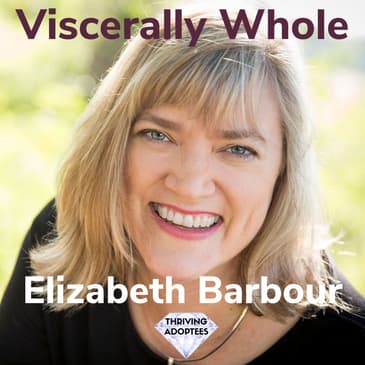
Have you felt separate? Alone? Elizabeth felt so separate that she thought she was an alien. So how did she get to that visceral feeling of wholeness? A deep dive into healing. Because that's where the gems are.
Note from Elizabeth – I want to apologize for the incorrect usage of the phrase trauma bonding near the very end of the episode. I was looking for a way to describe adoptees commiserating with one another about a shared traumatic experience. Simon’s term of validation is more appropriate in this instance.
Here's a bit about Elizabeth from her website:
I’m an adult adoptee living in reunion with my birth family. Since 1999, I’ve known my birth mom, my birth dad and my eleven (!!!) brothers and sisters. And, in 2011, I adopted our daughter Riley. She is the love of my life.
I’m Elizabeth Barbour, M.Ed, Life & Business Coach, Shamanic Practitioner, Speaker, Retreat Leader, Author and Mom.
I see what’s possible for you when you can’t see it for yourself. I see your strengths, your beauty, your gifts, your talents and all that you can possibly be… and I help you step more fully into the truest version of you.
As a life and business coach, I help entrepreneurial and professional women find work/life balance–and sanity–in the chaos of daily living. It’s not unusual for clients to cry in their first sessions with me because they are just so relieved to find support.
As a shamanic practitioner, I utilize the power of shamanic journey work to access messages and information from the spiritual realms (sometimes referred to as non-ordinary reality) to help my clients cut through the stuck places and gain clarity fast. I’m passionate about helping my clients to design rituals and celebrations when big transitions are afoot (life and death, weddings and divorces, moves, etc.) My first book is tentatively titled Sacred Celebrations.
When teaching and speaking, I’m multi-passionate. I’m equally comfortable facilitating a teambuilding session in an corporate environment, inspiring a room full of entrepreneurs to become authentic networkers, preaching the value of self-care to a room full of overworked realtors or leading an intimate women’s retreat through a fire ceremony ritual to release their stress and to reclaim their balance.
https://www.facebook.com/elizabethbarbour
https://www.instagram.com/elizabthbarbour/
Guests and the host are not (unless mentioned) licensed pscyho-therapists and speak from their own opinion only. Seek qualified advice if you need help.
Want to learn more about thriving for you, your kids, your families or your colleagues? Pick a time to talk here
[00:00:02] [SPEAKER_01]: Hello everybody, welcome to another episode of the Thriving Adoptees podcast.
[00:00:06] [SPEAKER_01]: And I'm delighted to be joined by Elizabeth, Elizabeth Barbour looking forward to our conversation today.
[00:00:12] [SPEAKER_04]: Thanks me too, Simon. Thanks for having me.
[00:00:14] [SPEAKER_01]: You're very welcome. Very welcome.
[00:00:18] [SPEAKER_01]: So what to what extent does this this word healing to what extent does that resonate with you, Elizabeth?
[00:00:29] [SPEAKER_04]: Very much so. You know, I've been thinking about it, knowing that you and I were going to have this conversation.
[00:00:35] [SPEAKER_04]: And to me, healing feels like a return to wholeness.
[00:00:41] [SPEAKER_04]: And it's about finding lost parts of ourselves and reintegrating them.
[00:00:49] [SPEAKER_04]: And, you know, when I think about my own personal healing journey, it started probably in high school.
[00:00:59] [SPEAKER_04]: Now, I knew, I knew that something was off and I didn't feel whole and complete and I didn't know what it was.
[00:01:10] [SPEAKER_04]: And I've really been thinking a lot about this.
[00:01:13] [SPEAKER_04]: You know, I worked as a peer helper in high school and then when I went to college, I was in a similar role sort of guiding and mentoring other students.
[00:01:23] [SPEAKER_04]: Went on and got my master's in counseling.
[00:01:27] [SPEAKER_04]: But I think initially my healing was, I didn't understand at the time, but it was about giving to others.
[00:01:35] [SPEAKER_04]: Let me help you. Oh, I'm fine over here. I don't have any issues.
[00:01:41] [SPEAKER_04]: And, you know, and then as you get into that work, you go, oh, wait a minute, I've got to shine the light on my stuff.
[00:01:49] [SPEAKER_01]: Yeah.
[00:01:51] [SPEAKER_02]: Yeah.
[00:01:53] [SPEAKER_01]: Because you've done you're a coach now, right?
[00:01:57] [SPEAKER_01]: And you coach some adoptees and you coach a lot of people that are non-adopted.
[00:02:01] [SPEAKER_01]: Yes.
[00:02:02] [SPEAKER_01]: Do you find a lot of separation?
[00:02:07] [SPEAKER_01]: If healing is a return to wholeness, do you find a lot of separation in the broader population?
[00:02:17] [SPEAKER_04]: Yes. Absolutely.
[00:02:20] [SPEAKER_04]: I think that we very early on in our lives experience separation, whether it's, you know, adoptee trauma or a family of origin challenges, health issues, whatever the conflict in the family.
[00:02:41] [SPEAKER_04]: And then of course there's always generational trauma, which I think maybe we'll get into a little bit later.
[00:02:47] [SPEAKER_04]: But yeah, I think separation is very much a part of the human experience.
[00:02:52] [SPEAKER_04]: And maybe that's why you're.
[00:02:55] [SPEAKER_01]: What are we separating from?
[00:02:59] [SPEAKER_04]: Good question.
[00:03:02] [SPEAKER_04]: I think we're separating from self.
[00:03:05] [SPEAKER_04]: We're separating from source.
[00:03:09] [SPEAKER_04]: We're separating from community.
[00:03:15] [SPEAKER_01]: Do you use the word self and source interchangeably?
[00:03:21] [SPEAKER_04]: No.
[00:03:21] [SPEAKER_01]: No.
[00:03:22] [SPEAKER_04]: No, to me, a self is sort of our soul or our spirits and source I think of as God force energy, you know, our creator, the universal energy.
[00:03:38] [SPEAKER_01]: Okay.
[00:03:38] [SPEAKER_01]: And how do you differentiate between those two?
[00:03:43] [SPEAKER_01]: Between spirit and create an energy, universal energy.
[00:03:50] [SPEAKER_04]: And self. Yeah.
[00:03:52] [SPEAKER_04]: Well, I think about it in terms of, you know, I think we all come here.
[00:03:58] [SPEAKER_04]: I think we incarnate to have an experience of the divine and have our own unique expression of the divine.
[00:04:13] [SPEAKER_04]: And so to me, it's like my myself or my soul is like my personal blueprint, my personal journey.
[00:04:20] [SPEAKER_04]: Like what did I, oh, you know, what did I sign up to?
[00:04:25] [SPEAKER_04]: What's the curriculum I signed up for in earth school?
[00:04:28] [SPEAKER_04]: You know, might be one way to think about it.
[00:04:30] [SPEAKER_04]: Yeah.
[00:04:31] [SPEAKER_01]: So the self is the personal but the source is the universal?
[00:04:37] [SPEAKER_04]: Yes.
[00:04:39] [SPEAKER_01]: And what do you think you signed up for?
[00:04:45] [SPEAKER_04]: I joke with my best friend.
[00:04:47] [SPEAKER_04]: We say we signed up for a triple PhD here.
[00:04:52] [SPEAKER_04]: That's a really great question.
[00:04:53] [SPEAKER_04]: What did I sign up for?
[00:04:55] [SPEAKER_04]: I think I signed up to learn about love.
[00:05:03] [SPEAKER_04]: So to learn about love of self, love of others, love of spirit.
[00:05:09] [SPEAKER_04]: You know, to me that's like the universal thread.
[00:05:16] [SPEAKER_04]: That's what binds us all together.
[00:05:18] [SPEAKER_04]: You know, who cares what we look like or our backgrounds or our political beliefs or whatever.
[00:05:23] [SPEAKER_04]: But love is that common connection.
[00:05:29] [SPEAKER_01]: Yeah.
[00:05:31] [SPEAKER_01]: And this seems pretty far out topics for adoptees.
[00:05:40] [SPEAKER_01]: Like in these spaces, do you, you know, like when in these spaces that you're learning these about this stuff?
[00:05:51] [SPEAKER_01]: Are you coming across many adoptees?
[00:05:55] [SPEAKER_04]: Some.
[00:05:58] [SPEAKER_04]: But good point.
[00:06:00] [SPEAKER_04]: It's not necessarily a common conversation among adoptees.
[00:06:06] [SPEAKER_04]: Although I'm finding it more and more.
[00:06:12] [SPEAKER_04]: I think, I think my experience as both an adoptee and an adoptive mom has informed some of this for me.
[00:06:22] [SPEAKER_01]: Yeah.
[00:06:26] [SPEAKER_01]: So how?
[00:06:31] [SPEAKER_04]: So when you and I talked before, I was telling you about an experience I had with a family constellations facilitator.
[00:06:42] [SPEAKER_04]: It's probably been 20 years ago.
[00:06:45] [SPEAKER_04]: And I was fairly newly in reunion with my biological family.
[00:06:51] [SPEAKER_04]: And I was having a challenge between my birth mom and my adoptive mom and sort of my, my loyalties to them and my relationship with each of them.
[00:07:00] [SPEAKER_04]: I was trying to parse through it all.
[00:07:03] [SPEAKER_04]: And the facilitator said to me as he was working with my constellation, he said, Elizabeth, you have four parents.
[00:07:12] [SPEAKER_04]: I just kind of looked at him.
[00:07:13] [SPEAKER_04]: I was like, what?
[00:07:14] [SPEAKER_04]: No, I don't have two.
[00:07:16] [SPEAKER_04]: He said, no, no, no.
[00:07:18] [SPEAKER_04]: You have four parents.
[00:07:19] [SPEAKER_04]: You have your adoptive mom.
[00:07:21] [SPEAKER_04]: You have your adoptive dad.
[00:07:22] [SPEAKER_04]: You have your biological mom.
[00:07:23] [SPEAKER_04]: You have your biological dad.
[00:07:25] [SPEAKER_04]: And it was the first time that someone spoke the truth to me, like capital T, like in a way that might, it was like, I remember, I remember exactly the room where it was all the people that were there.
[00:07:36] [SPEAKER_04]: And I remember having this very visceral experience of like, this missing piece came in and it just kind of went like, it's like, oh, that's the truth.
[00:07:49] [SPEAKER_04]: So now that I'm raising a daughter, she's now 13 who we adopted at birth.
[00:07:59] [SPEAKER_04]: We are raising her knowing that she has four parents.
[00:08:07] [SPEAKER_04]: She has her dad and I, her adopted parents, and she has her two biological parents.
[00:08:13] [SPEAKER_04]: And to me, that is letting who know about all the love that is available to her even though she might not have relationships with everybody and it might look different.
[00:08:27] [SPEAKER_04]: But it's about, to me, the love and how I'm able to express that to her is, you know, we are multifaceted beings.
[00:08:38] [SPEAKER_04]: And she is coming from nurture and coming from nature.
[00:08:44] [SPEAKER_04]: And it's all part of who she is.
[00:08:46] [SPEAKER_04]: It's all part of her path.
[00:08:47] [SPEAKER_04]: And then of course, you know, she gets to have her own experience as a little human on this planet.
[00:08:52] [SPEAKER_04]: But that's the foundation that she's coming from.
[00:08:55] [SPEAKER_04]: Does that make sense?
[00:08:57] [SPEAKER_01]: Yeah.
[00:08:58] [SPEAKER_01]: But you talked about a visceral, a visceral sense, a visceral feeling.
[00:09:04] [SPEAKER_04]: Yes.
[00:09:06] [SPEAKER_01]: Of what?
[00:09:08] [SPEAKER_01]: Of love?
[00:09:08] [SPEAKER_01]: Of a new insight?
[00:09:10] [SPEAKER_01]: Of, I mean, you mentioned of truth.
[00:09:14] [SPEAKER_01]: What was it that you've felt in the moment?
[00:09:21] [SPEAKER_01]: What was the emotional reaction?
[00:09:23] [SPEAKER_01]: So what was the sensation?
[00:09:25] [SPEAKER_01]: What was the emotional reaction?
[00:09:29] [SPEAKER_01]: How was it?
[00:09:30] [SPEAKER_01]: What was it evidence of or proof of or?
[00:09:40] [SPEAKER_04]: I think it was relief.
[00:09:42] [SPEAKER_04]: I think it was relief.
[00:09:46] [SPEAKER_04]: It was clarity.
[00:09:47] [SPEAKER_04]: It was like, oh, I'm not crazy.
[00:09:51] [SPEAKER_04]: I mean, I think I've spent so much of my life as an adoptee and I've talked to other adoptees about this too.
[00:09:59] [SPEAKER_04]: Feeling, and I don't really like that word crazy, but feeling other, feeling alien, feeling displaced, feeling like I didn't belong.
[00:10:15] [SPEAKER_04]: And there was something about that new knowledge or new information or new understanding.
[00:10:25] [SPEAKER_04]: That it was kind of like, you know, you take the Venn diagram and it's taking the two circles.
[00:10:30] [SPEAKER_04]: And it was like, instead of being two disparate circles, they finally overlapped, you know, and I was in that middle space.
[00:10:38] [SPEAKER_04]: Like, oh, I'm from here and I'm from there.
[00:10:40] [SPEAKER_04]: So it wasn't an either or it was suddenly a both and.
[00:10:44] [SPEAKER_01]: Yeah.
[00:10:45] [SPEAKER_01]: So it was at the end of a denial then in some, in some respects, you felt torn.
[00:10:54] [SPEAKER_01]: You felt torn between, well, you felt torn between two, two sets.
[00:11:02] [SPEAKER_01]: Yes.
[00:11:03] [SPEAKER_01]: The two different sets had different weightings for you or something.
[00:11:06] [SPEAKER_01]: I mean, was that it?
[00:11:10] [SPEAKER_04]: Well, and you know, it's interesting listening to your question because it's hard to find the language around this.
[00:11:16] [SPEAKER_04]: Right?
[00:11:17] [SPEAKER_04]: Oh, yeah.
[00:11:18] [SPEAKER_04]: And I think that is what is so unique about the whole adoption experience and certainly the adoptee experience but defining the feelings and emotions and experiences are really complex.
[00:11:34] [SPEAKER_04]: Um, but to your question though, end of a denial.
[00:11:40] [SPEAKER_04]: I don't think I was aware that I was in denial.
[00:11:48] [SPEAKER_01]: It's a relief in a, I mean, the thing that came to me was it's a relief when I was relieved when I read the primal word.
[00:12:01] [SPEAKER_03]: Yes.
[00:12:02] [SPEAKER_01]: So I, okay.
[00:12:03] [SPEAKER_01]: This explains it.
[00:12:05] [SPEAKER_01]: Right?
[00:12:06] [SPEAKER_01]: Yes.
[00:12:06] [SPEAKER_01]: Okay.
[00:12:07] [SPEAKER_01]: So I haven't consciously denied it, you know, like we talk a lot about that.
[00:12:10] [SPEAKER_01]: Oh, I've denied, you know, like I've denied it.
[00:12:13] [SPEAKER_01]: I've denied it.
[00:12:14] [SPEAKER_01]: I've stuffed the feelings.
[00:12:15] [SPEAKER_01]: I've run away from it and like, do we?
[00:12:19] [SPEAKER_01]: Yes.
[00:12:20] [SPEAKER_01]: Maybe I've been denied.
[00:12:23] [SPEAKER_01]: I squashed it down so far, but it wasn't a conscious decision.
[00:12:25] [SPEAKER_01]: It was like, it's a relief.
[00:12:32] [SPEAKER_01]: The truth is a relief.
[00:12:33] [SPEAKER_01]: Oh, okay.
[00:12:34] [SPEAKER_01]: Well, no wonder I've been, no wonder it's been complicated because I haven't just seen it.
[00:12:41] [SPEAKER_01]: I've got four pounds.
[00:12:43] [SPEAKER_01]: Yes.
[00:12:44] [SPEAKER_01]: There's a relief with that.
[00:12:45] [SPEAKER_01]: There's no denial.
[00:12:46] [SPEAKER_01]: You wouldn't, I wasn't, oh, I only have two.
[00:12:49] [SPEAKER_01]: I only have two pounds.
[00:12:50] [SPEAKER_01]: It wasn't like that.
[00:12:52] [SPEAKER_01]: It didn't sound like he was like that.
[00:12:53] [SPEAKER_01]: It was like a confusion was lifted.
[00:12:58] [SPEAKER_01]: You got some clarity.
[00:13:02] [SPEAKER_01]: And that's why I'm really mining this because I think sometimes I have a tendency on the
[00:13:11] [SPEAKER_01]: podcast in the absence of these really micro moments, translation moments.
[00:13:19] [SPEAKER_01]: I can go a bit macro and big, big.
[00:13:23] [SPEAKER_01]: And it's all a little bit too easy.
[00:13:26] [SPEAKER_01]: It's not, you know, I'm mining this because that's what I think.
[00:13:35] [SPEAKER_01]: I don't, people say that not in adoption, but people outside the world say, outside the
[00:13:40] [SPEAKER_01]: adoption world say, time is the biggest healer.
[00:13:43] [SPEAKER_01]: Well, I don't think so at all.
[00:13:45] [SPEAKER_01]: Time isn't a healer.
[00:13:46] [SPEAKER_01]: It's what happens in that time.
[00:13:48] [SPEAKER_01]: And what is it?
[00:13:50] [SPEAKER_01]: What is it that happens in that time is we have an insight.
[00:13:57] [SPEAKER_01]: We have a moment of clarity.
[00:13:59] [SPEAKER_01]: We have a visceral, you described it as a visceral moment and the visceral moment of clarity.
[00:14:11] [SPEAKER_04]: Yes.
[00:14:14] [SPEAKER_04]: I'd like to add another word to that too.
[00:14:16] [SPEAKER_04]: It was clarity and it was expansion.
[00:14:20] [SPEAKER_04]: It was an expansion of my understanding of myself and my experience on this planet.
[00:14:31] [SPEAKER_04]: And so it was like the, you know, it's sort of like being in, I don't know, you're in
[00:14:39] [SPEAKER_04]: a house right?
[00:14:40] [SPEAKER_04]: And you're in one room.
[00:14:41] [SPEAKER_04]: You're in the living room.
[00:14:43] [SPEAKER_04]: And then suddenly you start walking around the house and you realize, oh, there's a
[00:14:47] [SPEAKER_04]: kitchen and there's a dining room and there's a, you know, three bedrooms and there's a
[00:14:51] [SPEAKER_04]: basement.
[00:14:51] [SPEAKER_04]: And then suddenly it's like, oh, wow, this is, I thought I was just in this one space
[00:14:55] [SPEAKER_04]: in this room, but really I'm in this much larger experience.
[00:15:01] [SPEAKER_04]: So it feels like it was an expansion too.
[00:15:06] [SPEAKER_01]: Have you heard the word Ken show experience?
[00:15:10] [SPEAKER_04]: No, tell me about that.
[00:15:12] [SPEAKER_01]: So there was an astronaut and I don't think he's called Edgar something.
[00:15:21] [SPEAKER_01]: American guy Hoffman, Hoffman.
[00:15:24] [SPEAKER_01]: He had a Ken show experience, a moment of expansion.
[00:15:28] [SPEAKER_01]: I think it's Japanese, right?
[00:15:31] [SPEAKER_01]: So he was orbiting the earth, looking down on earth and he had this Ken show
[00:15:41] [SPEAKER_01]: experience, which is a kind of an opening, an enlargement.
[00:15:46] [SPEAKER_01]: You know, the sense of spaciousness came, boomf, you know, like in a moment and it
[00:15:55] [SPEAKER_01]: changed his life and he moved.
[00:15:57] [SPEAKER_01]: He'd gone from a very out the male, the very out the male world of fighter
[00:16:07] [SPEAKER_01]: pilots to NASA.
[00:16:09] [SPEAKER_01]: Because most of the like the best, well, the best in the best in the air force
[00:16:16] [SPEAKER_01]: become fighter pilots.
[00:16:19] [SPEAKER_01]: The best fighter pilots become test pilots, best test pilots become astronauts.
[00:16:23] [SPEAKER_01]: It's a well worn kind of track.
[00:16:26] [SPEAKER_01]: It's very, it's very alpha male.
[00:16:29] [SPEAKER_01]: It's very Taipei, beer personality.
[00:16:33] [SPEAKER_01]: It's very brainy.
[00:16:34] [SPEAKER_01]: It's very left brain.
[00:16:36] [SPEAKER_01]: It's very logic.
[00:16:37] [SPEAKER_01]: It's very chilled.
[00:16:38] [SPEAKER_01]: It's very ice, ice cold.
[00:16:41] [SPEAKER_01]: And it's the ultimate logic, right?
[00:16:43] [SPEAKER_01]: And then bang, you have this experience, this Ken show experience where his
[00:16:49] [SPEAKER_01]: whole world changed looking, looking, looking down back on the earth.
[00:16:53] [SPEAKER_01]: And he became a consciousness guy and he completely left behind the, yeah,
[00:17:03] [SPEAKER_01]: the career ladder.
[00:17:05] [SPEAKER_01]: I mean, I guess where do you go after you've been an astral, right?
[00:17:09] [SPEAKER_01]: You trade with astronauts, you know, where is the to go?
[00:17:16] [SPEAKER_02]: That's great.
[00:17:16] [SPEAKER_01]: It sounded like you had a Ken show.
[00:17:19] [SPEAKER_01]: What I think, I don't know if they, I hope I'm hoping pronouncing them correctly.
[00:17:26] [SPEAKER_04]: It sounds like it.
[00:17:27] [SPEAKER_04]: And I think it, you know, it's really interesting.
[00:17:31] [SPEAKER_04]: We're, we're now living in reunion with our daughter's biological dad for
[00:17:36] [SPEAKER_04]: the last four years.
[00:17:37] [SPEAKER_04]: And you know, I've had a lot of people comment like, oh, you're so,
[00:17:42] [SPEAKER_04]: you're so generous and you're so, you know, open to be willing to do that.
[00:17:48] [SPEAKER_04]: Almost as though I should receive accolades or praise for that.
[00:17:54] [SPEAKER_04]: And I'm like, no, no, no, no, no, no, no, no, no.
[00:17:57] [SPEAKER_04]: This is me being a good parent, a good steward of my daughter's experience
[00:18:05] [SPEAKER_04]: and knowing that two parents isn't enough because she comes from four.
[00:18:13] [SPEAKER_04]: And so I want to encourage that and give her this expansive experience
[00:18:18] [SPEAKER_04]: of knowing not only the two people who are loving her and raising her,
[00:18:22] [SPEAKER_04]: but also where she comes from, her background, her history, her ancestry.
[00:18:27] [SPEAKER_04]: You know, the people that she looks like and has, you know, similar tastes.
[00:18:32] [SPEAKER_04]: I mean, she started eating sushi when she was three.
[00:18:37] [SPEAKER_04]: And I was like, wow, that's really unusual for a three year old kid to like sushi
[00:18:41] [SPEAKER_04]: because she wanted mine.
[00:18:42] [SPEAKER_04]: She said, mommy, I want your sushi.
[00:18:43] [SPEAKER_04]: Come to find out.
[00:18:45] [SPEAKER_04]: She's part Japanese.
[00:18:47] [SPEAKER_04]: I mean, I don't know.
[00:18:48] [SPEAKER_04]: Maybe she just likes sushi, but really like her, she has a great,
[00:18:53] [SPEAKER_04]: great grandfather who was a fisherman in Japan.
[00:18:57] [SPEAKER_04]: That was his profession.
[00:18:59] [SPEAKER_04]: So I got to think that there's some genetic ties to it.
[00:19:05] [SPEAKER_01]: I've heard that from similar things from particularly from Asian Asian adoptees
[00:19:15] [SPEAKER_01]: when they go back to South Korea or someone and the food they take to the food.
[00:19:24] [SPEAKER_01]: You know, it's not a logic thing.
[00:19:28] [SPEAKER_01]: It's not an enemy thing.
[00:19:29] [SPEAKER_01]: It's lived experience.
[00:19:33] [SPEAKER_02]: Right.
[00:19:34] [SPEAKER_01]: Thing.
[00:19:38] [SPEAKER_01]: So I want to tie the two things together, right?
[00:19:42] [SPEAKER_01]: The space stuff that I was talking about and the alien, right?
[00:19:46] [SPEAKER_01]: Feeling alien.
[00:19:46] [SPEAKER_01]: So it is feeling, if we're all separating as human beings, if every human being is separating
[00:20:00] [SPEAKER_01]: to a greater or lesser extent from themselves, is feeling like an alien,
[00:20:07] [SPEAKER_01]: just a turbocharged version of that separation.
[00:20:15] [SPEAKER_03]: That's a great question.
[00:20:24] [SPEAKER_04]: My gut response is yes.
[00:20:28] [SPEAKER_04]: And I don't know what it's like to be a non-adopted person.
[00:20:34] [SPEAKER_04]: So I would have to ask my non-adopted friends and say, do you ever feel like an alien?
[00:20:42] [SPEAKER_02]: Yeah.
[00:20:43] [SPEAKER_04]: You know, it's not typically language that other people use in my experience,
[00:20:50] [SPEAKER_04]: but I could be wrong.
[00:20:52] [SPEAKER_01]: Do you feel like an alien anymore?
[00:20:55] [SPEAKER_01]: No.
[00:20:58] [SPEAKER_04]: No.
[00:20:59] [SPEAKER_04]: And that's, you know, I'm 54 now.
[00:21:02] [SPEAKER_04]: I was 29 when I met my biological family and I met my birth mom, my birth dad,
[00:21:08] [SPEAKER_04]: and 11 brothers and sisters.
[00:21:10] [SPEAKER_04]: So it's been an incredible experience.
[00:21:13] [SPEAKER_04]: And, you know, we've been living in reunion for 25 years now.
[00:21:16] [SPEAKER_04]: And so I've had 25 years of getting back in my body and learning my family history.
[00:21:31] [SPEAKER_04]: And again, it's not learning it new.
[00:21:33] [SPEAKER_04]: It's expanding my family history because my family history is also my adoption,
[00:21:37] [SPEAKER_04]: my adoptive lineage, you know, my adoptive mom and my adoptive dad.
[00:21:41] [SPEAKER_04]: I claim their lineage as my own too.
[00:21:44] [SPEAKER_04]: But now I also have my biological lineage from my birth mom and my birth dad
[00:21:49] [SPEAKER_04]: and their parents and their grandparents.
[00:21:53] [SPEAKER_04]: And so now it's all part of it.
[00:21:55] [SPEAKER_04]: You know, I sort of joke that instead of a family tree,
[00:21:57] [SPEAKER_04]: you know, I have a family forest.
[00:21:59] [SPEAKER_04]: And so I don't feel alien anymore.
[00:22:02] [SPEAKER_04]: I feel like I finally landed.
[00:22:08] [SPEAKER_00]: Yeah.
[00:22:09] [SPEAKER_01]: So I love the metaphor, the family forest.
[00:22:14] [SPEAKER_01]: I love that. That's cool.
[00:22:18] [SPEAKER_01]: To what extent do you think reunion is a requirement for not feeling an alien anymore?
[00:22:40] [SPEAKER_04]: For me, I think it was everything.
[00:22:49] [SPEAKER_04]: When I think about the biggest days of my life,
[00:22:55] [SPEAKER_04]: you know, when my daughter was born, when I married my husband,
[00:23:00] [SPEAKER_04]: the biggest, most important day of all was the day that I met my biological mother.
[00:23:07] [SPEAKER_04]: It was April 13th, 1999.
[00:23:09] [SPEAKER_04]: I'll never forget it.
[00:23:13] [SPEAKER_04]: So for me, I do think it was a requirement.
[00:23:19] [SPEAKER_04]: Is it for everybody?
[00:23:20] [SPEAKER_04]: I don't know.
[00:23:21] [SPEAKER_04]: I can't speak to that.
[00:23:22] [SPEAKER_04]: But that primal wound, you know, as you referenced, you know,
[00:23:26] [SPEAKER_04]: Nancy Berry's book, it's real.
[00:23:34] [SPEAKER_04]: It's very real.
[00:23:37] [SPEAKER_01]: And what is it in respect of the things that you've been talking about
[00:23:44] [SPEAKER_01]: in terms of finding lost parts, reintegration, love, all that sort of stuff?
[00:23:55] [SPEAKER_01]: What do you think the primal wound does?
[00:24:11] [SPEAKER_04]: I think that the separation from basically, you know, our first breath,
[00:24:23] [SPEAKER_04]: at least for me it was.
[00:24:24] [SPEAKER_04]: I did not see my biological mother.
[00:24:29] [SPEAKER_04]: She was drugged and I came into the world and she never saw me.
[00:24:35] [SPEAKER_04]: Wow.
[00:24:38] [SPEAKER_04]: And that's certainly not everybody's experience, you know?
[00:24:40] [SPEAKER_01]: It is common.
[00:24:42] [SPEAKER_01]: Common?
[00:24:43] [SPEAKER_01]: I don't know.
[00:24:44] [SPEAKER_01]: It's not rare.
[00:24:46] [SPEAKER_01]: I don't think it's rare.
[00:24:48] [SPEAKER_04]: Right.
[00:24:49] [SPEAKER_04]: Yes.
[00:24:50] [SPEAKER_04]: Well, and I think that was probably adoption practices decades ago.
[00:24:55] [SPEAKER_04]: I think it's a little different now.
[00:24:58] [SPEAKER_04]: Like our daughter's biological mother was in the hospital with her for two days
[00:25:03] [SPEAKER_04]: and held her and fed her and got to spend time with her
[00:25:07] [SPEAKER_04]: before she chose to place her for adoption.
[00:25:12] [SPEAKER_04]: So, yeah, I do think things are different now.
[00:25:15] [SPEAKER_04]: But so I think to that question about separation, you know,
[00:25:21] [SPEAKER_04]: we know that babies when they come into the world,
[00:25:26] [SPEAKER_04]: they are connected to the mother's voice and her smell
[00:25:31] [SPEAKER_04]: and her touch, you know, because they've spent nine months in the womb
[00:25:35] [SPEAKER_04]: and in her body and sharing cells and blood.
[00:25:39] [SPEAKER_04]: So that trauma of just that total separation, you know,
[00:25:50] [SPEAKER_04]: how can you not carry that with you?
[00:25:52] [SPEAKER_04]: And again, as we talked earlier, it's not conscious.
[00:25:55] [SPEAKER_04]: It's very subconscious.
[00:25:57] [SPEAKER_04]: It's very cellular memory.
[00:26:01] [SPEAKER_04]: But it's always there and, you know, and not all adoptees are want to
[00:26:07] [SPEAKER_04]: or are interested in doing the work to heal it.
[00:26:11] [SPEAKER_04]: And that's okay.
[00:26:12] [SPEAKER_04]: You know, there's no right or wrong about that.
[00:26:16] [SPEAKER_04]: But I know for me, my personal experience, I think I always knew
[00:26:19] [SPEAKER_04]: there was something wrong, different, missing, whatever.
[00:26:23] [SPEAKER_04]: And I knew I needed to heal it.
[00:26:28] [SPEAKER_01]: Yeah.
[00:26:31] [SPEAKER_01]: So you've referred to, you said we are self or soul or spirit.
[00:26:46] [SPEAKER_01]: Do you think that that's what impact or what impact,
[00:26:52] [SPEAKER_01]: if any, does the primal wound have on that?
[00:26:55] [SPEAKER_01]: Yeah.
[00:27:04] [SPEAKER_04]: Well, if I look at it in terms of what we were talking about earlier,
[00:27:09] [SPEAKER_04]: sort of, you know, what's my curriculum here on earth?
[00:27:14] [SPEAKER_04]: I would think the primal wound then was a catalyst for,
[00:27:19] [SPEAKER_04]: you know, that separation was a catalyst for me to be on this journey
[00:27:26] [SPEAKER_04]: of self-discovery, reflection, inquiry, search for wholeness, all of that.
[00:27:40] [SPEAKER_00]: A catalyst.
[00:27:42] [SPEAKER_03]: Mm-hmm.
[00:27:44] [SPEAKER_01]: So is that something that you're thankful for, grateful for?
[00:27:48] [SPEAKER_01]: I mean, you talked about the, you know, the lesson, so that would seem
[00:27:53] [SPEAKER_01]: to me that you'd be grateful for a catalyst.
[00:27:59] [SPEAKER_04]: You would think.
[00:28:01] [SPEAKER_04]: I would say it's a love-hate relationship.
[00:28:04] [SPEAKER_04]: I mean, you know, because that's such a great question.
[00:28:07] [SPEAKER_01]: But it's not all hate then, I guess.
[00:28:10] [SPEAKER_04]: No, no, no, no.
[00:28:11] [SPEAKER_04]: No, not at all.
[00:28:12] [SPEAKER_04]: No, I mean, I see the gift in it.
[00:28:15] [SPEAKER_04]: Absolutely.
[00:28:16] [SPEAKER_04]: 100%, I see the gift in it.
[00:28:19] [SPEAKER_04]: And, you know, I just came back a couple months ago.
[00:28:25] [SPEAKER_04]: I did my first ever vacation with three of my siblings on my birth mom's side.
[00:28:29] [SPEAKER_04]: And all four of us kids plus partners and our children all went on vacation together.
[00:28:36] [SPEAKER_04]: It was the first time we've done that 25 years.
[00:28:38] [SPEAKER_04]: And I came home from that trip and I cried for two days because I was so sad that I hadn't grown up with them.
[00:28:48] [SPEAKER_04]: And I was pissed that that opportunity had been denied to me.
[00:28:57] [SPEAKER_04]: And yet, you know, so that in here, I'm in my 50s and I've been reading for 25 years.
[00:29:04] [SPEAKER_04]: I've done so much therapy and personal work and whatever.
[00:29:08] [SPEAKER_04]: And still the layers are being revealed.
[00:29:12] [SPEAKER_04]: Still the emotions are coming up.
[00:29:16] [SPEAKER_04]: You know, they're being revealed to be healed.
[00:29:18] [SPEAKER_04]: So I feel like it's this lifelong journey.
[00:29:25] [SPEAKER_04]: Yeah, did that answer your question?
[00:29:26] [SPEAKER_04]: Yeah, I think so.
[00:29:28] [SPEAKER_01]: To me, the primal wound is basically the steel in the concrete of the separate self.
[00:29:45] [SPEAKER_04]: Say that again.
[00:29:46] [SPEAKER_01]: The primal wound is the steel in the reinforced concrete of the separate self.
[00:29:56] [SPEAKER_01]: So if you're not adopted, you have a separate self.
[00:30:02] [SPEAKER_01]: That's right.
[00:30:03] [SPEAKER_01]: Right.
[00:30:04] [SPEAKER_01]: And it's made of concrete.
[00:30:07] [SPEAKER_01]: But if you're adopted, it's reinforced concrete.
[00:30:17] [SPEAKER_01]: But that sounds like bad news.
[00:30:22] [SPEAKER_01]: But the good news is the separate self isn't who we are.
[00:30:28] [SPEAKER_04]: Right.
[00:30:30] [SPEAKER_01]: Well, you heard that acronym for separate self to me sounds like ego and sounds like that acronym for that Earth Guide only.
[00:30:40] [SPEAKER_01]: You heard that?
[00:30:41] [SPEAKER_04]: No, I haven't.
[00:30:42] [SPEAKER_01]: I love it.
[00:30:44] [SPEAKER_01]: Earth Guide only.
[00:30:45] [SPEAKER_01]: So we think that we are a separate self.
[00:30:50] [SPEAKER_01]: And the primal wound is made that thought a belief, a reinforced.
[00:30:58] [SPEAKER_01]: So it takes quite a big demolition crane.
[00:31:08] [SPEAKER_01]: Right.
[00:31:09] [SPEAKER_01]: What do they have?
[00:31:10] [SPEAKER_01]: What do they call those?
[00:31:11] [SPEAKER_01]: The balls on a demolition crane?
[00:31:14] [SPEAKER_04]: Yeah, the wrecking ball.
[00:31:15] [SPEAKER_01]: The wrecking ball, right?
[00:31:17] [SPEAKER_01]: Yeah.
[00:31:17] [SPEAKER_01]: It takes a really big wrecking ball to demolish the reinforced concrete.
[00:31:27] [SPEAKER_01]: Do you use that term in the US?
[00:31:29] [SPEAKER_01]: Reinforced concrete.
[00:31:30] [SPEAKER_01]: Does that make sense?
[00:31:30] [SPEAKER_04]: Yes, that makes sense.
[00:31:32] [SPEAKER_01]: It's not just the UK thing.
[00:31:33] [SPEAKER_01]: So it's and but it sounds like to me that what happened to you with the, I don't know, with the four parents.
[00:31:45] [SPEAKER_01]: Then what's that?
[00:31:48] [SPEAKER_00]: Did that know maybe not actually.
[00:31:51] [SPEAKER_01]: I don't know.
[00:31:52] [SPEAKER_01]: Were there other moments that have blown your healing wide open?
[00:32:00] [SPEAKER_01]: Were the big, other big healing moments where, where the separate, because the separate self dissolves, I guess.
[00:32:14] [SPEAKER_04]: I think one of the biggest moments, it was about a 20 minute period.
[00:32:26] [SPEAKER_04]: About six months after I had found my biological family and I brought my biological mom and my biological dad together with me and we spent 20 minutes just the three of us.
[00:32:43] [SPEAKER_04]: And I stood between the two of them with my arm linking hers on the right and my arm linking his on the left.
[00:32:54] [SPEAKER_04]: And we were a unit for 20 minutes.
[00:32:59] [SPEAKER_04]: The only time in my life that's ever happened.
[00:33:05] [SPEAKER_04]: And that again, it was a very visceral experience of feeling anchored, connected, belonging.
[00:33:21] [SPEAKER_04]: You know, it was like here I was and I mean if you think about that, like if there's non adopted persons who are listening to this, you know, they often not always, but often spend time with them.
[00:33:33] [SPEAKER_04]: They spend their lifetime being surrounded by the two people who created them and brought them into this world.
[00:33:39] [SPEAKER_04]: And like that's just a normal thing.
[00:33:42] [SPEAKER_04]: Of course, that's what everybody does.
[00:33:44] [SPEAKER_04]: And yet as an adopted person, you know, who lives thousands of miles away from my biological family, I had 20 minutes in my whole life to be with them.
[00:33:55] [SPEAKER_04]: Just profound.
[00:33:56] [SPEAKER_04]: It was really profound.
[00:34:10] [SPEAKER_01]: How would you, how would you define love then in this, in this sense because she talks about your curriculum being one of the things that he said first about your curriculum was to learn about love.
[00:34:29] [SPEAKER_04]: I love how you bring all these things back together Simon.
[00:34:35] [SPEAKER_01]: You said universal thread, right? So I'm just right.
[00:34:39] [SPEAKER_04]: Yeah, yeah, yeah. No, it's great. You're weaving the threads together. It's wonderful.
[00:34:44] [SPEAKER_04]: I that is such a great question because in that moment like I can close my eyes and be in that moment with the two of them.
[00:34:55] [SPEAKER_04]: And there was so much love.
[00:34:59] [SPEAKER_04]: And what it looked like was forgiveness and acceptance and apology and pain and grief and joy and relief at being reconnected.
[00:35:22] [SPEAKER_04]: I mean, it was all of the things you know, it was like love was like this, this bigger rally.
[00:35:28] [SPEAKER_04]: But then in that like so much happened in those 20 minutes, you know, with me thanking both of my parents and saying, you know, thank you for giving me life.
[00:35:40] [SPEAKER_04]: You know, just the very basic like thank you for giving me life. Thank you for being the portal through it for me to come into this and onto this planet.
[00:35:48] [SPEAKER_04]: But then they exchanged words with one another. You know, she said to him, you know, I was so angry at you for so many years but when I called you to tell you about Elizabeth,
[00:36:02] [SPEAKER_04]: you welcomed her with open arms and that healed me because you know you accepted her which means in some level you accepted me too, you know.
[00:36:11] [SPEAKER_04]: And then he, you know said to her, you know, I'm so sorry that I wasn't able to be there for you all those years ago and I'm so grateful that you brought Elizabeth into my life and into our lives because we're all enriched by this.
[00:36:26] [SPEAKER_04]: I mean it was just, I wish I had a recording of it really.
[00:36:31] [SPEAKER_04]: But I remember a lot of it was a long time ago.
[00:36:38] [SPEAKER_01]: So I'm going to have to break in with a bit of my story here because.
[00:36:42] [SPEAKER_01]: Yes, please do.
[00:36:43] [SPEAKER_01]: Otherwise, if somebody, if people are listening and there's no hope of reunion on the cards, right?
[00:36:54] [SPEAKER_01]: Yes.
[00:36:54] [SPEAKER_01]: They're going to think you're well I can't heal if I can't reunite. That was great.
[00:36:57] [SPEAKER_01]: That was the question behind mine. That was the question behind or they thought behind a question I asked about 10 minutes ago.
[00:37:05] [SPEAKER_01]: So have I told you about reading the letter from my birth mother? Have I told you about that?
[00:37:13] [SPEAKER_04]: Tell me again.
[00:37:14] [SPEAKER_01]: Okay.
[00:37:16] [SPEAKER_01]: So the coming out of the thought moment is happens when I'm 40 and it's to do with finding out the teddy bears from my birth mom.
[00:37:26] [SPEAKER_01]: That's right.
[00:37:27] [SPEAKER_01]: Okay.
[00:37:28] [SPEAKER_01]: And the teddy bear is an effing consolation prize from somebody that didn't love me enough to keep me.
[00:37:36] [SPEAKER_02]: Yeah.
[00:37:37] [SPEAKER_01]: That's that's those are the words that came out of my mouth.
[00:37:41] [SPEAKER_01]: They were challenged by the person that I was talking to and I saw them as incorrect.
[00:37:51] [SPEAKER_01]: I'd never thought those thoughts said those words.
[00:37:55] [SPEAKER_01]: As soon as she came out, as soon as they came out to my mouth, they were challenged by Sarah, the woman was talking to.
[00:38:01] [SPEAKER_01]: And I saw that the that those thoughts were incorrect.
[00:38:11] [SPEAKER_01]: Eight years later, I get my adoption file and in there there's a letter from a birth mother to the social worker.
[00:38:21] [SPEAKER_01]: Sorry listeners if you've heard this before, there's a letter from her to the social worker four days after she handed me over place me right February 967.
[00:38:34] [SPEAKER_01]: And it's all about the teddy bear.
[00:38:38] [SPEAKER_01]: And as I read, I'm getting the goosebumps now right.
[00:38:43] [SPEAKER_04]: I can see them.
[00:38:46] [SPEAKER_01]: Not great on a podcast but great on video.
[00:38:51] [SPEAKER_01]: Sorry listeners.
[00:38:54] [SPEAKER_01]: I feel the desperation of her predicament.
[00:39:00] [SPEAKER_04]: Yes.
[00:39:02] [SPEAKER_01]: I feel her love for me.
[00:39:07] [SPEAKER_01]: I realize as the tears streamed on my face that the teddy bear was not an effing consolation prize it was a symbol of her love for me.
[00:39:20] [SPEAKER_04]: Yes.
[00:39:22] [SPEAKER_01]: And I feel one with her and I feel as I now think about it as I know what I know now I I now feel at one with the world.
[00:39:39] [SPEAKER_01]: Right.
[00:39:40] [SPEAKER_01]: I'm not just that one with her one with the world.
[00:39:42] [SPEAKER_01]: So I'm I'm in that what you called source you took about source and God force universal energy, universality.
[00:39:55] [SPEAKER_01]: That's the moment that I hit.
[00:39:59] [SPEAKER_01]: That's the space that I touch.
[00:40:02] [SPEAKER_01]: That's the feeling that I have.
[00:40:06] [SPEAKER_01]: And that's you know, you've used the word visceral a couple of times.
[00:40:10] [SPEAKER_01]: That's the visceral feeling that I have in that moment.
[00:40:13] [SPEAKER_02]: Yes.
[00:40:14] [SPEAKER_01]: And then, you know, like a year or so later, I find out that she died early in the early 2000s.
[00:40:27] [SPEAKER_01]: So there was no re there was no reunion.
[00:40:30] [SPEAKER_02]: Right.
[00:40:30] [SPEAKER_01]: And yet there was that visceral healing moment and there's there have been hundreds of healing moments.
[00:40:43] [SPEAKER_01]: But that's the one that is the most easy to explain and the most easily grasped and the most transferable.
[00:41:00] [SPEAKER_01]: Right.
[00:41:01] [SPEAKER_01]: Other stuff that I've shared with people just like so you don't need to I in my opinion, right?
[00:41:09] [SPEAKER_01]: Or not my experience, my experience.
[00:41:12] [SPEAKER_01]: I didn't need to reunite to for for the separate for me to see through the separate sense of me to universal God force or whatever you
[00:41:29] [SPEAKER_01]: can.
[00:41:30] [SPEAKER_02]: Yes.
[00:41:31] [SPEAKER_01]: I didn't need to I didn't need to do that.
[00:41:33] [SPEAKER_01]: And I've spoken to plenty of other adoptees who have touched that space and and reunion isn't a prerequisite for it.
[00:41:45] [SPEAKER_01]: And neither is a letter from the birth mother.
[00:41:47] [SPEAKER_01]: That's not a prerequisite for it either.
[00:41:54] [SPEAKER_01]: What I think is a prerequisite for it is being open.
[00:42:03] [SPEAKER_04]: Yes.
[00:42:05] [SPEAKER_04]: Yes.
[00:42:06] [SPEAKER_04]: I'm so glad you just shared your story because yes that is such a good reminder for everybody listening.
[00:42:13] [SPEAKER_04]: You know, each of these journeys of those of us who are adoptees are so unique and healing comes in so many different forms so many
[00:42:23] [SPEAKER_04]: different ways.
[00:42:25] [SPEAKER_01]: And I had a mind blowing somatic experiencing moment a couple of weeks ago.
[00:42:34] [SPEAKER_04]: Oh yeah, what happened?
[00:42:40] [SPEAKER_01]: Well, I was I was sat on a chair with the somatic experience on a chair eight foot away from me while and I wasn't getting I wasn't
[00:42:55] [SPEAKER_01]: getting into like a I wasn't getting into the zone.
[00:42:58] [SPEAKER_01]: I wasn't feeling anything right.
[00:43:00] [SPEAKER_01]: So she gave me she gave me a chair without any legs.
[00:43:10] [SPEAKER_01]: Right.
[00:43:10] [SPEAKER_01]: So if you imagine because the standard chairs got some legs and then it's got a base and then it's got a back on it.
[00:43:17] [SPEAKER_01]: Right.
[00:43:17] [SPEAKER_01]: So imagine and this this one was cushion right.
[00:43:21] [SPEAKER_01]: So imagine a cushion chair that is literally just a base and the back you're sitting on the floor.
[00:43:30] [SPEAKER_01]: And I was so my body was supported.
[00:43:34] [SPEAKER_01]: I had my legs out in front of me.
[00:43:36] [SPEAKER_01]: So I felt supported.
[00:43:38] [SPEAKER_01]: And then we did we did some she asked me a couple of questions or whatever about the support.
[00:43:47] [SPEAKER_01]: And then I was sharing some stuff with her and suddenly this massive grief came my came came my way.
[00:44:02] [SPEAKER_01]: And I didn't push it away.
[00:44:07] [SPEAKER_01]: I just let it envelop me and and then I started crying.
[00:44:18] [SPEAKER_01]: And then the branch she's called the somatic experience a lady.
[00:44:26] [SPEAKER_01]: She she said she said do you want do you want a rock you look a bit cold.
[00:44:35] [SPEAKER_01]: And I just tears just burst open.
[00:44:40] [SPEAKER_01]: And you know went to the tears came they went from a trickle to a flood about the the gentleness and she could.
[00:44:49] [SPEAKER_01]: That that little act just blew it away.
[00:44:56] [SPEAKER_01]: But it was instead of trying to push the grief away I was welcoming you it's in and when it and it merged with me and it became me.
[00:45:29] [SPEAKER_01]: And a couple of weeks later I was trying to tell somebody about that on the podcast.
[00:45:35] [SPEAKER_01]: Yeah, I was trying and I was trying to get into the space.
[00:45:40] [SPEAKER_01]: I was trying to bring up the grief.
[00:45:44] [SPEAKER_01]: I couldn't do it.
[00:45:46] [SPEAKER_01]: I couldn't get I couldn't get to the place I can't get to the place now I can tell you about it in what seems as quite a visceral kind of fashion.
[00:45:53] [SPEAKER_01]: But I know where near that place.
[00:45:57] [SPEAKER_01]: So it's you talked about reintegrating.
[00:46:03] [SPEAKER_01]: You talked about healing as what did you say?
[00:46:09] [SPEAKER_01]: Finding lost parts and reintegration.
[00:46:13] [SPEAKER_02]: Yes.
[00:46:13] [SPEAKER_01]: Yeah.
[00:46:14] [SPEAKER_01]: So reintegrating instead of fighting the feelings and how many times have we heard this it doesn't work.
[00:46:21] [SPEAKER_01]: Did a post on Facebook.
[00:46:25] [SPEAKER_01]: You know, we never win in a fight with our feelings we never win.
[00:46:31] [SPEAKER_03]: Right.
[00:46:32] [SPEAKER_01]: The feelings always.
[00:46:35] [SPEAKER_01]: Always win.
[00:46:38] [SPEAKER_04]: Well and you know there's the saying about grief that you know it doesn't go away you're just going to have to carry it differently.
[00:46:45] [SPEAKER_04]: And that's sort of what I was thinking of as you were describing that experience it was like oh it suddenly became integrated in you and so you're you're carrying it differently your relationship with it is different.
[00:47:01] [SPEAKER_04]: It's still there.
[00:47:02] [SPEAKER_04]: It's part of you.
[00:47:03] [SPEAKER_01]: Yeah.
[00:47:04] [SPEAKER_01]: So as you were talking about the different emotions when you're holding lockdowns with your bio and we've done for 20 minutes.
[00:47:16] [SPEAKER_01]: It was like the image that came to my mind was a light going through a prism and bursting out into love going into prison so you got white light once one way and just the rainbow of colors come in.
[00:47:36] [SPEAKER_01]: The other way.
[00:47:37] [SPEAKER_01]: Like I'm not a Pink Floyd fan but there's the Pink Floyd album is it outside of the moon that that cover is it's light one way and so so it's all love basically what we're saying is all all all feelings are love even grief.
[00:48:01] [SPEAKER_01]: So universal being is all of us and all emotions.
[00:48:11] [SPEAKER_01]: And it's like an all inclusive right it's like an all inclusive holiday right all all all all emotions are welcome rather than.
[00:48:22] [SPEAKER_01]: Yeah.
[00:48:24] [SPEAKER_01]: Rather than a gated community where grief isn't allowed in.
[00:48:35] [SPEAKER_04]: Right.
[00:48:40] [SPEAKER_04]: I just I need to sit with that imagery for a minute Simon because you just touched a core in me.
[00:48:45] [SPEAKER_04]: I know your I know your listeners can't see this but I'm like really emotional with that visual.
[00:48:52] [SPEAKER_04]: That's really powerful because that is you described it beautifully it's like you were there and you saw it but that that that iconic Pink Floyd album cover you're so right.
[00:49:05] [SPEAKER_04]: Because right it's like it's the you didn't use this word but it's the kaleidoscope right.
[00:49:11] [SPEAKER_04]: It's the kaleidoscope of all the colors and the emotions and the experiences.
[00:49:17] [SPEAKER_04]: You got the news for us again.
[00:49:19] [SPEAKER_01]: You know what I was going to say.
[00:49:22] [SPEAKER_01]: What I'm going to say it's the Pink Floyd cover or it's a kaleidoscope.
[00:49:29] [SPEAKER_04]: Okay.
[00:49:31] [SPEAKER_04]: We're speaking the same language we're on the same page.
[00:49:35] [SPEAKER_01]: I can't remember the word for it.
[00:49:37] [SPEAKER_01]: Sorry.
[00:49:38] [SPEAKER_04]: Yeah no no no no but but yeah it is and and and and healing to your point like whether or not reunion takes place or not.
[00:49:51] [SPEAKER_04]: Healing and healing moments are about that kaleidoscope experience and again it goes back to expansion right that we talked about.
[00:50:02] [SPEAKER_04]: Like you know it's it's it's the light coming into the prism and then suddenly you see the rainbow right is this massive expansion of what we can perceive right because the white light has all the different colors in it.
[00:50:17] [SPEAKER_04]: But then it's through the lens of the prism that then we're able to see them distinctly.
[00:50:27] [SPEAKER_04]: So again it's perception.
[00:50:29] [SPEAKER_04]: It's kind of like you were talking about the astronaut.
[00:50:32] [SPEAKER_01]: Yeah and my favorite guy I haven't plucked in for a while so I'll plug him in.
[00:50:38] [SPEAKER_01]: Rupert Spira he describes love as the felt sense of oneness.
[00:50:50] [SPEAKER_01]: It's a lack of separation.
[00:50:54] [SPEAKER_01]: It's it's non duality.
[00:50:56] [SPEAKER_01]: It's not to.
[00:51:00] [SPEAKER_03]: I love that.
[00:51:03] [SPEAKER_01]: And that's with inners.
[00:51:06] [SPEAKER_01]: So most of us go outside looking for a felt sense of oneness a felt sense of belonging but it's inners that guy.
[00:51:20] [SPEAKER_01]: That astronaut had it had that expression that experience on his own.
[00:51:29] [SPEAKER_01]: I had my experience on my own.
[00:51:32] [SPEAKER_01]: I was sitting in a spare bedroom that I used to use as an office before I use this one nine years ago and I remember it clear as a day.
[00:51:42] [SPEAKER_01]: I can't remember which day it is but I can remember the expression you know reading that letter.
[00:51:46] [SPEAKER_01]: So I had the felt sense of oneness.
[00:51:55] [SPEAKER_01]: No universal on my own and the mistake that we you know we think that we make us adoptees and a lot of other people.
[00:52:06] [SPEAKER_01]: I'm sure you've you've met a lot of clients who are people pleases right so we go out.
[00:52:11] [SPEAKER_01]: Yeah yeah.
[00:52:12] [SPEAKER_01]: Yeah.
[00:52:13] [SPEAKER_01]: You know we go out in the world looking looking for for love and then looking for people to accept us.
[00:52:28] [SPEAKER_01]: We look outside for for a feeling.
[00:52:37] Yeah.
[00:52:40] [SPEAKER_01]: There was a you come across this adoptee guy is not with us anymore.
[00:52:49] [SPEAKER_01]: I didn't die.
[00:52:52] [SPEAKER_01]: 10 years ago a guy called Sydney Banks.
[00:52:56] [SPEAKER_02]: No.
[00:53:01] [SPEAKER_01]: So he had an enlightenment experience and like the astronaut they just in different circumstances and he said he used to say
[00:53:11] [SPEAKER_01]: I always tell people to look inside but they never do.
[00:53:16] [SPEAKER_03]: Hmm.
[00:53:19] [SPEAKER_03]: Hmm.
[00:53:27] [SPEAKER_04]: What a different world we would live in if we all took time to do that if that was if that was normalized if that was valued.
[00:53:39] [SPEAKER_04]: In our society if what was valued the looking inside.
[00:53:44] [SPEAKER_01]: I'll look.
[00:53:44] [SPEAKER_04]: Yeah the looking inside instead of always seeking it externally.
[00:53:50] [SPEAKER_01]: Yeah we're conditioned to look at outside the the distraction economy is I had somebody talk about it like $50 billion or something like that.
[00:54:06] [SPEAKER_01]: The distraction.
[00:54:07] [SPEAKER_01]: You know by this product.
[00:54:12] [SPEAKER_01]: Watch this movie.
[00:54:15] [SPEAKER_04]: Hmm.
[00:54:16] [SPEAKER_01]: Have this holiday.
[00:54:19] [SPEAKER_04]: Eat this food.
[00:54:20] [SPEAKER_01]: Eat this food.
[00:54:22] [SPEAKER_04]: Hmm.
[00:54:23] [SPEAKER_01]: That's the funniest one right that's the funniest one for me is that in so we got newspaper on the Saturday and Sunday.
[00:54:33] [SPEAKER_01]: And in the run up to Christmas.
[00:54:35] [SPEAKER_01]: Sorry.
[00:54:37] [SPEAKER_01]: Listen we're mentioning Christmas and it's August 15.
[00:54:42] [SPEAKER_01]: Hmm.
[00:54:43] [SPEAKER_01]: In the run up to Christmas it's all the chefs.
[00:54:48] [SPEAKER_01]: And all the.
[00:54:52] [SPEAKER_01]: South you know put three experts telling us how to.
[00:54:58] [SPEAKER_01]: How does he have the turkey get perfect turkey wine experts telling you which which wine.
[00:55:05] [SPEAKER_01]: Goes with which stuff you've got all the recipes what do you do with the rest turkey.
[00:55:12] [SPEAKER_01]: You've got all that tips on getting it just goes mental.
[00:55:17] [SPEAKER_01]: And it's not just in these papers all the whole the whole TV goes mad as well with.
[00:55:23] [SPEAKER_01]: TV chefs because we don't obviously wouldn't have Thanksgiving not obviously but we don't have Thanksgiving so turkey you have turkey Thanksgiving we're turkey.
[00:55:34] [SPEAKER_01]: We've turkey on Christmas day but we do have Tramburi which is from you guys having.
[00:55:40] [SPEAKER_01]: Anyway but then so they all go it's all about each drink each drink each drink each drink and then.
[00:55:49] [SPEAKER_01]: Then you just got Christmas out of the way.
[00:55:52] [SPEAKER_01]: Diet exercise diet detox.
[00:55:56] [SPEAKER_04]: Yes.
[00:55:57] [SPEAKER_01]: And then you just get out of the car and the same organizations the same newspapers the same.
[00:56:04] [SPEAKER_01]: TV channels they do the same thing every year.
[00:56:08] [SPEAKER_01]: Tell people to get to eat eat eat and drink too much and then they tell them how to lose the weight that.
[00:56:16] [SPEAKER_01]: That they've encouraged them to put on.
[00:56:19] [SPEAKER_01]: And that's the conditioning that's part of our conditioning and.
[00:56:25] [SPEAKER_01]: They have people in the social media people are very.
[00:56:32] [SPEAKER_04]: persuasive they are well and that's the.
[00:56:37] [SPEAKER_04]: That's the work then of healing right is on hooking from the conditioning you know allowing ourselves to be deconditioned and say I'm not going to participate in that destruction economy.
[00:56:52] [SPEAKER_04]: And you know we're talking about a specific you know I love that example of the holiday but that's true in every aspect of our life right.
[00:57:00] [SPEAKER_04]: It's it's about not hooking in to how we should be or how we should show up or what we should say or what we should look like or how we should behave or whatever and getting true to ourselves.
[00:57:16] [SPEAKER_04]: And.
[00:57:18] [SPEAKER_04]: Our identity and our wholeness and our being and our personal way of expression in the world and being true to that.
[00:57:27] [SPEAKER_04]: That core.
[00:57:32] [SPEAKER_04]: You know I think about the steel you talked about earlier we were talking about Primal wound just bringing this back.
[00:57:38] [SPEAKER_04]: And you said you know it's the steel in the reinforced concrete.
[00:57:42] [SPEAKER_04]: And you know steel is really strong.
[00:57:46] [SPEAKER_04]: Steel is really resilient.
[00:57:50] [SPEAKER_04]: And I think we all have that.
[00:57:53] [SPEAKER_04]: Capability and capacity within us.
[00:57:56] [SPEAKER_04]: You know we've just got to access it.
[00:58:03] [SPEAKER_04]: So what stops us accessing all the social media gurus telling us to eat and drink and be married.
[00:58:16] [SPEAKER_04]: No.
[00:58:19] [SPEAKER_04]: What prevents us from accessing it.
[00:58:22] [SPEAKER_04]: Fear.
[00:58:24] [SPEAKER_04]: I think.
[00:58:26] [SPEAKER_04]: Fear of you know what might I find am I.
[00:58:30] [SPEAKER_04]: Am I going to like this is it going to scare me can I handle it.
[00:58:34] [SPEAKER_04]: You know I mean we've been talking about some really heavy emotions.
[00:58:42] [SPEAKER_04]: You know grief and loss and abandonment and trauma you know all of those things and it's really hard to shine a light on those things and to sit in those experiences for a while not that you need to stay in wallow.
[00:58:58] [SPEAKER_04]: And they don't need to be part of your identity but even to dip into them for a period like you were describing being on the legless chair on the floor.
[00:59:07] [SPEAKER_04]: And you know you dipping into that and engaging with the grief in that way.
[00:59:16] [SPEAKER_04]: That's really brave work for you to do Simon.
[00:59:20] [SPEAKER_04]: Not not everybody wants to do that or can do that or is willing to do that.
[00:59:27] [SPEAKER_04]: But by you know creating a safe container for yourself with a you know a qualified therapist who could help you and being willing to do the work.
[00:59:39] [SPEAKER_04]: You've had this big shift and another level of human.
[00:59:44] [SPEAKER_04]: So we've got to be willing to do it.
[00:59:47] [SPEAKER_04]: We got to overcome the fears.
[00:59:49] [SPEAKER_01]: I think that social media is a world where everything is validated or chopped down in rhythm rhythm ribbons.
[01:00:22] [SPEAKER_01]: But in there like validation as a double edged sword right.
[01:00:35] [SPEAKER_02]: Yes.
[01:00:36] [SPEAKER_01]: So what do you I'm trying to try to think of a question here.
[01:00:49] [SPEAKER_01]: Where do you see validation and or do you see validation on social media in adoptee circles and trauma circles.
[01:01:01] [SPEAKER_01]: Do you see that.
[01:01:04] [SPEAKER_01]: Do you spend any time in those places.
[01:01:10] [SPEAKER_04]: I'm actually just returning to that world now now that I'm writing my next book which is about adoption reunions but I have not spent a lot of time in those spaces.
[01:01:31] [SPEAKER_00]: There's an awful lot of validation.
[01:01:34] [SPEAKER_02]: Yeah.
[01:01:37] [SPEAKER_01]: That that's not what coaches do is it.
[01:01:42] [SPEAKER_04]: No.
[01:01:43] [SPEAKER_01]: I think that validation has sometimes kept me stuck.
[01:01:56] [SPEAKER_03]: Sure.
[01:02:00] [SPEAKER_01]: And I don't think I'm the only one.
[01:02:06] [SPEAKER_01]: Right.
[01:02:08] [SPEAKER_04]: Well it's I don't know if I'm using this phrase properly but it's trauma bonding right.
[01:02:18] [SPEAKER_04]: It's you know well you have this wound and you have this experience and so did I and so let's let's commiserate.
[01:02:25] [SPEAKER_04]: Instead of OK you have this wound and so did I and so how are we going to heal from it.
[01:02:34] [SPEAKER_04]: You know.
[01:02:37] [SPEAKER_04]: And and I think at different times of our lives you know you're not always ready to do the work.
[01:02:54] [SPEAKER_04]: Yeah.
[01:02:55] [SPEAKER_04]: And you may not have the supports in place to do the work or the resources or the people around you you know I mean I think there are so many factors that go back to
[01:03:06] [SPEAKER_04]: go into it.
[01:03:08] [SPEAKER_04]: You know like if I think about my own experience you know I was raised by an adoptive mom who grew up in an orphanage.
[01:03:18] [SPEAKER_04]: She suffered tremendous abuse as a child.
[01:03:23] [SPEAKER_04]: And so the way that she raised me.
[01:03:30] [SPEAKER_04]: You know as lovingly as she possibly could and you know she wanted to do things so very differently from her own experience.
[01:03:37] [SPEAKER_04]: But she was so wounded.
[01:03:39] [SPEAKER_04]: And so then now I'm looking at being a parent and going OK so how am I raising my daughter differently than how I grew up.
[01:03:48] [SPEAKER_04]: I had my own wounding but it was less traumatic than hers.
[01:03:52] [SPEAKER_04]: I don't know.
[01:03:59] [SPEAKER_04]: I'm not sure I'm making sense but there's so much to unpack with all of this.
[01:04:05] [SPEAKER_04]: I mean I feel like we could talk for you know days.
[01:04:10] [SPEAKER_00]: I've been on podcast.
[01:04:13] [SPEAKER_00]: What's the longest ever podcast is.
[01:04:15] [SPEAKER_00]: Yeah I don't know.
[01:04:16] [SPEAKER_00]: What is the other.
[01:04:21] [SPEAKER_01]: So what is it something that I've not asked you about that you.
[01:04:28] [SPEAKER_01]: I was obviously as always listen to Elizabeth mentioned a book and I got a link.
[01:04:35] [SPEAKER_01]: I put a link in the show notes to what she's doing and I would encourage you to check that out.
[01:04:40] [SPEAKER_01]: Is there anything else that you would like to share that I've not asked you about.
[01:04:47] [SPEAKER_04]: Probably the only other thing you know I mentioned that I'm writing a book about living in reunion for people impacted by adoption and I'm still interviewing people.
[01:04:57] [SPEAKER_04]: So if any of your listeners are or know people who are living in reunion and would like to be interviewed and share their story whether it's been a positive reunion or a challenging reunion or some combination of all of the above which most of them are.
[01:05:20] [SPEAKER_04]: I would love to talk with people and so they can contact me through my website.
[01:05:26] [SPEAKER_04]: Yeah that would be great because I'm always looking for stories.
[01:05:30] [SPEAKER_04]: I think we heal a big part of our healing and Simon I just want to thank you for having me on today.
[01:05:36] [SPEAKER_04]: I love that the focus of your podcast isn't like telling me this story what I met them here and there and whatever your focus is on the healing.
[01:05:45] [SPEAKER_04]: But the stories that come from talking about the healing that's how we heal with one another right like we hear other people's stories and we go oh yeah.
[01:05:53] [SPEAKER_04]: I had that experience or ooh that's making me think about this I'm going to delve into that more or ooh I'm going to take that piece and I'm going to talk with my family or my friends or my therapist or my coach about it.
[01:06:06] [SPEAKER_04]: And so you're doing such great work in the world.
[01:06:10] [SPEAKER_04]: Thank you for this conversation it's been really rich.
[01:06:13] [SPEAKER_01]: Thank you and thank you for being part of it.
[01:06:17] [SPEAKER_04]: Yeah.
[01:06:17] [SPEAKER_01]: Be anything without the guests.
[01:06:20] [SPEAKER_04]: Yeah.
[01:06:21] [SPEAKER_01]: Thank you listeners thank you Elizabeth and we'll speak to you in person.
[01:06:24] [SPEAKER_01]: Take care.
[01:06:25] [SPEAKER_04]: Thank you.
[01:06:26] Bye.