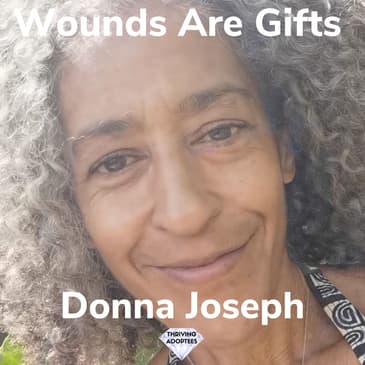
How do you feel about your wounds? Do they scare you? Do you just want them gone? Do you yearn to feel whole? What if you had a different relationship with them? Saw them as gifts. The cracks that let the light in. Listen in as we go deep to new perspectives on trauma. And peace.
Here's an interview with the Headless way guy https://dramyjohnson.com/2024/04/ep298-the-headless-way-with-richard-lang/
Here's a link to his website https://headless.org/
There's pain and beauty in adoption. Donna like she's been healing her whole life. But coming out of the fog was a shock to her system. Listen in as she shares her insights on an expanding awareness of her self. That's where the most profound shifts are happening that are powering on to a better life.
Listen to her first interview at https://thriving-adoptees.simplecast.com/episodes/painfully-beautiful-with-donna-joseph
https://www.linkedin.com/in/donna-joseph-6a277a6/
https://www.facebook.com/donna.joseph123
https://www.instagram.com/iamdonnajoseph
https://www.facebook.com/HealingAdoptee/
https://www.youtube.com/@donnamariejoseph
Guests and the host are not (unless mentioned) licensed pscyho-therapists and speak from their own opinion only. Seek qualified advice if you need help.
Want to learn more about thriving for you, your kids, your families or your colleagues? Pick a time to talk here
[00:00:00] Hello everybody, welcome to another episode of the Thriving Adoptees podcast. We've got
[00:00:08] a lovely lady on this afternoon, repeat guest and all-around superstar Donna. How are you
[00:00:15] Donna?
[00:00:16] I'm good, I'm good yeah, I'm really good right now.
[00:00:21] So who better to talk about healing with than the healing adoptee, because that's
[00:00:27] your Facebook name.
[00:00:29] Yeah, yeah, yeah.
[00:00:32] So why did you come up with that moniker? Why did you come up with that? How did you
[00:00:39] come up with that name?
[00:00:44] Now I can answer that in a way that may have been differently answered before. But
[00:00:51] I think the truth is, is that I've been healing all my life. I've been aiming to
[00:00:58] get somewhere all my life. I mean, I just, I just, when I, when I now look back, I
[00:01:05] realise I haven't, as painful as it's been, I haven't stopped actually trying to get
[00:01:13] somewhere. And bearing in mind, I was in this, you know, what's known as the
[00:01:18] Adoption Fog for decades. So, you know, and lots of other things happened as well
[00:01:24] as being adopted as well. So I've been, I've been searching for wholeness. And I
[00:01:31] think healing the word resonates. It's not healed. It's someone came on, what's
[00:01:41] his name? Oh, forgive me for forgetting his name, because it was a great
[00:01:44] interview. He said it's a process. He says he sees it as a process. And as I
[00:01:51] was listening, I was like, yes, it is. It's ongoing. It's, you know, but it
[00:01:58] doesn't mean that you're stuck in a healing as an adoptee. I am aka healing
[00:02:03] adoptee, but I'm healing Donna. You know, the healing adoptee is very much
[00:02:11] within the adoptee community. You know, and it felt right at the time. I look
[00:02:19] at it now sometimes and I wonder, you know, but it is, it's this is and I
[00:02:26] remind myself that there'll be people adoptees, especially reading or watching
[00:02:33] some of my content. It will be the right time for them. You know, it will
[00:02:38] be even though I want to change everything now because I feel
[00:02:41] different now. It's like I'm also learning to just remember that this is
[00:02:47] a journey and a process for everyone. So it doesn't, it's healing. You know,
[00:02:55] it's and it's yeah, so I don't know if that helps.
[00:03:00] So we never get there?
[00:03:04] I think we you know what I'm learning, I'm feeling and thinking is
[00:03:10] it's ongoing, but not in a stuck way. Not in a forever healing. I'm feeling
[00:03:20] really quite differently in 2024. I feel that I'm feeling a quite a special
[00:03:29] connection since I've been doing some work, real work and really feeling
[00:03:36] and it's since I've this all fast tracking a little bit. And I know I've
[00:03:39] shared some of this with you over the six months, this journey. As that's
[00:03:45] occurring, I'm realizing it's, it's healing, but it's healing through
[00:03:55] and finding the light, you know, and I think that healing is, I don't
[00:04:04] know, I'm not there yet, Simon. So I don't want to, you know, kind of
[00:04:10] create what may or may not happen. But it seems to be forever a journey of
[00:04:16] exploration of ourselves, which is never ending, you know, and actually,
[00:04:23] I don't know if you've heard of the headless guy who gets you looking,
[00:04:28] thinking about, you know, really looking into ourselves and it's ongoing.
[00:04:34] It doesn't stop. If you really were to look into us on a cellular level,
[00:04:40] you know, we just don't, we just go on and I think that's, that's
[00:04:45] probably the closest to what I'm feeling when I say healing and that's
[00:04:50] a healing through because we're so conditioned, aren't we? Not only the
[00:04:57] adoption narrative, but I think I'm realizing it's not just the adoption.
[00:05:01] It's everything. We've been separated from ourselves in many ways. And I
[00:05:12] think the journey of healing is bringing that ourselves back together.
[00:05:17] And it's forever. But you know, some people will go much further than
[00:05:22] others. I think adoptees, if we can see it and have that perspective, it's
[00:05:29] it gives us this being adopted has actually given us a perhaps we could
[00:05:33] look at it as an opportunity to go even further on this healing because
[00:05:41] if we can get through this, we're going to be a lot further than a lot
[00:05:45] of people that are just, you know, in a way from some of the complex trauma
[00:05:54] and life that we've, we've been accustomed to, whether we like it or
[00:05:58] not, kind of thing. Does that make sense? Simon? I think I've gone off
[00:06:02] on one but yeah, yeah.
[00:06:04] Yeah, I do expect you. I do expect you to go off on one night.
[00:06:10] Yeah, I do.
[00:06:12] That's why you're here. That's why you're here. So the headless guy,
[00:06:20] the headless guy, there's a link to him. I've forgotten his name too.
[00:06:26] But he's a great guy. And it's an experiential way of exploring who we
[00:06:36] actually are. And I think he says things like, well, we are space.
[00:06:46] We are space for the world. So in that sense, we're the whole, you
[00:06:55] know, we're bigger than the universe. If the universe is within us,
[00:06:59] you know, we're whole. Right? So the headless, that's what he would
[00:07:09] that's what he would say. So he would say that we're whole.
[00:07:13] Right? Richard, Richard, Richard, Richard Lang.
[00:07:16] Richard Lang. Yeah. Richard Lang. So I'll put a link into his
[00:07:23] into his podcast and videos and stuff. And it is very visual, the
[00:07:28] headless way. So I'm not going to try and explain it on an audio
[00:07:34] podcast. He does a pretty good job, though. Actually explained
[00:07:39] he changed a lot of things for me. I'm not really quite ready to go
[00:07:44] into the story of this just yet because I'm still navigating it.
[00:07:47] But in so far as my sort of closest relationship outside of myself,
[00:07:55] which is my marriage and recognizing without going into it,
[00:08:02] because you write it's a visual thing, but feeling into recognizing
[00:08:09] my own responsibility in witnessing and feeling my own trauma,
[00:08:17] my own energy. I want to move away from the trauma word and
[00:08:21] perhaps say my own story and the energy that goes with that.
[00:08:25] Each and every day that I'm looking into my partner's eyes.
[00:08:32] And I'm not being negative. I don't be wise enough to know that
[00:08:36] a 30 year marriage is not something to just suddenly start,
[00:08:40] you know, dismissing. But it was extremely what's the word,
[00:08:50] powerful for me to start looking at life that way and seeing myself.
[00:08:55] I mean, it's very much aligned with what you're saying, Simon,
[00:08:57] with the diamond. Like we are whole. We are. And what.
[00:09:04] But the reflection between each other,
[00:09:09] like how much I mean, especially as an adoptee,
[00:09:12] it's like how much we pick up off others to make up who we are ourselves.
[00:09:20] How much we pick up from day one.
[00:09:23] I mean, being a transracial adoptee, being black in a white family.
[00:09:28] I'm picking up absolutely everything.
[00:09:30] My mother's gone and I'm feeding off everybody around me to make up who I am.
[00:09:36] Realizing that made so much sense.
[00:09:41] And then the second thing which I've just touched on was realizing that
[00:09:47] some of the pain that I felt was
[00:09:54] my own pain through someone else's eyes.
[00:09:58] And that was massive.
[00:10:00] Because I was it was almost like recognizing,
[00:10:07] bringing your own trauma back in
[00:10:11] to your life now.
[00:10:15] And what I've realized over the last few weeks is how
[00:10:19] within a relationship,
[00:10:21] a story of its own trauma, if you call it,
[00:10:25] mutates of its own and becomes its own protection.
[00:10:31] And the headless guy
[00:10:35] was like a massive in exposing this for me.
[00:10:40] And maybe it was timing for me because of the journey that I've been on
[00:10:44] with the nervous system and various fascia release and all these other things.
[00:10:47] Maybe if the headless guy had come to me a year ago, I'd have just gone
[00:10:52] you know, not really took it as I did.
[00:10:56] But this year, wow.
[00:10:59] But not only has it changed my perspective, it's actually woken me up
[00:11:03] to being more conscious.
[00:11:07] Of. What I really feel about myself
[00:11:15] when looking into other people's eyes.
[00:11:19] Because. It's massive how much we
[00:11:23] feed off each other.
[00:11:26] And what I love is how he also gets you very cleverly
[00:11:30] to understand that behind those eyes, we are everything.
[00:11:36] Like we are everything.
[00:11:38] And the way he somehow gets that across and got it to me.
[00:11:44] Was phenomenal.
[00:11:46] And it was.
[00:11:48] I'm glad you're going to put a link in because I'm sure
[00:11:51] it will resonate with some of the listeners here, that sort of realization,
[00:11:54] just how lost we are, all of us, not just adoptees, but just.
[00:12:00] Until we look in the mirror.
[00:12:03] And make our own mind up.
[00:12:06] And are able to do that, unless our parents have done it, which they don't.
[00:12:11] We are totally ourselves based on what everybody else has.
[00:12:16] Said or.
[00:12:19] Done.
[00:12:20] You know. So that's massive for a trans racial adoptee
[00:12:25] that's only realizing they're black in a white family and their moms.
[00:12:31] And I suddenly, you know, how much of the how much of we ourselves
[00:12:35] do we make up from that?
[00:12:38] And I'm yet now on a journey of wholeness trying to come through
[00:12:42] and find who I am.
[00:12:44] And I think uncovering the headless.
[00:12:48] Side of things really helps me understand where.
[00:12:52] And how it kind of got corrupted
[00:12:56] in the very beginning for all of us, all of us.
[00:13:00] Auntie Moe, isn't she lovely? Isn't she lovely?
[00:13:03] Am I lovely? Am I lovely? Am I lovely?
[00:13:05] I don't know. I feel lovely. Everyone's telling me I'm lovely.
[00:13:08] I know, you know, you know, and then what our little tiny
[00:13:11] developed brains are having to feed off all this.
[00:13:14] And yet I'm also aware in the last few years how much we adoptees,
[00:13:19] especially our feeling in all of that
[00:13:24] at the same time, like we're just feeling so much hurt already
[00:13:29] and damage without realizing what that is.
[00:13:32] So how much of all of that makes up who we think we are,
[00:13:38] not who we are, who we think we are
[00:13:42] and how much of who we think we are.
[00:13:44] Do we be throughout our lives completely missing
[00:13:51] who we really are, which like Simon, I'm with you on the diamond
[00:13:55] like metaphor, you know, behind these eyes we are.
[00:14:00] It's well, it never ends.
[00:14:04] So. I find this, I find myself saying this quite a lot at the moment,
[00:14:09] but have you seen anything?
[00:14:11] Have you seen this Dick Schwartz stuff, internal family systems?
[00:14:14] Have you come across that?
[00:14:16] Yeah, I have, but not as not not enough for me to just resonate.
[00:14:22] OK, with that with it. Yeah, so
[00:14:27] I think I've just asked the question.
[00:14:29] So Richard Schwartz talk about that.
[00:14:31] It talks about the uppercase S self, the true self.
[00:14:36] Yeah. OK.
[00:14:38] What other people would call my other people might call consciousness
[00:14:43] or what other people might call the non physical self?
[00:14:47] What other people might people call spirit?
[00:14:53] And my metaphor for that is the diamond.
[00:14:57] Yeah, that's what we truly are.
[00:15:06] And identity is pretty simple when you see that.
[00:15:11] Yeah, I think our mind,
[00:15:14] I'm so glad that I went on a retreat in 2001
[00:15:19] and discovered that my mind.
[00:15:23] Could be calmed down because I think what gets in the way massively
[00:15:29] again, probably relates to all this feedback
[00:15:32] that we've been building ourselves on as an adoptee.
[00:15:35] So lost inside as well.
[00:15:38] This this feeling, this this mind can get in the way of self.
[00:15:45] The mind and the mind hides, the mind hides,
[00:15:49] hides, hides the ego.
[00:15:52] I think the ego has to have something.
[00:15:55] And I think these parts that have been created,
[00:15:57] I've learnt a lot about resonated a lot with my own parts in the last six months.
[00:16:02] And, you know, they've all got egos in them, these parts.
[00:16:04] They were wanting to get somewhere with this to keep it moving.
[00:16:09] And I think that's that's how it hides the self.
[00:16:13] But but what if there's nowhere to get?
[00:16:15] What if it's a seeing job, isn't it?
[00:16:19] It's seeing what I mean, it's a seeing job.
[00:16:22] It's not a doing job. It's not a going job.
[00:16:23] We don't have to go anywhere.
[00:16:25] We just have to see, see the diamond that's hidden by our trauma,
[00:16:30] see the diamond that's hidden by our mind.
[00:16:33] I think this is the this is the journey.
[00:16:37] That. I would love.
[00:16:41] To be able to find a way to to, you know,
[00:16:46] get that shift, you know, that sort of that.
[00:16:49] It's like I think I said to Sage, you know, we all know Sage.
[00:16:52] It's like a it's like a.
[00:16:55] It's like a hook, right?
[00:16:56] And then they've got it. They're on the way to that.
[00:16:59] But it's a journey because in our head, it's not just our mind.
[00:17:03] It's like all those beliefs, limited beliefs on self
[00:17:07] about ourselves that are so unconscious
[00:17:10] that we don't even know that it's happening.
[00:17:14] We can understand parts and know that there's a protector there.
[00:17:18] But it is so deep, this unconscious
[00:17:23] devalue of self that has occurred, that has so
[00:17:29] hidden that the mind and the ego will and is so good.
[00:17:37] I mean, it took me having five puncture wounds in my leg
[00:17:41] by a dog, I believe now for me to recognise
[00:17:46] how just so far away I was from this,
[00:17:52] even though I've had conversations with you, Simon,
[00:17:55] and I'm on the adopted groups and I've done this and that
[00:17:59] to be faced with how little.
[00:18:03] Seriously. Little
[00:18:07] I valued myself was hidden so deep within me.
[00:18:13] I've been able to mask with my ego and with my mind,
[00:18:20] healing others, putting others like the wounded healer is huge.
[00:18:25] And I respect as well.
[00:18:28] But wow, like that is why I think it's not as easy
[00:18:34] or as straightforward as that is for adoptees or complex.
[00:18:42] You know, child development or trauma from way back is
[00:18:50] because that's why the fog, I think, is quite a good term in my view, really,
[00:18:54] because there is a protection in there,
[00:18:58] really, from the heart when you really do start to explore
[00:19:04] the complexities of, you know,
[00:19:07] realising just how little I.
[00:19:11] Thought of myself.
[00:19:14] Was was was was I thought I'd been through it all with the fog,
[00:19:17] I mean, I quit everything for two years and was down on my knees, but that.
[00:19:23] Last year, last part of last year was.
[00:19:29] I didn't know.
[00:19:31] I did not know, and you can look back at all my journals.
[00:19:35] You can see myself trying to come out, trying to find the answers.
[00:19:41] But unless we realise how little we think of ourselves truthfully,
[00:19:47] honestly, with ourselves, we will not find our diamond.
[00:19:54] That's what I'm starting to believe.
[00:19:56] Oh, God, the connection comes into it for me as well, like massively
[00:20:02] helping me.
[00:20:04] You know, sort of sent to this now for me,
[00:20:08] you know, looking up in the sky, recognising Christ and not overly religious
[00:20:13] at all because I've got my views on that.
[00:20:15] But feeling a connection within.
[00:20:19] Is now really.
[00:20:22] And God guiding me, I think, but I have connection to what
[00:20:28] a connection to myself, to the self that we're talking about.
[00:20:32] But it's almost as if I had to face the value piece, Simon.
[00:20:37] The value piece is massive self worth.
[00:20:44] You can't you can be preaching to a brick wall about the diamond.
[00:20:51] If even if someone's a healer and they're healing others,
[00:20:55] if they're a mask that they've had on since they were whatever decades.
[00:21:02] And they truly underneath that do not value themselves.
[00:21:07] They I don't believe they will get your message or mine.
[00:21:12] Well, they will.
[00:21:13] And they will.
[00:21:14] Like I do. And I did.
[00:21:17] But a lot is now really coming to me
[00:21:21] since I I think.
[00:21:28] Yeah, I'm facing that truth
[00:21:32] about self, you know, it
[00:21:37] just I won't go into it because it's a whole thing on its own.
[00:21:39] But I was I could have been killed and I wasn't thinking about myself.
[00:21:43] I was thinking purely about the dogs, because in the UK,
[00:21:46] those dogs would have been destroyed instantly with what they did.
[00:21:52] And I was faced with having to be told by someone else
[00:21:57] that I was more important than than the dogs.
[00:22:02] And I wasn't thinking about myself at all.
[00:22:07] Yeah, so it's a it's a it's a you know, it's a big claim.
[00:22:10] It's still going ahead now.
[00:22:12] And I, you know, and now I can recognize in the journey
[00:22:15] I've had to go through to value myself through this whole case
[00:22:20] has been like a huge lesson from God source somewhere south.
[00:22:28] Because when I talk of God,
[00:22:29] I really do consider all of us as a collective.
[00:22:33] You know, it's within its.
[00:22:37] Yeah, yeah.
[00:22:40] Value value self-worth and value, I think is huge to get into where
[00:22:46] where.
[00:22:48] Yeah, where you and I are right now, I feel.
[00:22:54] Well, we can't put a value on something that we don't know.
[00:22:59] We have to we have to identify ourselves before we can put a value on ourselves.
[00:23:03] Surely? Yeah.
[00:23:04] Well, I realize that I when it comes to to sort of like.
[00:23:10] I was forced into a sort of situation
[00:23:11] where I had to think about money and also recognize
[00:23:14] that I really have haven't really got any money as such like.
[00:23:20] Masses of it in the bank, but I have a lot.
[00:23:28] And I've given a lot.
[00:23:30] And I've done a lot.
[00:23:32] In fact, when I was writing out everything I've done,
[00:23:36] I've done a ridiculous amount
[00:23:39] and I realize that it's millions, actually.
[00:23:43] But it's not in the currency of money per se because of my who I am.
[00:23:49] It's in the currency of love.
[00:23:51] So over this period of time, I've had to almost put the question out to you.
[00:23:55] Like, what am I?
[00:23:56] What am I worth to sort of feed off what you know, what am I?
[00:24:00] And it's been quite a staggering thing to recognize all of what you've done
[00:24:05] and this journey that you've been on,
[00:24:08] like putting absolutely everyone else before yourself.
[00:24:12] Likely because I've actually underneath thought very little of myself worthy.
[00:24:20] But I've done so much training, so much learning.
[00:24:24] It's incredible the amount of stuff I've done.
[00:24:28] And yet just took a little piece of myself for myself,
[00:24:32] but then dished the rest out to everybody else.
[00:24:36] So where's the connection?
[00:24:38] Where's the connection between our before I start a photo?
[00:24:44] So the diamond metaphor has its its limitations, right?
[00:24:48] Like any other metaphor and diamond.
[00:24:52] Diamonds value is set by a number of characteristics set by the marketplace.
[00:24:57] So it's set by somebody else.
[00:25:00] So a group of other people.
[00:25:03] Diamond traders, whatever they set.
[00:25:05] Right.
[00:25:06] Well, so our value and it is finite.
[00:25:11] A diamond has a finite value.
[00:25:15] That's that's where the metaphor goes wrong.
[00:25:17] That's where that's the limits to the metaphor.
[00:25:21] Because our worth is infinite.
[00:25:25] Nobody can put a.
[00:25:27] Nobody can put a value on it.
[00:25:31] So how how does our worth?
[00:25:36] Well, first off, do you do you think I'm on the right?
[00:25:39] Do you agree with that?
[00:25:40] Yeah. Well, what I'm yeah.
[00:25:41] What I'm thinking is the question you were asking earlier about healing
[00:25:45] and the ongoing what I was, you know, when I was answering the journey,
[00:25:49] it's like ongoing and like the headless like it's just it's just ongoing.
[00:25:55] I think that's the worthiness is like, you're right.
[00:25:59] It will never cease.
[00:26:01] It will keep going.
[00:26:03] But only if you get it started.
[00:26:07] You know, and I feel that's the piece that that.
[00:26:13] Is is is for me anyway, was was massively missing, actually,
[00:26:19] and in my relationship as well, relationship.
[00:26:25] As well, you know, and the more it's kind of come about,
[00:26:28] the more I'm realizing how, yeah, of course.
[00:26:33] And it's beautiful because I actually do feel like
[00:26:38] I know it's going to get easier now.
[00:26:41] So when I look at the things that have happened recently
[00:26:44] and also not just recently, but actually over the whole of my life,
[00:26:48] it's been very dramatic.
[00:26:50] And traumatic, dramatic events,
[00:26:54] almost like trying to get me to to maybe see this actually.
[00:27:01] You know, it's taken me nearly losing my leg
[00:27:03] and thinking I was going to die in a flood in the last six months
[00:27:06] to realize shit, I need to wake up
[00:27:12] to to myself and this ongoing worthiness,
[00:27:17] this ongoing what you're what I think you're getting at.
[00:27:21] Well, I'm talking about your infinite value.
[00:27:24] OK, yeah.
[00:27:25] So I'm infinite.
[00:27:28] Infinite means you could take infinite in terms of
[00:27:34] that, you know,
[00:27:37] ten thousand pounds, hundred thousand pounds, twenty thousand,
[00:27:40] you know, infinite in terms of in terms of the price of it,
[00:27:45] the worth of it.
[00:27:47] But you could also take infinite in terms of the duration of it.
[00:27:52] You know, it's it's value.
[00:27:54] And I've never really thought about it that way.
[00:27:57] So I'm going to have to give that some thought.
[00:27:59] A question for you.
[00:28:00] What how do you see this?
[00:28:03] How do you see the relationship between our infinite value
[00:28:08] and our bank balances?
[00:28:13] Because there are two different things, right?
[00:28:14] To be honest, I've had to just separate the two completely.
[00:28:18] And it makes perfect sense why I've
[00:28:21] struggled with this thing called money.
[00:28:25] Actually, you know,
[00:28:29] I've never really
[00:28:33] you know, I realize this is probably going off a little bit.
[00:28:36] I try and keep it contained, but I hadn't realized until the last year or so
[00:28:39] just how intuitive I am and have always been,
[00:28:43] but have always internalized that as some kind of paranoia
[00:28:48] or some kind of problem with myself.
[00:28:51] So there's a lot of things that are going on with me at the moment
[00:28:54] in the financial side of life that I'm recognizing some really serious
[00:28:59] fraud that's been happening around me that I think intuitively I knew,
[00:29:05] but I always felt like I was the I was sorry,
[00:29:10] the one that was always in fear around finance, always around money.
[00:29:15] Fear, fear, fear.
[00:29:17] But yet I was always giving, giving, giving.
[00:29:19] I would be out in the home with the homeless in Birmingham.
[00:29:22] I would be working in refugees with women suffering from domestic violence,
[00:29:26] doing podcasts for this.
[00:29:27] It wasn't about the money.
[00:29:30] So for me, those two things do not align.
[00:29:32] And the more this world is starting to sort of show itself,
[00:29:37] the more I'm realizing, no, I'm right.
[00:29:39] And the rest of the world is wrong.
[00:29:42] And it has been actually like all my life.
[00:29:46] My adoption was wrong.
[00:29:47] I'm not saying my you know, I've come a kind of from a weird camp in adoption
[00:29:51] because I love my adopted parents.
[00:29:56] But it doesn't make my adoption right.
[00:29:59] It shouldn't have been.
[00:30:02] I wouldn't have had it was upside down.
[00:30:04] Shouldn't have been that way.
[00:30:05] My mom should have been in a house and love and support.
[00:30:10] So this system and that was monetary.
[00:30:12] And I've never ever, I think, really bought
[00:30:16] what I have realized is and what I lost at the end of this year
[00:30:19] was a huge amount of money.
[00:30:21] If you want to call it cash money with
[00:30:25] amazing projects I had with programs,
[00:30:28] I was talking to you about my Learn to Love program.
[00:30:30] I was writing my book.
[00:30:32] I was building my shed on the thing I was doing so much.
[00:30:36] And I think.
[00:30:38] I was so close back then, and I am again now, hopefully,
[00:30:42] to feeling that, you know, monetary thing.
[00:30:46] But the lesson is to realize
[00:30:51] really the importance of this is love currency and it's millions.
[00:30:56] Simon, you are worth millions in that other currency.
[00:31:01] The diamond currency, the love currency, whatever.
[00:31:04] For me, it was love, you know, and what it really started to look at,
[00:31:08] which I've talked a lot over the years as well.
[00:31:10] Love and fear.
[00:31:12] Love and fear, the two things and fear
[00:31:15] has been wrapped up in this financial world
[00:31:19] and I've never really enjoyed it.
[00:31:22] But now things are starting, the truth is starting to show in myself
[00:31:25] that I'm not wrong and I'm not, you know,
[00:31:30] I can have a good partnership with money.
[00:31:33] And it's merged in with love.
[00:31:36] And, yeah, I'm excited about that.
[00:31:39] That's, I think, the ongoing journey of of healing through self-worth.
[00:31:44] You know, the most important
[00:31:49] the most important thing I learned last year about healing.
[00:31:54] Is that on one level will be healing forever.
[00:32:01] Yeah. And on another level, we were never wounded.
[00:32:05] We were never wounded.
[00:32:09] We were never wounded, but we were.
[00:32:15] Depends how you define the we.
[00:32:17] I know. Depends how you define it.
[00:32:20] So how do you define the we?
[00:32:23] Well, it's how do we, sorry, how do I define the we?
[00:32:29] How do you define identity?
[00:32:31] So I'll give you an example.
[00:32:33] My identity, how I define identity is consciousness.
[00:32:37] That's how I define it.
[00:32:38] I don't. I am consciousness.
[00:32:41] I am not the content of which I am aware.
[00:32:47] I am the context in which my thoughts and feelings occur.
[00:32:54] So one word consciousness.
[00:32:57] So how do you define consciousness?
[00:32:59] I, the same, except I would also add.
[00:33:03] I think that.
[00:33:06] Honestly, with.
[00:33:09] With that really is that I'm also aware that.
[00:33:13] My mind.
[00:33:15] Or I might as far as my identity, certainly growing up.
[00:33:25] It was so powerful.
[00:33:27] That it really did be come.
[00:33:31] Who I was at that time and the wound is the wound is, is, is, is, is there.
[00:33:39] And but what you say I am is absolutely, absolutely right.
[00:33:44] And when I look back, even before coming out of the fog, you can see.
[00:33:48] It's like the secret.
[00:33:50] You can see it in there.
[00:33:52] I'm always lifting myself trying to get somewhere.
[00:33:55] And it's there. It is. I am consciousness.
[00:33:58] I am. But the what we're talking about, the wound is the journey.
[00:34:05] I'd not an identity, but a recognition of how.
[00:34:12] We have.
[00:34:14] You know, we've been led to believe really so much that's that's not true.
[00:34:20] And that's OK, because we're now on our way to finding the truth.
[00:34:24] We're not our beliefs, right?
[00:34:27] But we think we are.
[00:34:29] Yes, yes, yes.
[00:34:32] And we yeah.
[00:34:33] And the thing and the thing is, and I think what I've learned
[00:34:36] really is the sensations we feel we feel we are.
[00:34:40] And actually, the healing is in our sensations, I think.
[00:34:42] And if that's so mixed up with feelings of.
[00:34:46] Of belief, of feeling that we are the opposite,
[00:34:49] then we're far away from feeling this truth.
[00:34:55] And sadly, I know because it's a lot of,
[00:34:58] yeah, I think a lot of all of this healing is in our body
[00:35:03] and stored in our.
[00:35:06] I'm totally with you on that.
[00:35:09] Another word for consciousness,
[00:35:12] the word I heard yesterday, which I thought was really good
[00:35:16] was the non physical self.
[00:35:20] So if we say we are consciousness
[00:35:23] or we are awareness or we are spirit,
[00:35:28] we can also say another word for this
[00:35:30] that means the same is the non physical self.
[00:35:36] Separating.
[00:35:39] Who I am as the non physical self
[00:35:42] and the sensations that are in my body.
[00:35:45] Yeah, so I'm feeling.
[00:35:48] It is separating out from.
[00:35:54] Have you heard, I don't know if you've read any about
[00:35:56] ready read any stories about near near death
[00:35:59] experiences or that moment when people lying
[00:36:03] or maybe you've had one of these when you're lying on the hospital bed
[00:36:05] and then you you
[00:36:09] you point your perspective changes.
[00:36:12] Yeah. And you're you're up in the corner
[00:36:15] of the hospital ward.
[00:36:18] You're looking down on yourself.
[00:36:21] So none.
[00:36:22] You it's a non physical self thing.
[00:36:26] Yes, it's it's it's consciousness.
[00:36:29] It's it's not it's what's conscious of the body.
[00:36:33] So, yeah, it's stored all this trauma stuff, as they all say.
[00:36:38] That's what I'm right.
[00:36:39] You know, that's and that's what you know,
[00:36:43] one of the biggest thing, another massive learning from last year.
[00:36:47] Right. You've got to do this.
[00:36:49] You've got to do the somatic act for me.
[00:36:51] I've got to do the somatic work because preverbal trauma.
[00:36:56] I don't have words for preverbal trauma.
[00:36:59] So what's the point of talk therapy when I can't when I have
[00:37:04] for something which I have no memory of, no, no cognition, no words for.
[00:37:10] It's absolutely pointless for me.
[00:37:13] I think it could be it could be quite dangerous as well as well.
[00:37:17] I think with
[00:37:19] with some things, it almost like going back into the
[00:37:23] going back into the pit when actually you can't really remember the details.
[00:37:27] But you can.
[00:37:28] I realize that you sort of you ask certain questions
[00:37:31] and making them up as I was going along, not making them up,
[00:37:35] but just going for one.
[00:37:36] And now I've realized the somatic is so powerful.
[00:37:40] I'm learning just how quite.
[00:37:44] Yes, dangerous is to go to
[00:37:49] to just keep going over it like that, you know,
[00:37:52] because because the feelings in your body are feeling everything
[00:37:55] that's going over in your mind.
[00:37:57] And so that's all going on.
[00:38:00] And without an understanding of those sensations,
[00:38:03] I've done body scans and all sorts over the years as a mindfulness teacher.
[00:38:07] I've, you know, calmed down and did it with your body and done all this stuff.
[00:38:12] But it was only when I really actually directed
[00:38:17] to my story and some parts of my story, which I hadn't
[00:38:23] really done this before that I realized I hadn't gone anywhere near.
[00:38:28] I had not gone anywhere near this
[00:38:32] until earlier this year.
[00:38:34] And that's with the help of Peter Levine, actually.
[00:38:37] And also, I think the analogy that what you just said there about coming up,
[00:38:40] it hasn't happened to me.
[00:38:41] I've heard many of these stories in comas and stuff.
[00:38:45] But I've learned a lot back in December about fascia or fascia,
[00:38:49] however you want to say it, release of old wounds and
[00:38:53] stresses stored in our fascia, which is just underlined under our skin.
[00:39:00] And so I imagine as looking down at that and seeing a whole lump of that,
[00:39:03] like if we didn't have fascia, we wouldn't have all our organs together.
[00:39:07] And it's kind of like that.
[00:39:09] It's all in there.
[00:39:11] It is. It's all stored down there.
[00:39:13] And it's ourselves that are.
[00:39:17] But that's real. I mean, it is there.
[00:39:20] See? So we eat it.
[00:39:25] It is hard, isn't it?
[00:39:28] Because that is those things have happened.
[00:39:32] And somatic work, you're absolutely right.
[00:39:35] I actually think I'm starting to realize, which is exciting,
[00:39:38] that it actually can be quite simple once we get
[00:39:44] a control of our nervous system.
[00:39:47] I think we can start to control somatically
[00:39:52] this house and move on maybe to the next level of healing,
[00:39:56] whatever, or worthiness or whatever.
[00:39:58] But we can move on with momentum.
[00:40:00] I think once we yeah, once we
[00:40:05] realize the simplicity.
[00:40:07] So just to cut in there,
[00:40:09] the Donna mentioned this Peter Levine guy,
[00:40:12] he is one of the somatic gurus basically, isn't he?
[00:40:17] And it's interesting to see him, him and him.
[00:40:20] Dick Schwartz is the Richard Schwartz is the IFS guy,
[00:40:24] the internal family systems guy, talks about the uppercase S self.
[00:40:28] And he would contend and he does contend that the uppercase S
[00:40:33] is intact, untouched,
[00:40:41] intact, untouched, undamaged, unmolested,
[00:40:44] 100% pristine, right?
[00:40:48] So he would, I think he would say,
[00:40:52] I'm putting words into his mouth.
[00:40:54] I think he would say that the trauma is in the parts,
[00:41:00] not in the uppercase S self.
[00:41:03] But we're starting to see on my Facebook feed,
[00:41:06] because obviously I'm into this stuff.
[00:41:08] I'm starting to see Peter Levine with his somatic stuff
[00:41:12] coming together with Dick Schwartz with his IFS stuff.
[00:41:16] So they're now starting to look at,
[00:41:19] we're looking at two, the intersection between
[00:41:22] and the relationship between two different,
[00:41:25] let's call them modalities for want of a better word.
[00:41:29] And I think that's really,
[00:41:30] I think that's really interesting.
[00:41:31] So if you want to check out Peter Levine,
[00:41:35] the somatic guy, he's on Amazon.
[00:41:39] And it's something Tiger by the tail or something, is it?
[00:41:42] Yeah.
[00:41:43] And thanks again to Sage,
[00:41:45] because me and her got another adoptee.
[00:41:48] She introduced me to Peter Levine.
[00:41:50] I'd never heard of him.
[00:41:52] And I'm so glad that I read his
[00:41:54] Waking the Tiger it's called.
[00:41:55] I'm so glad I read it.
[00:41:57] It's really not good on audible, sorry, audible,
[00:42:01] but it's really not great.
[00:42:02] And healing trauma is brilliant on audible,
[00:42:05] but you wouldn't know it from the sample.
[00:42:10] And I just think, God, what's going on?
[00:42:11] Because adoptees especially, I think,
[00:42:15] or complex trauma, pre-verbal trauma,
[00:42:18] I love the way he writes
[00:42:21] and the way he reads himself over.
[00:42:24] But you don't get that from audible on the first one.
[00:42:27] And it's such a shame
[00:42:27] because I would not be where I am now
[00:42:30] if I hadn't have found the book
[00:42:32] and the content of it, The Waking the Tiger.
[00:42:35] I read it within two days
[00:42:37] and I'm already practicing a process with a client.
[00:42:40] We're working together now
[00:42:41] and he's having some phenomenal results
[00:42:44] because I'm also seeing people now
[00:42:46] and I've done training on NLP and coaching for years
[00:42:51] and never felt this confident going out.
[00:42:55] And really, but because I'm having such direct
[00:42:58] experience with myself and my nervous system
[00:43:01] and vagus nerve, it's just so easy.
[00:43:04] And I just think, oh my God, I'm an expert.
[00:43:05] I had three decades of conscious awareness
[00:43:08] of how messed up my nervous system was and I hid it.
[00:43:11] So yes, I am a professional.
[00:43:14] I'll put a million letters after my name
[00:43:15] with confidence because of the life,
[00:43:19] and I just think it's wonderful now.
[00:43:20] I think I've just gone off on a tangent.
[00:43:22] Sorry, Simon.
[00:43:27] That's cool.
[00:43:30] So what do you think gets in our way then of healing?
[00:43:35] Ourselves, man.
[00:43:37] Even I can feel it in the house.
[00:43:39] Ourselves.
[00:43:40] I say, ironic.
[00:43:43] Ourselves.
[00:43:44] We are.
[00:43:45] Okay, let me take you back.
[00:43:47] Let me take you back, right?
[00:43:48] Does the uppercase S self get in the way of our healing?
[00:43:58] Well, no, not in the way that you've...
[00:44:01] I think what I'm gauging from the uppercase self S
[00:44:05] is that that's untouchable, isn't it?
[00:44:08] There's an S.
[00:44:09] That's what I'm picking up from the uppercase S.
[00:44:12] It's the true self.
[00:44:14] It's the true self.
[00:44:15] Not a bold S.
[00:44:16] Yeah, yeah, no, it's untouchable.
[00:44:18] And I think that's all part of the unveiling,
[00:44:22] I think, as you get along.
[00:44:23] So I'm sort of realizing now with sort of just not doing,
[00:44:29] effortlessly being.
[00:44:30] And like, yeah, I've done this interview.
[00:44:33] But there's nowhere to get...
[00:44:36] Effortlessly being means there's nowhere to get to though.
[00:44:41] There's always.
[00:44:42] There's always...
[00:44:43] Well, that's why I'm saying that.
[00:44:46] Psychologically, right?
[00:44:47] So I said, I think I said something like,
[00:44:51] on one level we'll be healing forever.
[00:44:53] It's a process.
[00:44:54] Yeah. Yes.
[00:44:55] Yeah, totally with you.
[00:44:57] And on another level, we were never wounded.
[00:45:02] So what I'm saying is that the wound is in our parts.
[00:45:08] The wounds is in our psychology.
[00:45:10] The wounds are in our somatically.
[00:45:12] Our wounds are in somatically.
[00:45:14] They're stored in the body.
[00:45:15] The wounds are in our emotions, right?
[00:45:16] So look at it there.
[00:45:19] That's where we'll be healing forever.
[00:45:23] But at a more profound level of identity,
[00:45:29] our uppercase S self, our true self,
[00:45:32] not our false self, our spirit.
[00:45:35] That has got nowhere to go.
[00:45:43] It was never wounded, so there's no healing.
[00:45:47] No, I think on the...
[00:45:49] This is what, for me, this is what I'm feeling.
[00:45:52] And I love this.
[00:45:53] I think there's transformation in somatic,
[00:45:56] the healing of this.
[00:45:57] I think this is where it is.
[00:45:59] I think that it's transformational.
[00:46:02] There's power.
[00:46:03] So when I'm looking down, I've got this fixed now.
[00:46:06] I'm looking down from the fascia
[00:46:09] and all the wounds and everything.
[00:46:11] It's like we have an opportunity to transform that
[00:46:16] and expand, grow, and become even more of an S.
[00:46:24] Because we're a collective.
[00:46:25] We're all...
[00:46:27] And I think that's why I'm getting so much
[00:46:30] from serving others.
[00:46:31] Again, doing what I've always done,
[00:46:32] but this time it is.
[00:46:36] It's like an effortless.
[00:46:40] And I think it's because the wounds,
[00:46:42] if that's what we wanna label them as,
[00:46:45] actually are our gifts.
[00:46:48] They're our gifts.
[00:46:49] They can help towards the S being...
[00:46:55] Yeah, spreading the S,
[00:46:58] the S figure for everyone else.
[00:47:01] Somebody said this, right?
[00:47:03] The darkness is where the lightness comes in or something.
[00:47:09] The dark...
[00:47:10] Yes.
[00:47:10] Our cracks are where the lightness comes in.
[00:47:15] So yeah, gifts.
[00:47:16] The wounds are our gifts.
[00:47:18] Absolutely.
[00:47:19] And the real meaning of the word transformation
[00:47:27] is beyond form.
[00:47:31] I mean...
[00:47:32] Beyond form.
[00:47:34] Beyond form.
[00:47:35] And then we go back to this,
[00:47:37] the headless thing.
[00:47:39] And the headless,
[00:47:41] the headless way is beyond form.
[00:47:46] It's space.
[00:47:47] Beyond form, we have space.
[00:47:49] Beyond our head.
[00:47:51] You know, as we are headless,
[00:47:54] we are whole and we are space for the world.
[00:47:59] It's beyond form, transform, beyond form.
[00:48:02] Yeah. Space.
[00:48:05] Yeah.
[00:48:06] Context, not content.
[00:48:09] Room, not objects in it, not furniture.
[00:48:15] And for me, the headless,
[00:48:17] not only is that awareness, it's quite phenomenal,
[00:48:24] but realizing what we see actually,
[00:48:30] how much we make up of this view as everything of ourselves.
[00:48:36] But actually when you start to shift your perspective
[00:48:38] with the headlessness,
[00:48:40] you realize there's so much more here.
[00:48:45] I'm doing this with my hands.
[00:48:47] You know, there's so much more space actually
[00:48:49] than we could ever have realized.
[00:48:51] And what's out there is...
[00:48:54] But we're in control of it.
[00:48:56] It just gave me more sort of sense of control
[00:48:58] and awareness and observation.
[00:49:00] And I don't know.
[00:49:06] It really helped.
[00:49:07] I'm glad you're gonna put a link in.
[00:49:08] And I think sometimes when you're trying
[00:49:10] to describe this headless thing,
[00:49:12] it can kind of sound a bit probably crazy,
[00:49:14] but he describes it really well.
[00:49:17] The guy himself, Richard Lang.
[00:49:19] So yeah, I think it shifts a lot into that
[00:49:25] and also what our awareness is with this view
[00:49:29] that we have and the power that we have with that.
[00:49:33] Because everyone's seeing like,
[00:49:34] are they seeing all of that space?
[00:49:36] What are they seeing actually?
[00:49:39] What do they see?
[00:49:40] And you know, it's just fascinating.
[00:49:43] And there's some, I haven't even really gone there.
[00:49:48] But I think it's really important
[00:49:49] with some of the amazing exercises
[00:49:52] that you can do with the mirror
[00:49:53] to really kind of start shifting.
[00:49:56] It's a shift.
[00:49:58] I got it when I went to a retreat in Thailand.
[00:50:00] It was a shift in reality.
[00:50:02] Headlessness is a shift in reality.
[00:50:04] But it's for me, and this healing journey
[00:50:07] is a good one.
[00:50:08] I'm happy for it.
[00:50:10] I'm happy for his being aware of him
[00:50:13] and Peter Levine.
[00:50:15] The view of who we are.
[00:50:17] It's our view of who we are
[00:50:19] rather than a third party view,
[00:50:21] somebody else's view of who we are.
[00:50:24] And that feeds back into what you were talking about,
[00:50:30] other people labeling you
[00:50:33] and you're posting their beliefs on you
[00:50:38] and that stuff.
[00:50:41] So-
[00:50:42] Really just becoming aware of how much of our,
[00:50:46] how much the other person is feeding off how we feel
[00:50:52] and taking responsibility for that.
[00:50:56] Checking in, it's like,
[00:50:58] it's helped me to check in.
[00:51:00] You know, you do that,
[00:51:01] oh, I'm checking in every day.
[00:51:03] You know?
[00:51:03] But actually, am I really?
[00:51:05] Or am I just going through the process
[00:51:06] of checking in every day?
[00:51:08] And the headless is a shift
[00:51:09] that actually really starts getting you
[00:51:11] looking at the perspective is much deeper.
[00:51:13] And, you know, it really is a check-in,
[00:51:16] like on a much deeper, more,
[00:51:22] I don't know,
[00:51:24] required level with others
[00:51:27] because they're feeding back to me as well.
[00:51:31] What, you know, we really are working together in this,
[00:51:34] in this partnership with what we pick up.
[00:51:37] And I've been feeling so much enclosed
[00:51:40] and picking up wrong things with this amazing intuition
[00:51:43] and getting it all flipped up and wrong.
[00:51:48] And I'm learning that as well on this journey
[00:51:50] to not assume I know anything really,
[00:51:56] because I'm just following this intuition
[00:51:59] that's starting to become less fearful
[00:52:02] and pretty damn good actually.
[00:52:07] Brilliant.
[00:52:10] Feels like a good place to bring it in.
[00:52:13] So as always, listeners, links to Donna's socials
[00:52:18] in the show notes.
[00:52:22] Anything else you wanna talk about?
[00:52:24] No, no, that was great.
[00:52:27] That was a good trip.
[00:52:31] Thanks listeners, we'll speak to you again very soon.
[00:52:33] Bye.